Japan is Nippon
How Do You Sort Your Garbage in Japan? Rules, Collection Days, Perfume Bottles and Spray Cans
In Japan, household garbage is generally split into burnable garbage, recyclables (cans, bottles, PET bottles, plastic and paper), oversized items and so on, and put out at the collection point by 8:00 on the set day. But the categories differ from one city to the next: the same perfume bottle goes
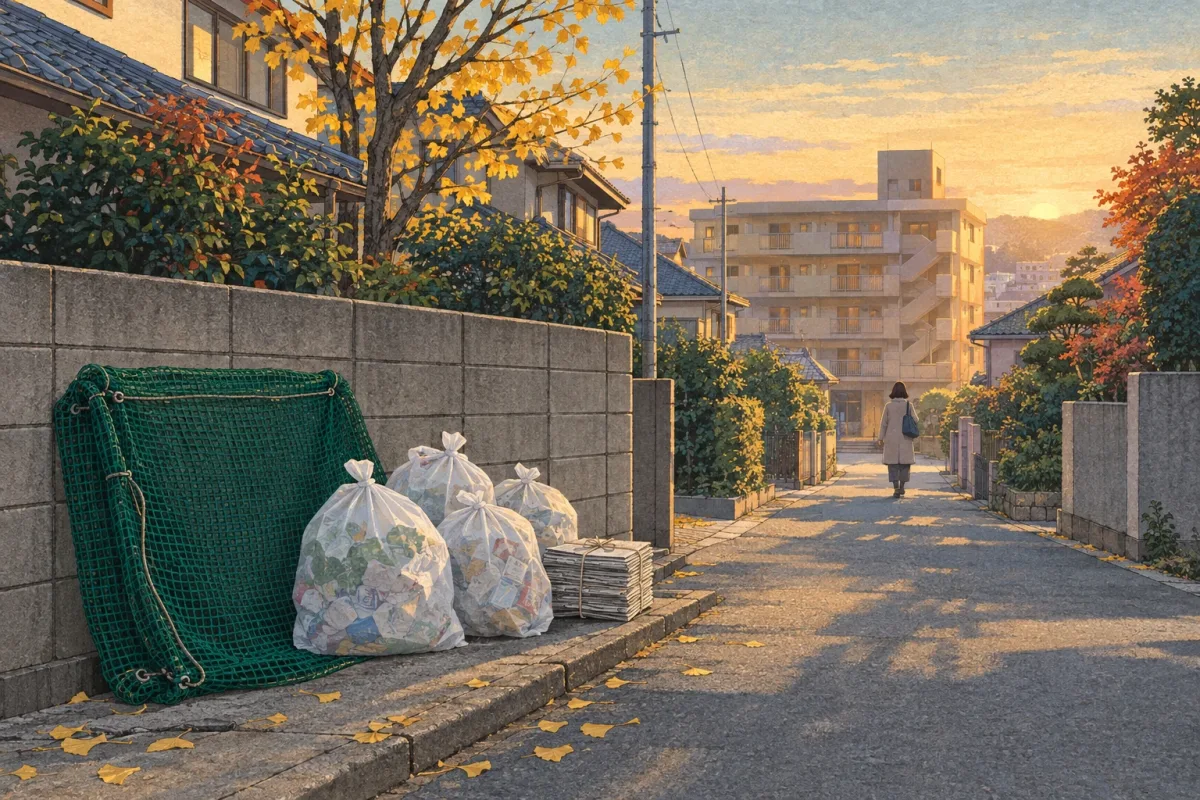
The short answer
One of the first things that puzzles foreigners who move to Japan is garbage sorting, or bunbetsu (separating things by type). Household garbage in Japan is usually split into burnable garbage, cans, bottles and PET bottles, plastic, used paper, metal, ceramics and glass, and sodai gomi (oversized garbage). It's not just how you sort it: the day, the time and even the type of bag are all set.
The most important thing to know is that there's no single national rulebook: the rules differ depending on the city, town or village you live in. Just comparing the official guides from Shinjuku City in Tokyo, Yokohama and Kyoto, the category names, the bags and how perfume bottles and spray cans are handled all differ slightly. This guide uses those three cities' official guides to explain the common patterns, but in the end, check your own city's guide.
If you don't follow the rules, your garbage may be left behind uncollected. Yokohama leaves unsorted garbage at the collection point with a warning sticker on it, and people who ignore the warnings and keep doing it are fined 2,000 yen (an administrative fine). Kyoto also puts a sticker marked 'improper' on bags of garbage in the wrong category and doesn't collect them.
Why are garbage rules different in every city in Japan?
Collecting household garbage is the job of the city, town or village, not the national government. Municipalities bear overall responsibility for handling general waste (such as household garbage) within their area. Which garbage to separate and how to collect it is also decided by each municipality, which refers to the national standard categories while taking into account local conditions, the market for recyclables, how much waste it would cut and so on.
So differences in the incinerators and recycling facilities a city has show up as differences in how you sort. Kyoto, for example, has no 'non-burnable garbage' category: even glass and leather go in the 'burnable garbage' bag with food waste. Yokohama, on the other hand, has a dedicated category for ceramics, glass, fluorescent tubes, light bulbs and the like, while Shinjuku City collects them twice a month as 'metal, ceramic and glass garbage'.
If you move to a different city, town or village, treat the rules as practically brand new and start by reading the new place's guide. Even within the same city, collection days vary by neighbourhood. In Yokohama, check your area's collection days on the sticker posted at the collection point or ask your neighbours.
How do you sort and put out garbage in Japan?
Shinjuku City's English guide for foreign residents (2026 edition) divides household waste into two broad groups: 'resources' and 'garbage'. Resources are newspapers, magazines, cardboard and paper cartons; plastic (since April 2024, plastic containers and packaging can go out together with products made entirely of plastic that are 30 cm or smaller); bottles; cans; spray cans, gas cartridges for portable stoves and dry-cell batteries; and PET bottles, all collected once a week. For garbage, 'burnable garbage' such as food waste is collected twice a week, and 'metal, ceramic and glass garbage' twice a month.
In many cities, the deadline is 8:00 on the morning of collection day. Shinjuku City, Yokohama and Kyoto all ask you to put your garbage out at the designated collection point by 8:00 on collection day. Yokohama and Kyoto don't allow putting it out the night before either. Bags put out at night get torn open by cats and crows.
Bag rules vary from city to city too. In Shinjuku City and Yokohama you use clear or semi-transparent bags so the contents can be seen. In Shinjuku City, collection of household resources and garbage is free in principle, but large amounts of garbage and oversized garbage are charged for. Kyoto has had a system of paid designated bags for household garbage since October 2006, and garbage put out in anything other than the city's designated bags isn't collected.
Kyoto's designated bags for burnable garbage are semi-transparent yellow and cost 45 yen each for 45 L, 30 yen for 30 L, 20 yen for 20 L, 10 yen for 10 L and 5 yen for 5 L. The bags for recyclables, used for cans, bottles and PET bottles and for plastics, are colourless and transparent and cost 22 yen for 45 L, 15 yen for 30 L, 10 yen for 20 L and 5 yen for 10 L (as of November 2026). The designated bags are sold at nearby supermarkets, convenience stores and similar shops. Note that even in Kyoto, apartment buildings whose garbage is collected by a private company don't use the designated bags and follow the building's rules instead.
How do you throw away glass perfume bottles and spray cans in Japan?
'How do I throw away a glass perfume bottle?' is a question foreigners often get stuck on. The answer depends on the city. Shinjuku City puts cosmetics bottles in the 'bottles' resource category, the same as food and drink bottles. Kyoto also puts cosmetics bottles under 'cans, bottles and PET bottles'. In Yokohama, however, bottles from cosmetics or medicines (excluding oral medicines) go out as 'non-burnable garbage'.
Broken bottles and bottles you can't wash clean are handled differently too. Shinjuku City doesn't collect broken bottles, bottles that can't be washed, light bulbs or fluorescent tubes as bottle resources; it asks you to put them out as 'metal, ceramic and glass garbage', and to wrap glass and other sharp items in thick paper and write kiken (danger) on them. In Kyoto, wrap broken bottles in thick paper or similar and put them in the middle of your 'burnable garbage' bag. In every city, the basic rule is to give bottles a quick rinse with water before putting them out.
Use up the contents of spray cans and gas cartridges for portable stoves before putting them out. Whether to puncture them depends on your city's rules. In Yokohama, use up the contents in a safe place away from any flame; there's no need to puncture them. Kyoto goes further and asks you not to puncture them, because making a hole to let the gas out risks an explosion. In Shinjuku City, use up as much of the contents as you can, then put them out in a clear or semi-transparent bag.
Whether to crush cans and PET bottles is also the exact opposite depending on the city. In Shinjuku City, you rinse PET bottles with water and then crush them. Kyoto, on the other hand, asks you not to crush cans or PET bottles, because crushed ones are harder for the recycling machines to identify.
How do you throw away batteries and rechargeable devices in Japan?
The thing Japan is especially worried about right now is lithium-ion batteries (the rechargeable batteries used in smartphones, power banks and many other everyday products). Lithium-ion batteries don't cope well with strong impacts or high temperatures, and they have caught fire after being crushed in garbage trucks or in the shredders at waste facilities. In fiscal 2024, by the Ministry of the Environment's count, there were 9,923 fires during waste handling suspected to have been caused by lithium-ion batteries (23,068 including incidents with smoke or sparks).
Dispose of unwanted lithium-ion batteries, and products with batteries inside, according to the garbage rules of your city, town or village. Many of the items that caught fire were small, cheap products or products with a plastic exterior, and one reason is that it's hard to tell from the outside that they're dangerous. Batteries with more charge left are more likely to burn fiercely when struck, so using them up before throwing them away is an effective way to prevent fires.
Exactly how to put them out varies by city. In Shinjuku City, you insulate the terminals of rechargeable batteries with tape, put out rechargeable batteries on their own in a clear or semi-transparent bag, and take swollen or deformed batteries directly to a sanitation office. In Yokohama, too, you insulate them with tape before putting them out, and take swollen or damaged batteries to an office of the Resources and Waste Recycling Bureau. In Kyoto, rechargeable batteries, button batteries and small electronics go to collection points such as ward offices.
What every city has in common is: don't mix batteries in with plastic or burnable garbage. In both Shinjuku City and Yokohama, rechargeable batteries and lighters must not go in with plastic resources. In Yokohama, small electronics whose batteries can't be removed go out in a separate bag from other garbage.
How do you get rid of large items, TVs, fridges and computers in Japan?
Large items such as furniture, futons and bicycles are sodai gomi (oversized garbage), and in many cities you have to book a collection and pay. In Shinjuku City, anything with a side longer than 30 cm counts as oversized garbage: you book through the reception centre by phone or online, buy and attach the city's oversized garbage disposal ticket (a sticker), and put it out by 8:00 on collection day. In Yokohama, metal items with a longest side of 30 cm or more and other items of 50 cm or more count as oversized garbage; it takes about two weeks from booking to collection, and the tickets are sold at convenience stores and other shops in the city.
Four kinds of appliance, namely air conditioners, TVs, fridges and freezers, and washing machines and clothes dryers, can't go out as oversized garbage. They fall under the Home Appliance Recycling Act (in force since April 2001), which obliges retailers to take them back and manufacturers to recycle them. The person getting rid of them pays a recycling fee and a collection and transport fee. In Shinjuku City and Yokohama, if you're replacing one, you ask the shop where you buy the new one to take the old one away, and if you're only getting rid of it, you ask the shop where you bought it. In Yokohama you can also pay the recycling fee in advance at a post office and take the appliance to a designated drop-off site yourself.
Computers aren't collected as municipal garbage in Shinjuku City, Yokohama or Kyoto either. In Shinjuku City and Yokohama, you ask the computer's manufacturer to collect it, or contact the PC 3R Promotion Association if you don't know the manufacturer. In Yokohama, computers that fit through the slot of a small electronics collection box (30 cm × 15 cm) can also be recycled as small electronics.
Watch out for vehicles that drive around calling 'We collect for free!' through a loudspeaker. Yokohama says operators licensed by the city never collect unwanted items by calling out through loudspeakers, and warns that there have been problems where people were charged high disposal fees after items were collected supposedly for free.
Where can you find English garbage guides, and what about moving or leaving Japan?
Many cities, towns and villages offer garbage guides in foreign languages and sorting apps. Yokohama publishes its sorting booklet in six languages, including English, and its leaflet in ten, and provides Mictionary (with an English version), where you can look up how to sort an item by name, as well as a sorting app in English, Chinese and Korean. Shinjuku City publishes an English guide on its living information site for foreign residents and recommends the sorting app '3R'. Kyoto offers an English handbook and an app called San-aru (さんあ~る) that lets you check collection days and get help from a chatbot.
When looking for your own city's guide, the quickest way is to search the official city, town or village website for gomi (garbage) and bunbetsu (sorting), or garbage and recycling on English pages. Yokohama's foreign-language booklets and leaflets are also handed out at ward offices, so if you're not comfortable online you can pick them up at the counter. If you don't understand Japanese, ask someone who speaks Japanese to make enquiries for you.
Before moving house or leaving Japan, plan your garbage disposal early. In Yokohama it takes about two weeks from booking oversized garbage to collection. If a move leaves you with a lot of garbage at once, in Yokohama you consult an office of the Resources and Waste Recycling Bureau, and Shinjuku City also charges for collecting large amounts of garbage. Dumping a pile of garbage at the collection point in a panic in your last week may mean it isn't collected and becomes a nuisance for the neighbours, so it's safest to start clearing out by working back from the collection days and your oversized garbage booking.
Tips
- When you move in, start by looking for an English garbage guide or sorting app on your city, town or village's official website. You can also check collection days on the notice at the collection point.
- The basic rule is to put garbage out by 8:00 on collection day. In many cities, putting it out the night before is against the rules.
- Cosmetics bottles such as perfume bottles count as 'bottles' in some cities and 'non-burnable garbage' in others. Rinse them out and check your city's sorting app.
- Use up spray cans and gas cartridges before putting them out. Follow your city's rules on puncturing them; some cities, like Yokohama and Kyoto, say not to.
- Don't put power banks and other rechargeable batteries in your garbage bags: tape over the terminals and put them out the way your city specifies. If a battery is swollen, ask at your city's office (as of November 2026).
Sources
- ごみ処理基本計画策定指針(平成28年9月 環境省 大臣官房廃棄物・リサイクル対策部 廃棄物対策課) (opens in a new tab)
- リチウムイオン電池関係 | 環境再生・資源循環 | 環境省 (opens in a new tab)
- 概要 - リチウム蓄電池関係 | 環境再生・資源循環 | 環境省 (opens in a new tab)
- リチウムイオン電池の適正処理の現状(環境省 環境再生・資源循環局 廃棄物適正処理推進課) (opens in a new tab)
- 家電リサイクル法の概要 | 環境再生・資源循環 | 環境省 (opens in a new tab)
- Shinjuku City, Information on Everyday Living for Foreign Residents (2026): 6 Living – Garbage and Recycling (opens in a new tab)
- Sorting and disposal procedures for garbage and recyclables(ごみと資源物の分け方・出し方) 横浜市 (opens in a new tab)
- Rules for disposing of garbage(ごみ捨てのルール) 横浜市 (opens in a new tab)
- Oversized garbage (粗大ごみ) 横浜市 (opens in a new tab)
- Garbage which the City of Yokohama does not collect and recycling(市では収集しないごみとリサイクル) 横浜市 (opens in a new tab)
- 京都市:ごみ出しのルール (opens in a new tab)
- 京都市:家庭ごみ有料指定袋制について (opens in a new tab)
- Kyoto City: How to separate and dispose of recyclables and garbage (English handbook, issued April 2024) (opens in a new tab)