Why Does Every Town in Japan Have Its Own Mascot?
Prefectures, cities, even the police have a "yuru-kyara" mascot. Behind the cuteness lies a serious business: selling your region to the world.
The short answer
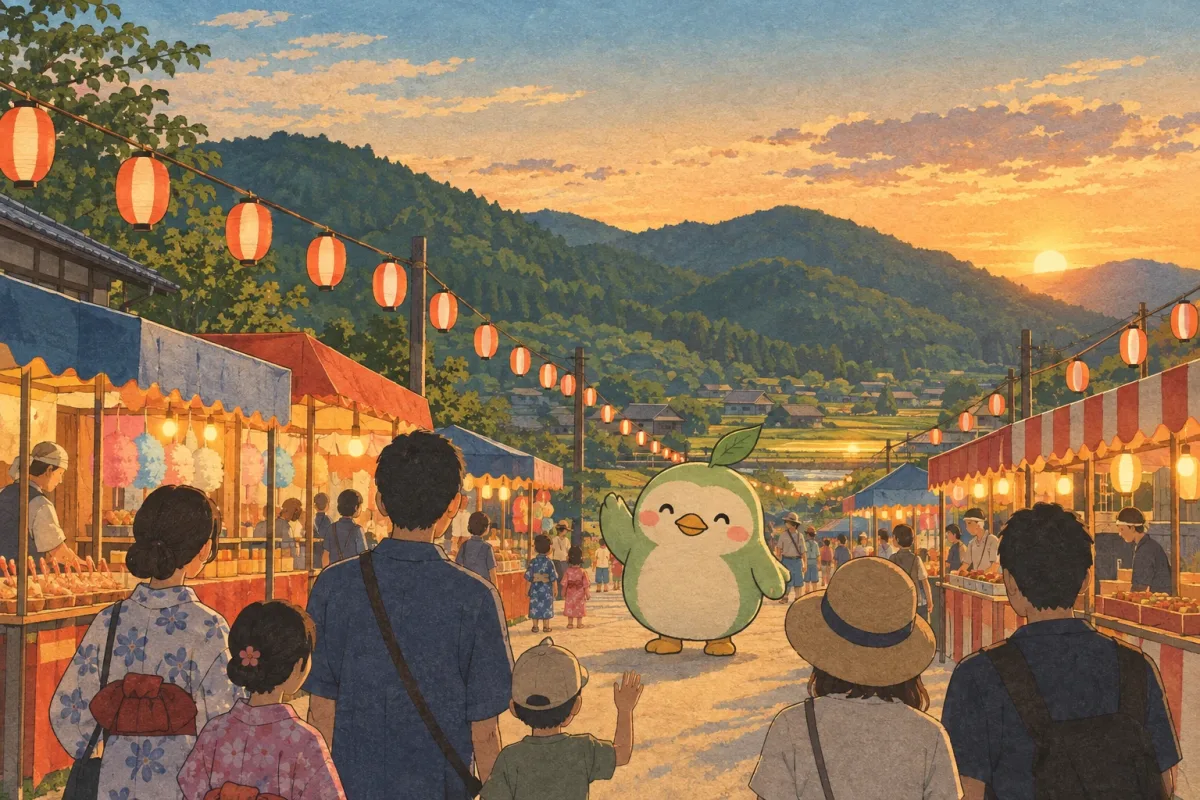
Many of Japan's local governments and tourist areas have a mascot character to promote their home turf. They are usually called "yuru-kyara" (short for "yurui kyarakutā", roughly "laid-back characters") or "gotōchi kyara" (local characters).
Two huge hits showed that a character could dramatically raise a region's profile and boost sales of its local products: Hikonyan in 2007, and Kumamon's runaway success from around 2011. After that, local governments across the country created mascots one after another. On the other hand, some have been lost in the crowd as numbers exploded, and others have been criticised as a waste of taxpayers' money.
Where the word "yuru-kyara" came from
The term "yuru-kyara" was coined by Jun Miura, a manga artist and essayist. Around 2000 he became fascinated by the rather homespun, clumsy mascots at regional events and began featuring them in a magazine column. The Japan Times translated the term as "laid-back characters", explaining that it emphasises the contrast with the polished characters produced by professionals at big companies.
Miura set out three conditions for a yuru-kyara: "a strong message full of love for the hometown", "unsteady, unique movements and behaviour" and "lovable looseness". As a rule, he also requires that it exists as a kigurumi (a large costume worn by a person inside who moves it around). The origins of yuru-kyara are said to lie in the mascots created during the boom in regional expos in the 1980s.
Once the word caught on, the boom became a social phenomenon. "Yuru-kyara" was shortlisted for the 2008 Buzzword of the Year awards, and in 2013 "gotōchi kyara" made the top ten, with Kumamon among the winners. That same year, 376 characters gathered at an event in Hanyu, Saitama Prefecture, earning a Guinness World Record for the "largest gathering of mascots".
The mascots that started it all: Hikonyan and Kumamon
The boom was sparked by Hikonyan from Hikone in Shiga Prefecture. He first appeared in 2007 as the character for the 400th anniversary festival of Hikone Castle. Based on the legend of a white cat said to have saved Ii Naotaka, lord of the Hikone domain, from a lightning strike, he is a cat wearing the Ii family's red samurai helmet. Hikone City let people use the character free of charge with permission at first, so all kinds of goods and sweets were made, including by small local firms. His popularity continued after the festival ended, and he still appears at Hikone Castle almost every day.
An even bigger success is Kumamon from Kumamoto Prefecture. With the Kyushu Shinkansen due to open along its full length in 2011, the prefecture feared Kumamoto would become "just a station people pass through", so in 2010 it announced a PR campaign and Kumamon. Kumamon won the 2011 Yuru-Kyara Grand Prix, and his official title is the prefecture's "Sales Manager", ranking just below the governor and vice-governor. He even has a "Sales Manager's Office" in a department store in Kumamoto City. The prefecture bought the copyright and made it free to use on products with permission. As a result, sales of related products grew from about 2.5 billion yen in 2011 to about 44.9 billion yen in 2013, and the total for 2011 to 2021 is said to exceed one trillion yen. The Kumamoto prefectural government still has a department called the "Kumamon Division".
Why local governments create characters
A survey of Japan's prefectures, cities and wards by the Nikkei newspaper found that the number of regional characters doubled in ten years, from 714 in fiscal 2011 to 1,553 in fiscal 2021. According to the same report, in as many as 20 prefectures the prefecture's character has more followers on X (formerly Twitter) than the governor.
One reason is that a character reaches a lot of people for relatively little money. It can go to events and post on social media to get people talking, and it can also be put on the packaging of local products. Kumamoto Prefecture estimated that Kumamon's publicity in fiscal 2010 alone was worth 640 million yen in advertising.
Another is a system where the local government charges little or nothing for use and lets local businesses use the character freely. Research based on questionnaires sent to local governments has also found that, in many cases, the local government holds the character's intellectual property rights and allows it to be used free of charge. The character works as a "shared brand" for the whole region, not just the town hall.
The bright side and the dark side of the boom
Not every mascot is a success, though. The same research shows that while many local governments feel they have got some results, they also face problems such as low name recognition, a lack of staff to run the character, and the cost of maintaining the costume. There was also criticism that different departments within the same local government were each creating their own characters, and that the resulting glut actually made each one less memorable.
In 2014, the Sankei newspaper reported that Osaka Prefecture had ended up with as many as 45 characters and was aiming to consolidate them into its oldest, "Moppy". Research presented to the Japan Association for Social Informatics also found a clear change in the purpose of mascot activities and how they used social media between the pre-boom period (2006 and earlier) and the boom period (2007 onwards).
Entries to the Yuru-Kyara Grand Prix, which began in 2010, peaked at 1,727 characters in 2015 and fell below 1,000 in 2018. Problems such as local governments spending large amounts of tax money to chase a top ranking, and organised voting, contributed to the Grand Prix ending in 2020. Its successor event, "Yuru-Verse", is now held, and a record 135 characters are taking part in the 2026 final vote.
How travellers can enjoy them
Characters are often designed to pack in a place's specialities and history, and finding out why a character looks the way it does makes a trip more fun. For example, Arukuma from Nagano Prefecture, winner of the 2019 Grand Prix, wears a hood shaped like an apple, a famous local product, and sometimes swaps it for hoods shaped like wine, soba (buckwheat noodles) or matsutake mushrooms to show off what the prefecture has to offer.
As with Kumamon and Hikonyan, local companies often make sweets and local products featuring the character, which makes choosing souvenirs more fun too. In Kumamon's case, 85% of food sales came from businesses within Kumamoto Prefecture (2013). Some characters, like Hikonyan at Hikone Castle, appear only at set times and places, so it is a good idea to check their appearance schedule on the official website before you go. Kumamon's "workplace" is Kumamon Square in the Tsuruya department store in Kumamoto City, and he is said to be away every Tuesday and Thursday, so check the day of the week if you plan to visit him.
Tips
- Check the official website or social media of the local government where you are travelling to see when its local character is appearing at events.
- A character's design often hides local products or history. Looking into where it comes from tells you a lot about the place.
- If you cannot decide on a souvenir, try sweets or local products featuring the local character. They are often made by local companies.
- When taking photos with a costumed character, let the children around you have their turn and follow the staff's directions.
- The police and companies have mascots too. Hunting for characters in unexpected places is fun, such as Pipo-kun of the Tokyo Metropolitan Police Department.
Sources
- ゆるキャラ - Wikipedia
- くまモン - Wikipedia
- ひこにゃん - Wikipedia
- くまモンランドとは - 熊本県
- ご当地キャラクターの活用とライセンシング - 情報知識学会誌(J-STAGE)
- ご当地キャラクター活用実態の変遷に関する考察 - 社会情報学会大会研究発表論文集(J-STAGE)
- Chubby Nagano Prefecture bear beats nearly 800 other characters to win annual mascot competition - The Japan Times
- ゆるナビ(ゆるキャラグランプリ・ゆるバース公式)
- 警視庁ホームページ(シンボルマスコット「ピーポくん」表記)