Why Is Everything in Japan a Seasonal Limited Edition?
Cherry blossom flavours in spring, chestnut and sweet potato in autumn. An old food culture of the seasons meets our weakness for "only for now".
The short answer
Japan has long had a food culture that treasures "shun", the time when an ingredient tastes best, and enjoys the changing seasons through its food and sweets. Add the human urge to buy anything you are told you can "only get now", plus manufacturers' strategies for winning shelf space, and you get konbini (convenience stores) and supermarkets overflowing with "seasonal limited" and "limited-time" products.
A survey by the printing company Dai Nippon Printing (DNP) found that at one point, about 30% of the snacks in supermarkets in the Tokyo area were some kind of "limited edition". When travellers feel there are limited editions wherever they look, they are not imagining it.
The foundation: a food culture that savours "shun"
According to the Agency for Cultural Affairs, Japan, with its four distinct seasons, has long treasured "shun" ingredients, each at its tastiest in its own season. People even give separate names to the first of the season, "hashiri", and the last, "nagori", savouring the smallest shifts in the seasons.
Wagashi (traditional Japanese sweets) are the classic example. Through their colours and shapes they announce the arrival of each season, with motifs such as cherry blossoms and rapeseed flowers in spring, morning glories and Tanabata (the star festival) in summer, autumn leaves and chestnuts in autumn, and winter camellias and daffodils in winter. You could say this culture of enjoying the seasons with the eyes as well as the tongue carries on right into today's konbini desserts.
There is also a saying, "hatsumono shichijūgo-nichi" (first-of-the-season food, 75 days). It is an old folk belief that eating the first of something caught or grown that year, such as the first bonito or the first aubergines, adds 75 days to your life. The joy of welcoming the start of a season was already there among people in the Edo period.
Ironically, an encyclopaedia points out that now that fishing in distant seas and forcing crops to grow out of season have become normal, the sense of the seasons that once brightened Japanese dinner tables is fading. You could also argue that precisely because everything is available all the time, people are once again looking for products that let them feel the season.
Just how many limited editions are on the shelves?
"Limited edition" covers all sorts of things. DNP sorts them along three axes: "limited in time", sold only for a certain period (seasonal or limited-time); "limited in place", sold only in certain regions or shops (regional or channel-limited); and "limited in quantity". The more of these axes are combined, the higher the "rarity", which gives rise to products such as a "XX store exclusive, limited quantity, spring-only strawberry flavour".
When DNP surveyed three large supermarkets in Tokyo and Chiba in October 2019, limited editions made up about 30% of snack items. Of these, 15.6% were "channel-limited" products, such as own-brand goods that can only be bought in particular shops, and 13.0% were "limited-time". Among ready-to-drink alcohol such as canned chūhai (shochu-based fizzy drinks), limited editions accounted for nearly 20%.
Manufacturers are busy too. According to the same survey, the number of companies' new-product press releases that promoted something as "limited" almost doubled, from 44 in August 2014 to 79 in August 2019.
What is more, limited editions really do sell. In sales data from a drugstore chain for July 2019, limited products such as limited flavours made up 36.9% of sales among the top 20 premium ice creams.
Only a tiny fraction of all the products out there make it onto a shop's shelves. DNP sees the fact that limited editions take up 20 to 30% of those shelves as proof of how much effort sellers put into them. Some brands on the shelves reportedly had no regular flavour at all, only limited ones.
Why are we so weak to "only for now"?
In a 2020 DNP survey of 1,000 people in their 20s to 60s across Japan, 64.7% said they had bought limited-edition food or drinks at a supermarket. Most of those had bought limited-edition sweets or snacks, and 85.5% of them had bought "limited-time" ones. The most common reason, at 70.8%, was "I was curious about a flavour I'd never tried", followed by "I wanted to feel the season" at 48.8%.
Marketing research also reports that words signalling scarcity, such as "limited-time" and "limited quantity", make people rate products more highly. The harder something is to get, the more valuable it feels, and the thought "I don't want to regret not buying it later" gives people a push. Research has also been cited showing that when the chance to buy is limited, people tend to regret passing it up and missing out more than they regret buying something that turns out to be a dud.
Manufacturers have their own reasons. A Consumer Affairs Agency survey found that around 40% of people always choose the same products or brands, so getting people to try something new is not easy. Interestingly, DNP's survey found that people who usually stick to one brand were actually more drawn to limited editions. A seasonal limited edition gives people who normally play it safe a reason to pick something up. Popular limited flavours are sometimes promoted to year-round regulars, so limited editions also serve as a testing ground for new products.
What surprises travellers
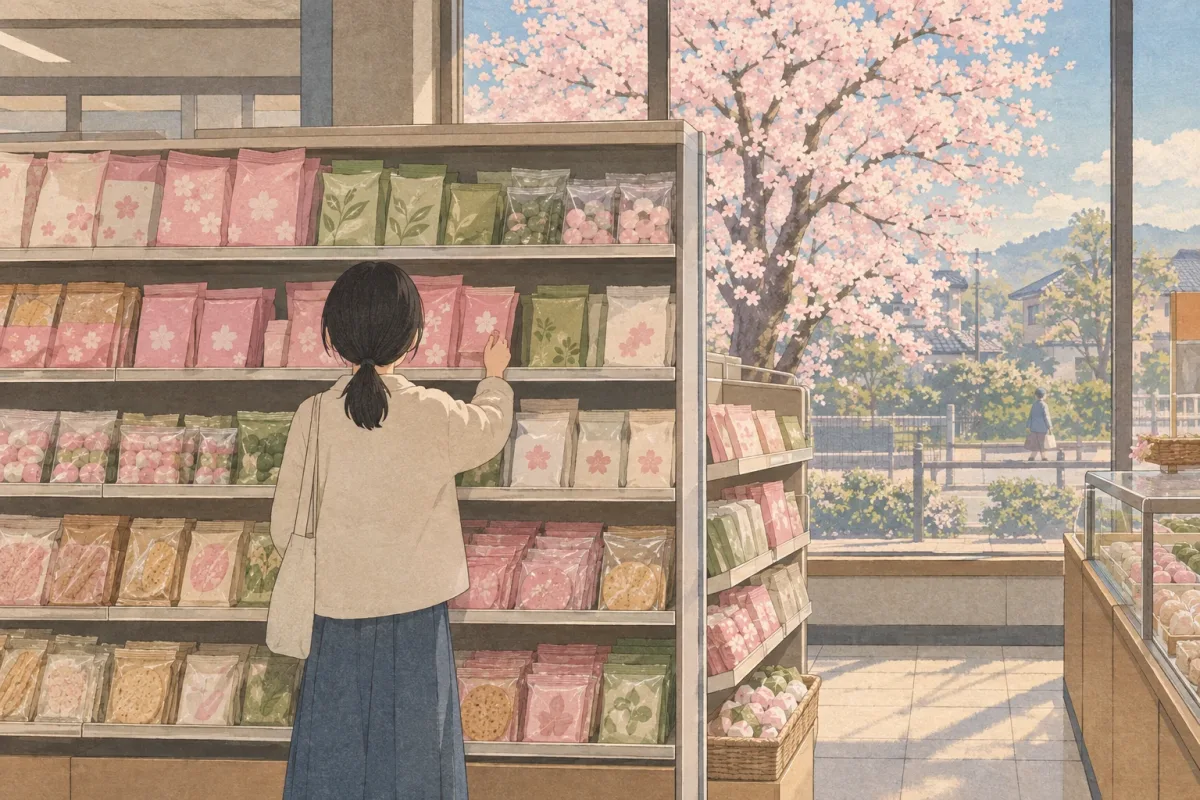
Spring cherry blossom stands out most of all. In Japan so much attention focuses on this one flower that cherry blossom forecasts make the news, and cherry-blossom-flavoured products pour out not only in traditional wagashi such as sakura mochi (rice cakes wrapped in a cherry leaf) but also from Western-style patisseries and confectionery makers. In autumn, flavours such as roasted sweet potato and chestnut fill the shelves, and from winter into spring, mikan (mandarin), yuzu (a Japanese citrus) and strawberry.
Another feature is the "regional limited edition". Local-flavour sweets that you can only buy on your travels have the appeal of both "only here" and "only now", which makes them popular souvenirs.
With advances in distribution and preservation, the same things are now available everywhere all year round. A DNP marketer suggests that this is exactly why "anytime, anywhere" alone has started to feel unsatisfying, and limited editions fill that gap.
How to make the most of it
As the name says, seasonal limited editions vanish from the shelves once their time is up. If you spot something that catches your eye, the best thing is to try it on the spot. If you learn the kanji for "limited" (限定, gentei) on packaging, you can pick them out even if you cannot read Japanese.
Seasonal wagashi are also well worth trying. The display cases in wagashi shops change with the seasons, so even the same shop looks completely different depending on when you visit.
Tips
- Learn the two characters for "limited", 限定 (gentei). You will see them on packaging in phrases such as "seasonal limited", "limited-time", "regional limited" and "limited quantity".
- If a limited edition catches your eye, buy it when you see it. Once its period is over, it disappears from the shops.
- At station and airport shops on your travels, look for "gotōchi" (local) flavours you can only buy in that region. They make welcome souvenirs too.
- If you visit Japan in spring, try counting how many cherry-blossom-flavoured products you can find in a konbini.
- Wagashi shops line up sweets with seasonal motifs. Look for sakura mochi in spring and sweets made with chestnuts in autumn.