Japan is Nippon
Verdict Real
Do Japanese Students Really Clean Their Own Classrooms?
Yes. At almost every Japanese elementary and junior high school, students spend about 15 minutes a day cleaning their classrooms, the corridors and even the toilets themselves. For elementary schools it is written into the national curriculum as one of the class duties, and it is simply part of scho
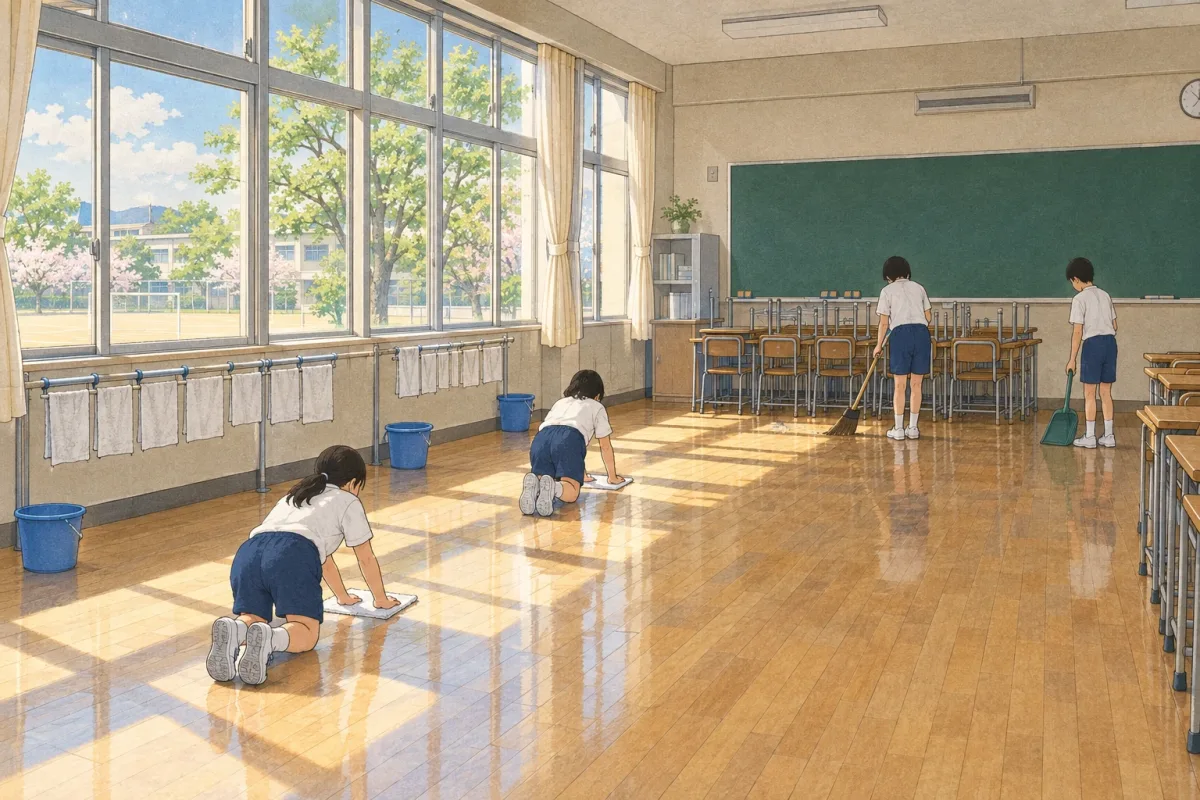
The desks are pushed to the back of the room and students grab brooms and floor cloths. Someone skips cleaning duty and gets told off, or two classmates left to clean alone start talking for the first time: in anime, cleaning time is where stories begin.
At most elementary and junior high schools, each class cleans its assigned areas for about 15 minutes after the lunch break or after lessons. Students look after the corridors and toilets as well as their own classroom, and wiping the floor with a cloth is still standard.
The short answer
The cleaning time you see in anime is an everyday reality in Japanese schools. When the chime rings, students carry their desks to the back of the room, sweep the floor, wipe it down with cloths, and then put everything back.
In a 2011 survey by Duskin, a cleaning company, about 90% of elementary and junior high school students said they cleaned at school four or more days a week, and only 1.8% said students did no cleaning at all. In many countries school cleaning is done by janitors, so this habit often surprises people from abroad.
This article covers what happens during cleaning time, why students do it, how it is changing, and how anime's cleaning scenes compare with the real thing.
When, and for how long?
Cleaning time is short: about 15 minutes at most schools. In Duskin's 2011 survey of teachers, almost every school took less than 20 minutes. Many elementary schools clean after school lunch or after the lunch break, while about 70% of junior high schools clean once the day's lessons are over.
Schools that clean every single day are slowly becoming fewer, but a 2022 survey still found 85.7% of schools cleaning four or more days a week.
Some schools play music during cleaning time; others practise mugon seisō, "silent cleaning", where students work without talking.
What gets cleaned, and with what?
Students clean classroom floors, shelves, corridors, desks and chairs, and special rooms such as the science lab and the music room. At most schools each class is given its own areas, and small groups (han) take turns. Some elementary schools clean in tatewari-han, mixed groups with children from every year, first grade to sixth.
The main tools are still the zōkin (a folded cotton cloth for wiping floors), the broom and the dustpan. The share of schools using vacuum cleaners fell from 48.3% in 2001 to 33.5% in 2011, and the tools teachers most often show students how to use are cloths, brooms and blackboard erasers.
Many schools have students clean the toilets too: a 2021 survey of 167 schools found students cleaning the toilets at more than 80% of them, with only about one in ten leaving it to contractors. The staff room, the swimming pool and the outside of the buildings are usually looked after by teachers, staff or contractors.
Why do students clean?
Japan's national curriculum for elementary schools lists class duties such as cleaning under "special activities" (tokubetsu katsudō), with the aim of teaching children the value of working together for everyone. In other words, cleaning is treated as part of education rather than just a school rule.
It also reflects the place cleaning has long held in Japanese culture. In Zen temples, samu, physical work that includes cleaning, is part of a monk's training, and in martial arts and the tea ceremony the space is cleaned before and after practice. Jimon seisō, a style of school cleaning done in silent self-reflection that began in Nagano Prefecture, is said to draw on its creator's experience at a Zen temple.
The thinking is that cleaning the places you use yourself teaches you to take care of things and to be considerate of others.
Is it changing?
Student cleaning has not gone away, but how it is done is being rethought. As teachers' heavy workloads became a national issue, the government's Central Council for Education in 2019 listed cleaning the school among the tasks that "teachers do not necessarily have to take on".
Since then, some schools have moved to cleaning every other day, and some leave everything beyond the daily cleaning to outside services. Kasama Junior High School in Ibaraki alternates cleaning days with free lunch-break days, and the city of Yokohama has handed some light school cleaning to workplaces that employ people with disabilities.
What about other countries?
A 1977 study of 105 countries found that school cleaning was done mainly by janitors in 58.1% of them and mainly by students in 34.3%. The countries where students cleaned included Japan, South Korea, China and others in Asia and Africa.
Japanese-style school cleaning has also spread abroad. Since 2016 Egypt has been building schools in cooperation with Japan that adopt Japan's "special activities", and students there clean their own classrooms. At first, some parents objected to their children being made to clean.
At the 2022 FIFA World Cup, Japanese fans drew attention for picking up rubbish in the stadium after matches, and some of the fans interviewed linked it to the cleaning they had done at school.
Anime versus reality
In anime, two students left alone on cleaning duty start talking, or someone skips cleaning and gets scolded, and cleaning time sets the story moving. The scenes may look exaggerated, but the system behind them, with each class dividing up the areas and taking turns, is exactly how it works.
If anything is different, it is the length. Real cleaning lasts about 15 minutes, which leaves little time for long conversations. Also, most of the surveys mentioned here cover elementary and junior high schools; how high schools handle cleaning varies from school to school.
For Japanese students, cleaning is not a special event but part of every school day, like school lunch or morning homeroom. Anime's cleaning scenes are simply a slice of that everyday life.
Official videos
Videos from official YouTube channels. They load from YouTube only when you press play.
Where you will see it
- Neon Genesis Evangelion In episode 15 of the TV series, Shinji sees Rei Ayanami wringing out a floor cloth on cleaning duty and later tells her she seemed "kind of like a mother". Even in a story about giant robots, cleaning duty is just part of ordinary school life.
- Azumanga Daioh In episode 12, during after-school cleaning, Tomo can't sweep properly with a broom and Osaka can't work the dustpan. It shows a high school with cleaning time too.
- Nichijou (My Ordinary Life) In episode 18, Misato confronts Sasahara: "Why are you skipping cleaning duty again?" Getting told off for skipping cleaning is a classic school moment.
- Teasing Master Takagi-san Season 1, episode 4 is titled "Cleaning Duty" (Sōji Tōban): Nishikata is ordered to clean the science room as a punishment. It isn't the daily cleaning, but the term itself is the episode title.
- Chibi Maruko-chan In the episode broadcast on 20 October 2024, Maruko's classmate Maeda tells her off for the way she cleans during cleaning time.
Tips
- If your child goes to a Japanese school, you may be asked to send in a zōkin at the start of term. The traditional way is to sew one from an old towel at home, but shop-bought ones are fine too.
- At Japanese stadiums and event venues, taking home the rubbish around your seat is appreciated. There are few public bins in Japanese cities, so it helps to carry a small bag.
- To see a Japanese school day on video, the English video "Tell Me About Elementary School in Japan!" on the official channel of Japan's education ministry (MEXT) includes a cleaning-time scene.
- At the end of the year, Japanese homes and workplaces do ōsōji, a "big clean". Like school cleaning, it is about welcoming the new year in a clean space.
Sources
- 第6章 特別活動:文部科学省 (opens in a new tab)
- 子どもからみた学校掃除に関する実態調査(2011年)| ダスキン (opens in a new tab)
- 教員からみた学校掃除に関する実態調査(2011年)| ダスキン (opens in a new tab)
- By the Numbers: A Day in the Life of a Japanese Elementary School Student | Nippon.com (opens in a new tab)
- 学校トイレノウハウブック2025 | 学校のトイレ研究会 (opens in a new tab)
- 3分類に基づく14の取組の実効性を確保するための各主体による「対応策の例」| 文部科学省 (opens in a new tab)
- 学校掃除「自問清掃」の発想原理と方法的原則 | 信州大学 (opens in a new tab)
- 中国の中学校における学校清掃 | 京都女子大学 (opens in a new tab)
- 無言清掃の取組 | 広島県 (opens in a new tab)
- How Japan's Education System is Making a Difference in Egypt | JICA (opens in a new tab)
- Japanese fans win praise for stadium cleaning at World Cup 2022 | Al Jazeera (opens in a new tab)
- エヴァンゲリオン 綾波レイ | PRESIDENT Online (opens in a new tab)
- List of Azumanga Daioh episodes | Wikipedia (opens in a new tab)
- List of Nichijou episodes | Wikipedia (opens in a new tab)