Japan is Nippon
Verdict Anime only
Can You Really Eat Lunch on a Japanese School Roof?
At most schools, no. Japanese schools are asked by the government to keep rooftop doors locked when the roof is not in use, to prevent falls. Elementary and junior high students eat school lunch in their classrooms, and most high school students eat their packed lunches there too. Only a handful of
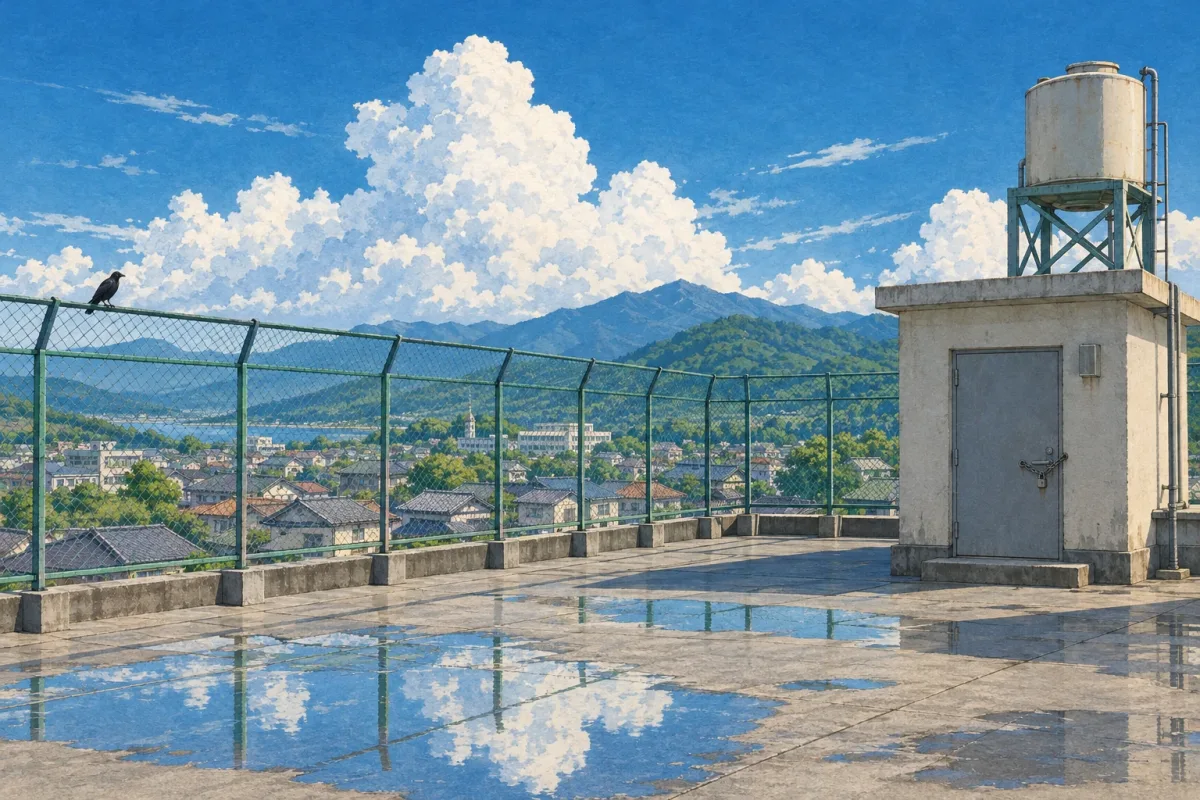
When the lunch bell rings, the main character heads for the roof. Packed lunches under a blue sky, confessions, skipping class to lie in the sun: the roof is where the big moments happen.
At most schools the door to the roof is locked and students cannot go out. Lunch at elementary and junior high schools is school lunch in the classroom; at high schools it is mostly a packed lunch at your desk.
The short answer
In anime and manga, the school roof is the go-to place at lunchtime. In real Japanese schools, though, the roof is usually off limits and the door is locked.
The reason is safety. Japan's Ministry of Education (MEXT) asks schools to manage rooftop doors so that students cannot easily open them, and to keep them properly locked. One of the reasons this became so strict was a real and tragic accident.
This article explains why roofs are closed, which schools are exceptions, where Japanese students actually eat lunch, and why anime loves rooftops so much.
Why are school roofs locked?
MEXT's 2009 guidance on preventing accidents in school buildings says rooftop entrances should be managed and locked so that pupils cannot easily get out. Ladders up to rooftop equipment should also be made hard to climb, for example with lockable covers.
If a roof is used for lessons or other activities, it must have proper handrails or safety fences. Building rules also require handrails at least 1.1 metres high on any roof that people can walk out onto.
The same guidance describes falls from high school roofs: one student fell from a small structure on top of the roof, and another stepped backwards off the edge after a club activity. On a roof, a moment's carelessness can lead to a serious accident.
The accident that changed things
On 18 June 2008, at an elementary school in Suginami, Tokyo, a sixth-grade boy taking a maths lesson on the roof stepped onto a skylight. It broke, and he fell about 12 metres and died.
The building had been designed without children going onto the roof in mind, but as teachers changed over the years, that knowledge was not passed on. Two days after the accident, MEXT sent a notice to education boards across Japan asking schools, among other things, to lock rooftop doors whenever the roof is not in use.
Articles on preventing injuries at school still give "keep the rooftop door locked at all times" as a basic rule.
Some schools do open their roofs
Not every school keeps its roof closed. At Azabu Junior and Senior High School, a private school in Tokyo, the roof was opened to students at lunchtime in June 2006. It had been closed for three years after misconduct by a few students, and it reopened, with wire fencing added, after a student petition.
A 2026 survey of 29 private high schools in Shizuoka Prefecture found that five allowed students to eat lunch outside their classrooms, and one of the places mentioned was a "rooftop lawn".
Some schools keep astronomy equipment on the roof and go up only with a teacher, for the astronomy club or special events. Even so, schools where students can freely go up to the roof at lunchtime are the exception.
So where do students eat lunch?
Almost all elementary and junior high schools serve school lunch (kyūshoku). In a 2025 survey, 99.1% of elementary schools and 91.6% of junior high schools served it (98.5% of public junior high schools).
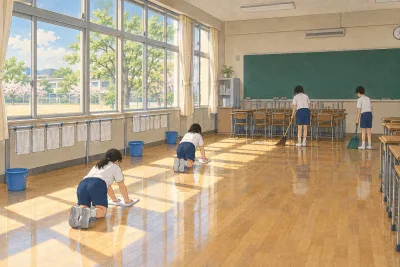
School lunch is eaten in each classroom, together with the homeroom teacher. Students on lunch duty carry the food from the school kitchen and serve it out in the classroom. There is neither a reason nor the time to go up to the roof.
High schools generally have no school lunch, so students bring their own. In a 2021 survey of about 1,000 high school students, about 90% ate a packed lunch made at home; the next most common choices were buying from the school shop, picking something up at a convenience store or supermarket, and eating in the cafeteria. In the Shizuoka survey too, only five schools out of 29 let students eat outside their classroom, so most high school students eat lunch in their own classroom.
Why does anime love rooftops?
If school roofs are locked in real life, why do they appear so often in anime? The usual explanations are that a roof has a wide view that looks good on screen, that you can talk there without other students overhearing, and that it gives two people the privacy a confession or a serious talk needs.
Roofs are also a stage for small rebellions: skipping class or bending school rules out of the teachers' sight. They are drawn as a special place that belongs only to the main characters.
Among Japanese anime fans, "real school roofs are locked" is a well-known example of the gap between anime and reality. Perhaps it is precisely because you can almost never go there that the roof has become a place people dream about.
Anime versus reality
Eating lunch on the roof is, almost entirely, "anime only". In real schools the roof is usually locked, and lunch is normally eaten in the classroom.
Still, schools that open their roofs do exist. If you ever attend a Japanese school and it lets you up onto the roof, you are having a rare experience.
Official videos
Videos from official YouTube channels. They load from YouTube only when you press play.
Where you will see it
- Bleach In episode 4 (chapter 7 of the manga), Ichigo and his friends spend the lunch break on their high school roof, and Rukia can't work out how to push the straw into a juice carton. In this series the roof is the usual place to eat lunch with friends.
- Kuroko's Basketball Episode 2 (chapter 2 of the manga). New members of the basketball club traditionally shout their goals for the year to the whole school from the roof during morning assembly. They get told off by teachers for breaking school rules every time, which shows the roof is not a place you are normally allowed to go.
- Persona 5 (a game, also adapted as an anime) The main characters' school roof is officially off limits, but the door turns out to be unlocked, so it becomes the group's secret meeting place. It builds the real-life rule into the story.
- Your Lie in April In episode 3, Kaori tells Kōsei on the roof why she plays music. It is a classic use of the roof as a place where two people speak from the heart.
- My Teen Romantic Comedy SNAFU In season 1, episode 12, the head of the school festival committee disappears before the closing ceremony, and Hachiman searches for her and finds her on the roof.
- Kids on the Slope In episode 1, Kaoru, a new transfer student, feels unwell, escapes to the roof and meets Sentarō there. The story begins on a rooftop.
- Gakkō e Ikō!: "Shout It Out" (Mirai no Shuchō), a TBS variety show A segment in which students shout their feelings from the school roof to classmates gathered below. It isn't anime, but it helped make the school roof an icon in Japan.
Tips
- Japanese school grounds are closed to outsiders. If you visit a school that appears in an anime, look from outside only: don't walk in, and don't photograph students.
- For rooftop views, try the rooftop gardens and observation spaces on department stores and station buildings. Many of them are open to everyone.
- To try a Japanese high schooler's lunch, buy a bento, onigiri or bread at a convenience store and eat it in a park.
- If you see a sign or rope saying 立入禁止 (tachiiri kinshi), do not go past it. You will often see it at rooftop doors, building sites and parts of shrines and temples.
Sources
- 学校施設における事故防止の留意点について(2009年3月)| 文部科学省 (opens in a new tab)
- 校舎天窓落下事故 | 失敗知識データベース (opens in a new tab)
- 【子どものケガを減らす(4)】学校での転落事故 | 教育新聞 (opens in a new tab)
- 屋上開放 | 麻布中学校・高等学校 (opens in a new tab)
- 【静岡・私立高校の昼ごはん事情】弁当持参が多数派!29校アンケート結果 | 静岡新聞アットエス (opens in a new tab)
- 学校給食実施状況等調査(令和7年5月1日現在)| 文部科学省 (opens in a new tab)
- 食に関する指導の手引 第5章 | 文部科学省 (opens in a new tab)
- 高校生の朝食、2位は「パン」 1位は? 空腹時の対処もLINEが調査 | BCN+R (opens in a new tab)
- The Reason High School Students in Anime Hang Out on the Roof | CBR (opens in a new tab)
- Japanese college students share four ways anime high school is different from real high school | SoraNews24 (opens in a new tab)
- 坂道のアポロン 第1話「モーニン」| WEBザテレビジョン (opens in a new tab)
- Shout It Out 未成年の主張 | TBS Program Catalog (opens in a new tab)
- Do Japanese High School Kids Really Hang Out On The Roof? | Anime News Network (opens in a new tab)
- Karakura High School | Bleach Wiki (opens in a new tab)
- 黒子のバスケ | BOOK☆WALKER (opens in a new tab)
- I Am Serious (episode 2) | Kuroko no Basuke Wiki (opens in a new tab)
- Shujin Academy | Megami Tensei Wiki (opens in a new tab)
- Episode 03: Inside Spring | Shigatsu wa Kimi no Uso Wiki (opens in a new tab)
- Episode 12 | Oregairu Wiki (opens in a new tab)