Chichibu Night Festival
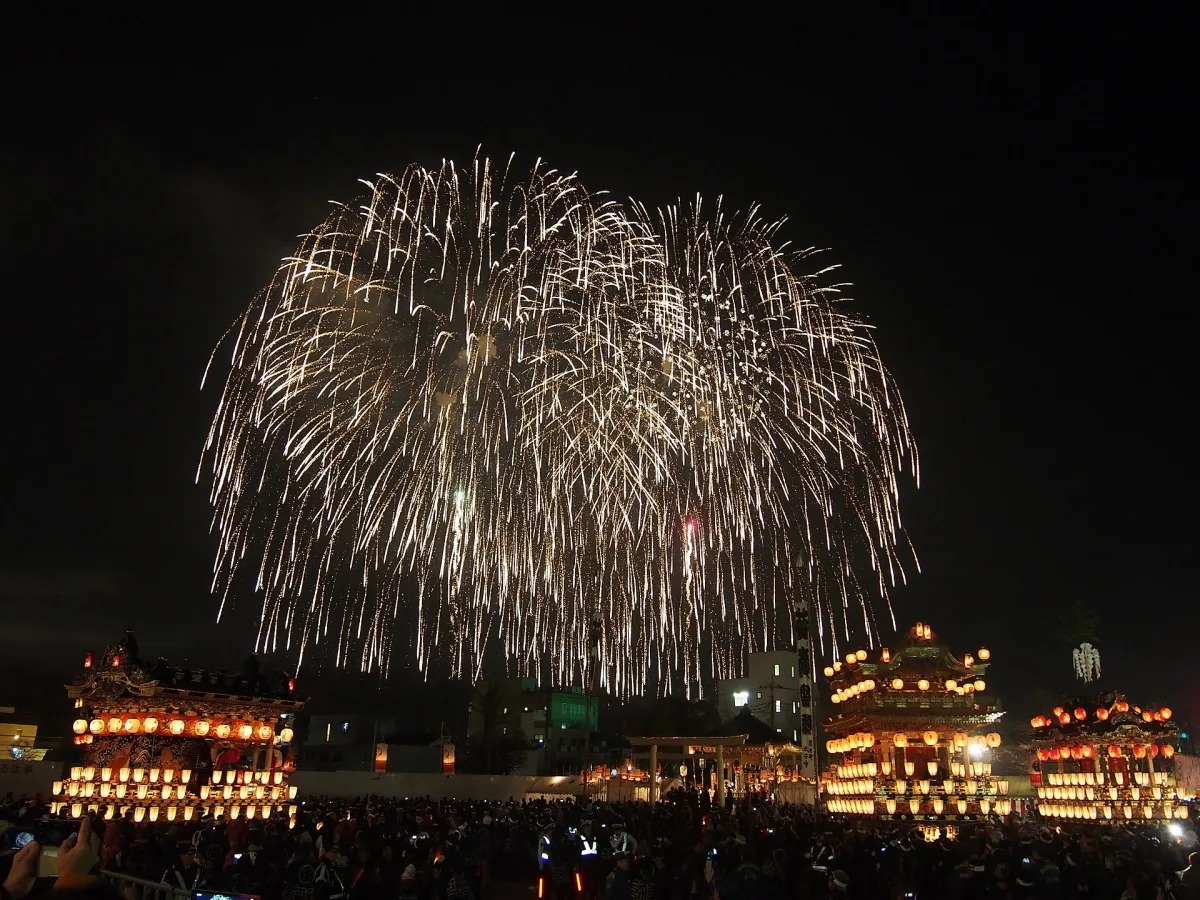
Floats weighing up to 20 tonnes race up a steep slope under winter fireworks. Held in Chichibu, Saitama every 2 and 3 December, a UNESCO-listed festival.

Saitama
- SaitamaChichibu Shrine and central Chichibu; the climax is on the night of the 3rd at the otabisho at the top of Dangozaka
Recent years
| Year | Dates | Visitors | Notes |
|---|---|---|---|
| 2026 | 2–3 December | — | The dates are fixed every year: 2 December (yoimiya, the eve) and 3 December (the main festival). |
| 2025 | 2–3 December | about 248,000 (over two days) | Held with a fireworks display marking the 20th anniversary of Chichibu City. The night was relatively mild and all six floats made it up Dangozaka. The Nakamachi yatai took its turn staging the float theatre for the first time in six years. |
| 2024 | 2–3 December | about 257,000 (over two days) | Reports said there were noticeably more overseas visitors than in previous years. |
| 2023 | 2–3 December | about 368,000 (over two days) | The first year since the pandemic that the festival fell on a Saturday and Sunday, drawing over 80,000 more people than the year before. The Shitago kasaboko could not climb Dangozaka because of trouble near its wheels. |
| 2022 | 2–3 December | about 284,000 (over two days) | The float events were cancelled in 2020 and 2021 because of COVID-19, so the kasaboko and yatai were pulled through the streets for the first time in three years. |


When and where is it held?
The Chichibu Night Festival (Chichibu Yomatsuri) is the reitaisai, the most important annual festival, of Chichibu Shrine in Chichibu City, Saitama Prefecture. Whatever the day of the week, the dates never change: 2 December is the yoimiya (the eve, a sort of festival preview) and 3 December is the taisai (the main festival). In 2026 that means Wednesday 2 and Thursday 3 December.
Together with Kyoto's Gion Matsuri and the Hida-Takayama Festival in Gifu Prefecture, it is counted as one of Japan's three great hikiyama festivals (festivals where large floats are pulled through the streets). Its kasaboko and yatai float events and Chichibu Shrine's kagura (sacred dance) are designated Important Intangible Folk Cultural Properties, and in 2016 it was added to UNESCO's Intangible Cultural Heritage list as one of 33 "Yama, Hoko, Yatai" float festivals from across Japan.
Locals also call it the "winter festival" or the "night festival". According to Chichibu Shrine, people in the surrounding villages have called it "Myoken-machi", and silkworm-raising families "Okaiko Matsuri" (the silkworm festival).
A festival that grew with the silk market
In the mid-Edo period, a silk market known as the Kinu no Takamachi (the great silk fair) began to be held around Chichibu Shrine, and as the market brought prosperity, the festival grew grander too. The float events are said to date back to either the Kanbun era (1661–73) or the Kyoho era (1716–36). There is no longer a silk market as such, but during the festival a "Chichibu Silk Market" is held on a street near the shrine, selling traditional textiles such as Chichibu meisen (a colourful woven silk).
There is a local story behind the festival. Myoken, the goddess enshrined at Chichibu Shrine, and the male god of Mount Buko, which rises to the south of the town, are allowed to meet only on this one night of the year. The mountain god's lawful wife is said to be "Osuwa-sama" of nearby Suwa Shrine, so on the night of the 3rd, when the floats pass close to Suwa Shrine, the custom is to stop the music and move along quietly. The Chichibu Festival Museum even describes it as a "winter version of the Tanabata legend", but it is, of course, just a legend.
The six floats and what to look out for
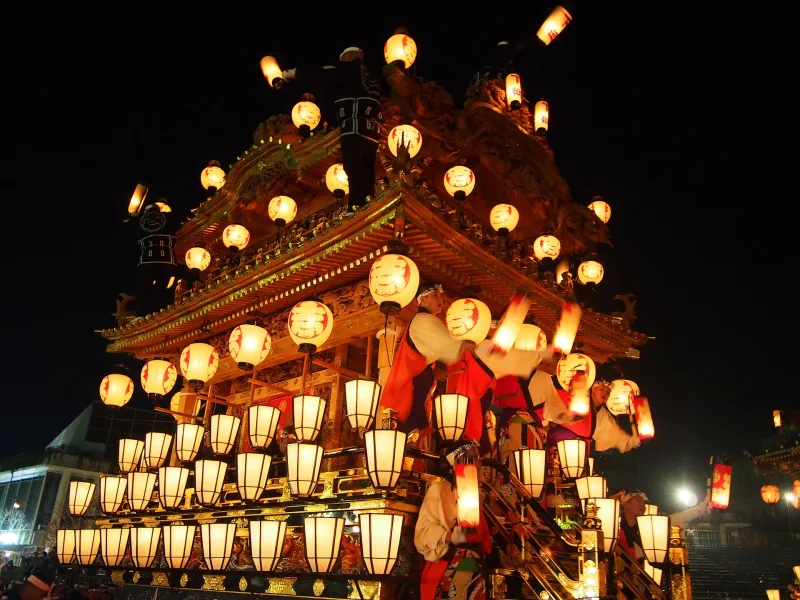
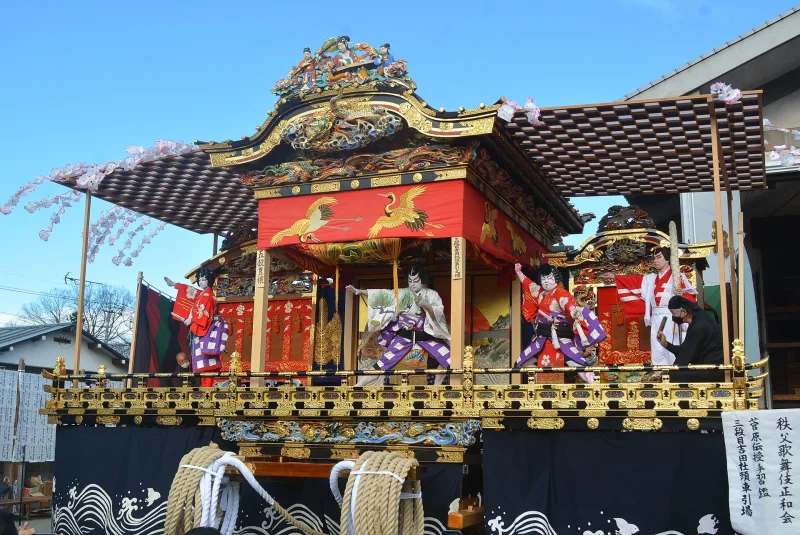
The stars of the festival are six floats: two kasaboko (umbrella-topped floats) and four yatai (stage floats). The kasaboko belong to Nakachika and Shitago, and the yatai to Miyaji, Kamimachi, Nakamachi and Motomachi. Decorated with lavish carvings and embroidered curtains, they are nicknamed "moving Yomeimon" (after the ornate gate at Nikko's Toshogu Shrine). Each weighs roughly 12 to 20 tonnes and is pulled by 150 to 200 hikite (rope pullers). Inside the floats, the Chichibu Yatai Bayashi, festival music played on drums, flutes and kane (small gongs), never stops.
The people riding at the front of each float in red-and-white juban (the robe worn under a kimono) are called hayashite. Chosen from their neighbourhood only once in a lifetime, they are the festival's star performers, urging the pullers on with the call "Horyai!". According to Chichibu City, the correct form is "Horai", said to come from Mount Horai, a legendary mountain where immortal sages live.
Two more highlights are yatai shibai (float theatre, also called yatai kabuki), staged on platforms that fold out from both sides of a yatai, and hikiodori, in which children perform Japanese dance to nagauta (traditional sung accompaniment). The four yatai neighbourhoods take turns hosting the float theatre each year. At junctions, look out for giri-mawashi, where the crew use thick poles to lift the float onto a single point and swing it round to face a new direction.
The climax: Dangozaka on the night of the 3rd
On the night of the 3rd, a procession (goshinko) carrying the mikoshi (portable shrine) and leading the goshinme (the sacred horse of the gods) sets off from Chichibu Shrine, with the six floats following behind towards the otabisho (the place where the deity rests for a while). The last and hardest stretch is a steep slope called Dangozaka, with a gradient of about 25 degrees. The moment the heavy floats charge up it in one go, to roaring calls, is the high point of the festival. Along the way the floats cross a Chichibu Railway level crossing, where workers take down the overhead power lines by hand to let them through.
At the same time, fireworks are launched from Hitsujiyama Park, famous for its shibazakura (moss phlox). Fireworks in the clear winter air are a point of pride for the people of Chichibu; in 2025, about 4,100 were set off on the 3rd alone. All six floats are gathered at the otabisho by around 10 pm, after which the hikiodori dance offerings continue, and the floats return to their neighbourhoods late at night.
Crowds and rules for spectators
In recent years roughly 250,000 to 370,000 people have come over the two days, and the night of the 3rd is extremely crowded. According to Chichibu City, the area around Dangozaka is very narrow and paid grandstand seats are set up there, so without a seat reservation it is almost impossible to see the floats being hauled up. You can see the floats at night at Chichibu Shrine, in front of Chichibu Railway's Chichibu Station, and along Motomachi and Nakamachi streets, among other places; if you only want the fireworks, recommended spots include the areas in front of Seibu-Chichibu Station and Chichibu Station and along National Route 140.
The yoimiya on the 2nd centres on four yatai and is easier to watch than the 3rd, with close-up views of floats passing each other and of the hikiodori dances. Flying drones and filming with them is banned at all festival venues, and the tourism association warns that flying one at the fireworks site will cause the display to be called off. Large-scale traffic restrictions are in place in the city centre and heavy road congestion is expected, so visitors are strongly urged to come by train.
Tips
- For a more relaxed visit, go on 2 December, the yoimiya (eve). You can see the floats pass each other and the hikiodori dances up close, and during the day you may even be allowed to help pull a float's ropes.
- If you want to see the floats hauled up Dangozaka, check early for the paid grandstand seats (sajiki seats) at the otabisho, run by the Chichibu Tourism Association.
- Come by train, not by car. The nearest stations are Seibu-Chichibu Station on the Seibu Railway, and Chichibu and Ohanabatake stations on the Chichibu Railway; on the 3rd, extra trains run until late at night.
- December nights in Chichibu get cold, and you will be outside until late, so bring proper warm clothing.
- Outside the festival days you can still see the kasaboko and yatai floats and related exhibits at the Chichibu Festival Museum in front of Chichibu Shrine.
Sources
- 秩父神社「秩父夜祭」
- 秩父観光なび(秩父市公式)「秩父夜祭」
- 秩父観光なび(秩父市公式)「秩父夜祭Q&A」
- 秩父観光協会「秩父夜祭(宵宮・本祭)」
- 秩父観光協会「令和7年の秩父夜祭について」
- 秩父まつり会館「秩父夜祭」
- 秩父市 市長ブログ「秩父夜祭」(2025年12月5日)
- 秩父経済新聞「秩父夜祭に延べ24万8000人」(2025年)
- 秩父経済新聞「秩父夜祭の屋台芝居 当番町『中町屋台』、6年ぶりに舞台務める」(2025年)
- 秩父経済新聞「『秩父夜祭』に延べ25万7000人」(2024年)
- 秩父経済新聞「『秩父夜祭』に延べ36万人超」(2023年)
- 秩父経済新聞「秩父夜祭 『下郷笠鉾』囃子手、団子坂上れずも役目果たす」(2023年)
- 秩父経済新聞「『秩父夜祭』に延べ28万人超 屋台・笠鉾、3年ぶりに街なかを曳行」(2022年)