Japan is Nippon
How Do You Book and Ride the Shinkansen, and What About Big Suitcases?
Buy your shinkansen ticket from a station ticket machine or ticket office, or online through a service such as smartEX, then go through the gate with a paper ticket, QR code or IC card. On the Tokaido, Sanyo, Kyushu and Nishi-Kyushu Shinkansen, luggage whose three dimensions add up to more than 160
The short answer
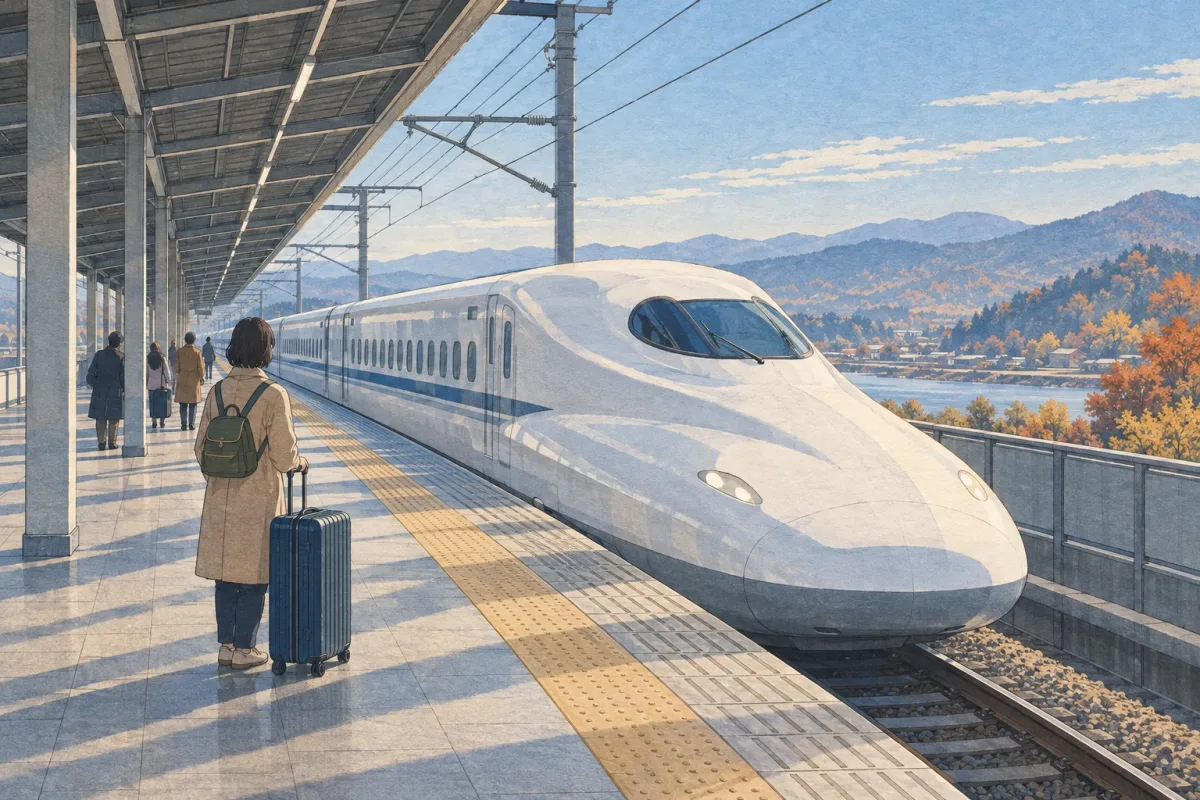
The shinkansen (bullet train) is Japan's high-speed rail network linking its major cities. There are the Hokkaido, Tohoku, Akita, Yamagata, Joetsu, Hokuriku, Tokaido, Sanyo, Kyushu and Nishi-Kyushu Shinkansen, run by the JR companies (JR Hokkaido, JR East, JR Central, JR West and JR Kyushu). You can get from Tokyo Station to Shin-Osaka Station in 2 hours 21 minutes.
To ride, you normally need two things: a basic fare ticket (jōshaken) and a limited express ticket (tokkyūken). The two are sometimes combined on a single ticket, and you can also do it all digitally by pairing an online booking with an IC card.
The big recent change for travellers is the rule on large luggage. On the Tokaido, Sanyo and Kyushu Shinkansen, which link Tokyo, Nagoya, Kyoto, Osaka, Hiroshima and Hakata, and some other lines, you need to book space for a large suitcase together with your seat. This guide covers the types of train, how to buy tickets, how to board and the luggage rules, in that order.
What's the difference between Nozomi, Hikari and Kodama?
The Tokaido and Sanyo Shinkansen run three kinds of train, the Nozomi, Hikari and Kodama, which differ in how many stations they stop at. The Nozomi makes the fewest stops and is the fastest way to reach Kyoto, Shin-Osaka and Shin-Kobe. Station departure boards show the Nozomi in yellow, the Hikari in red and the Kodama in blue.
The boards alternate between Japanese and English and list, from left to right, the train name, departure time, destination and platform. Check the board for your platform and car number. At busy times a Nozomi leaves every few minutes, and the average delay is under a minute.
JR East's lines, such as the Tohoku Shinkansen, also have trains of different speeds. The Hayabusa and Hayate on the Tohoku Shinkansen, the Komachi on the Akita Shinkansen and the Tsubasa on the Yamagata Shinkansen are all-reserved, with no non-reserved seats. The Kagayaki on the Hokuriku Shinkansen has no non-reserved seats either.
Which trains can you ride with the Japan Rail Pass?
The Japan Rail Pass (JR Pass) is a ticket for foreign visitors that gives unlimited travel on the trains of the six JR Group companies. Bought on its official website, the Ordinary Car pass costs 50,000 yen for 7 days, 80,000 yen for 14 days and 100,000 yen for 21 days, and the Green Car pass 70,000 yen for 7 days, 110,000 yen for 14 days and 140,000 yen for 21 days (adult, as of November 2026). Buy from a designated agent outside Japan and every type costs a little more, for example 53,000 yen for the 7-day Ordinary Car pass.
Watch out for the Nozomi and Mizuho on the Tokaido, Sanyo and Kyushu Shinkansen. The JR Pass alone won't get you on these two; you need a separate special ticket that only pass holders can buy. It costs 4,960 yen for Tokyo to Shin-Osaka, 4,180 yen for Tokyo to Nagoya and 6,500 yen for Tokyo to Hiroshima, and you buy one for each ride. The Hikari and Kodama can be ridden at no extra charge.
GranClass, the top class on JR East and some other lines, also needs a separate ticket even if you have a JR Pass. If you bought your pass on the official site, you can also reserve seats online before you travel.
Reserved, non-reserved or Green Car, and where do you buy shinkansen tickets?
Shinkansen seats come in three kinds: reserved seats (shiteiseki), where your seat is assigned; non-reserved seats (jiyūseki), where you take any free seat on a first-come, first-served basis; and the roomier premium Green Car. The non-reserved cars on the Tokaido Shinkansen are cars 1 and 2 on the Nozomi, cars 1 to 5 on the Hikari, and cars 1 to 6 and 13 to 16 on the Kodama (subject to change). The Nozomi becomes all-reserved in peak periods. If you want to be sure of a seat, book a reserved one.
You can buy tickets from station ticket machines or at Midori-no-Madoguchi, the JR ticket offices. Station ticket machines work in several languages. To book the Tokaido, Sanyo and Kyushu Shinkansen online, the handy option is smartEX, the booking service run by JR Central, JR West and JR Kyushu. There's no annual fee, and you need a credit card to sign up (the cardholder must be 18 or over). To board, you can choose a QR code ticket, a paper ticket collected at the station, or a registered IC card.
With smartEX, you can book 24 hours a day up to 4 minutes before departure, and with the standard product that combines the basic fare and limited express tickets, you can change your booking as many times as you like for free, as long as you haven't gone through the gate and the train hasn't left. Refunds cost a 320 yen fee before the departure time. The smartphone app is available in the US, Canada, Australia, Singapore, Hong Kong, Malaysia and Thailand; people elsewhere book through the website.
JR East's lines, such as the Tohoku, Joetsu and Hokuriku Shinkansen, can be booked through JR East's online service, JR-EAST Train Reservation. If you link the Shinkansen e-ticket you booked to an IC card such as Suica, you can ride just by tapping the card, without collecting a ticket. Each person needs their own IC card.
How do you get from the ticket gate onto the train, and can you eat on the shinkansen?
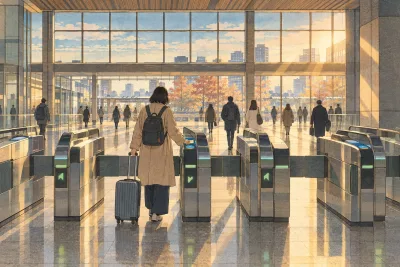
With a smartEX QR ticket, you enter by holding the QR code over the reader on the shinkansen gate. As you go through, the gate gives you a small slip called Seat Information (zaseki annai in Japanese) showing your train and seat, and the crew may ask to see it on board. If you don't have it, you may be charged the fare and the limited express charge, so don't lose it. You leave through the gate with the same QR code when you get off.
When you transfer from a conventional line (an ordinary line that isn't the shinkansen), hold up the QR code first and then tap your IC card. The conventional-line fare is taken from your IC card balance. With paper tickets, you put the basic fare ticket and the limited express ticket into the gate together, one on top of the other, and remember to take them when they come out.
If you miss your train, you can take a non-reserved seat on a later train on the same day over the same route. Large luggage is a different story, though: as explained below, you can't take it into the non-reserved cars.
Eating and drinking on board is fine. Enjoying the view over an ekiben (a boxed meal sold at stations) is recommended. There's no trolley service in the Ordinary Cars of the Tokaido Shinkansen, though, so buy food at the station before you board. JR Central asks passengers to avoid phone calls and watching videos with the sound on, and to make calls in the deck area between carriages. Smoking is banned throughout the train.
Do you need to book space for a big suitcase on the shinkansen, and how much does it cost?
On the Tokaido, Sanyo, Kyushu and Nishi-Kyushu Shinkansen, luggage size is measured as the total of its three dimensions: length, width and height. Luggage up to 160 cm can go at your feet or on the overhead rack, with no booking needed. 'Oversized baggage' of 161 to 250 cm has to go in the dedicated space behind the last row of seats, and you need to book a 'seat with oversized baggage area' when you buy your ticket. Luggage over 250 cm can't be taken on board.
A seat with oversized baggage area costs the same as an ordinary reserved seat or Green Car seat, with no extra charge. If you bring oversized baggage on board without a booking, you'll pay a 1,000 yen handling fee (tax included) and have to put the luggage where the conductor tells you. If the train is full, you'll be asked to book a different train.
A Nozomi on the Tokaido Shinkansen (a 16-car train) has 57 seats with oversized baggage area: five per car in Ordinary Cars 3 to 6 and 12 to 16, and four per car in Green Cars 8 to 10. They're the five seats in the last row (four in the Green Car), which share the space behind them.
To book, ask at a ticket office for a 'seat with oversized baggage area', or choose one at a reserved-seat ticket machine or through online booking such as smartEX. JR Pass holders can book at ticket offices or through JAPAN RAIL PASS Reservation. Pushchairs, musical instruments and sports equipment are exempt from this rule. Under JR's rules, you can bring up to two items per person free of charge, each weighing 30 kg or less with three dimensions totalling 250 cm or less (and no longer than 2 m).
What if the oversized baggage seats are sold out, and what about JR East's shinkansen?
A complaint you often hear from travellers is that every seat with oversized baggage area was sold out. These seats aren't included in smartEX's advance reservations up to a year ahead; they can be booked from the day sales open, one month before the travel date. Popular trains fill up fast, so book early.
If they're sold out, book a seat with oversized baggage area on a different train. Also, since 1 July 2025 JR West has opened the former 'oversized baggage corners' in some decks (the areas by the carriage doors) on a trial basis as 'luggage storage (no reservation required)' that anyone can use without booking. Each one only takes a single item up to 80 x 60 x 40 cm (80 x 60 x 50 cm on the upper tier), though, and you need a transport IC card to lock it.
You can also travel without your luggage. There is LUGGAGE EXPRESS, a paid service that takes bags you leave at a hotel or station and delivers them to your next hotel the same day (up to 200 cm in total dimensions). Sending large luggage ahead and riding the shinkansen with just hand luggage is one way to do it.
On the Tohoku, Hokkaido, Akita, Yamagata, Joetsu and Hokuriku Shinkansen, you don't need to book luggage space. These trains have space for large luggage, available without booking on a first-come, first-served basis. It can get crowded, though, in the ski season for example. You're asked not to put heavy or awkwardly shaped luggage on the overhead racks, as it's dangerous if it falls.
Tips
- On the Tokaido, Sanyo, Kyushu and Nishi-Kyushu Shinkansen, if your suitcase's three dimensions add up to more than 160 cm, always book a 'seat with oversized baggage area'. Without one you'll pay 1,000 yen, and if the train is full you'll be asked to take a different one (as of November 2026).
- Seats with oversized baggage area can be booked from one month before the travel date. Once your plans are fixed, booking on the day they go on sale is the surest bet.
- The JR Pass alone won't get you on the Nozomi or Mizuho. Either buy the special ticket (4,960 yen for Tokyo to Shin-Osaka) or take the Hikari or Kodama, which cost nothing extra.
- There's no trolley service in the Ordinary Cars of the Tokaido Shinkansen, so buy your ekiben and drinks at the station before boarding. If you want to see Mount Fuji, JR Central recommends seat E in the Ordinary Car and seat D in the Green Car.
- If you miss your train, you can take a non-reserved seat on a later train the same day, but oversized baggage isn't allowed in the non-reserved cars. If you have large luggage, change your booking before you board.
Sources
- Luggage information | Central Japan Railway Company (opens in a new tab)
- Shinkansen Perfect Guide: Tickets & Tips | Golden Route with the Shinkansen (JR Central) (opens in a new tab)
- Tokaido Sanyo Kyushu Shinkansen Internet Reservation Service (smartEX): key points and registration (opens in a new tab)
- Taking Baggage Onboard | smartEX (opens in a new tab)
- smartEX Service | smartEX (opens in a new tab)
- Reception Times/Time-Periods | smartEX (opens in a new tab)
- Boarding with QR-Ticket | smartEX (opens in a new tab)
- Boarding with an IC card | smartEX (opens in a new tab)
- Oversized Luggage | West Japan Railway Company (opens in a new tab)
- 新幹線への「特大荷物」の持ち込みについて | 新幹線のサービス:JRおでかけネット (opens in a new tab)
- Oversized Luggage Guide | JR-EAST (opens in a new tab)
- Shinkansen e-ticket / Express train e-ticket | JR-EAST (opens in a new tab)
- Use on the Shinkansen (Touch de Go! Shinkansen) | Welcome Suica Mobile | JR-EAST (opens in a new tab)
- Types and prices | JAPAN RAIL PASS (opens in a new tab)
- Use of NOZOMI/MIZUHO trains | JAPAN RAIL PASS (opens in a new tab)
- About JAPAN RAIL PASS | JAPAN RAIL PASS (opens in a new tab)
- Oversized baggage | JAPAN RAIL PASS (opens in a new tab)
- Shinkansen (Bullet Train) | Travel Japan - Japan National Tourism Organization (Official Site) (opens in a new tab)