Japan is Nippon
What Is Suica, and How Do Travellers Use It in Japan? Cards, Top-ups and Area Limits
Suica is a prepaid IC card from JR East that you top up and tap at the ticket gate to ride trains and buses, and you can pay with it at convenience stores too. Short-term visitors can get a Welcome Suica with no deposit (valid for 28 days, balance not refunded), but it can't be used for journeys tha
The short answer
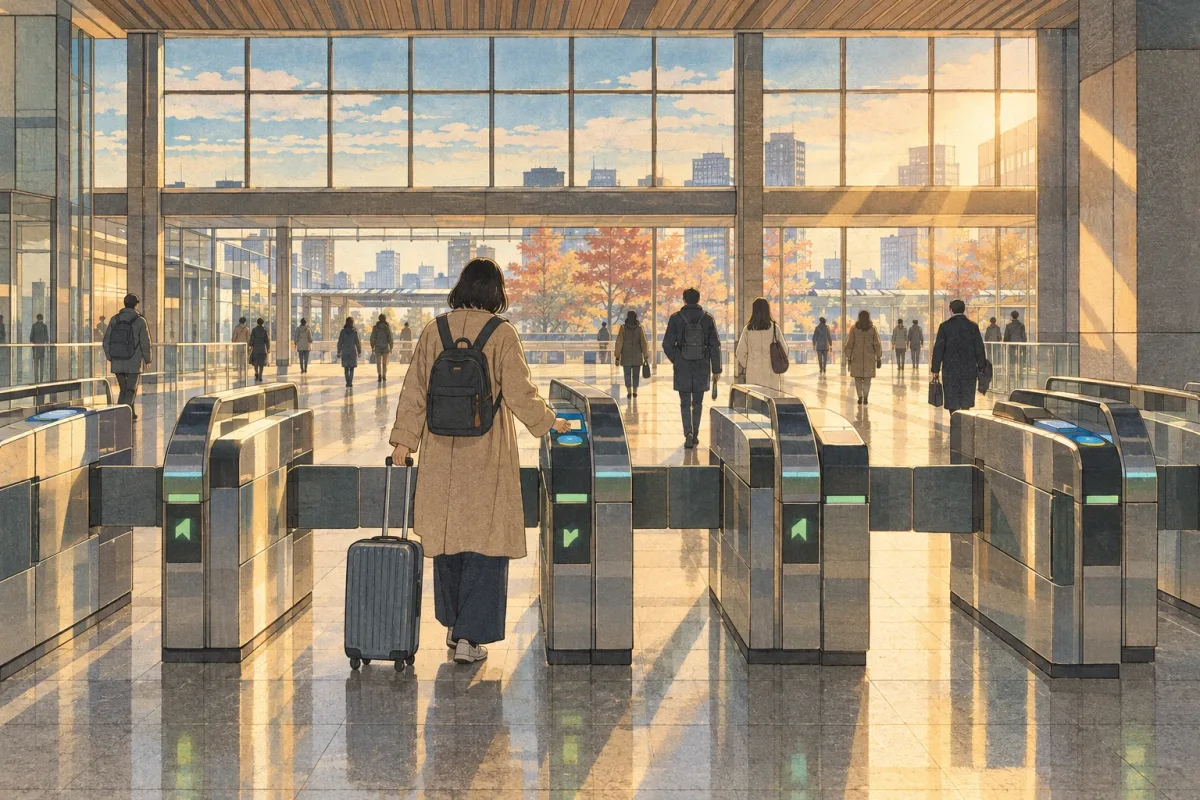
Suica is a transport IC card issued by JR East (East Japan Railway Company, which runs the JR lines in eastern Japan, Tokyo included). Suica is prepaid electronic money: you load money onto it in advance. Tap it on the reader at the station ticket gate, and when you get off, the fare is worked out automatically and taken from your balance. There's no need to buy a ticket from a machine every time you ride.
Suica isn't just for trains: it also works on subways, buses and monorails. You can pay with it at convenience stores, restaurants, vending machines and station coin lockers too, so you'll spend a lot less of your trip counting out coins.
There are three things travellers tend to trip over. First, there are lots of different cards, and the differences aren't obvious. Second, you can't use them for journeys that cross from one IC card area into another. Third, on the shinkansen (bullet train) and limited express trains, tapping your Suica often isn't enough to ride. This guide goes through all three in turn.
What's the difference between Suica, PASMO and ICOCA, and do they work everywhere?
Japan's transport IC cards are issued by different companies in different regions. Suica comes from JR East; PASMO from PASMO Co., Ltd., whose members include private railways, subways and bus companies in the Greater Tokyo area; ICOCA from JR West (the JR company for Kansai, the Chugoku region and elsewhere); and TOICA from JR Central (the company that runs the JR lines around Nagoya and Shizuoka and the Tokaido Shinkansen).
Ten cards (PASMO, Suica, Kitaca, TOICA, manaca, ICOCA, PiTaPa, Hayakaken, nimoca and SUGOCA) are linked through a scheme called zenkoku sōgo riyō, 'nationwide interoperability'. On trains and buses and in shops that show the matching logo, any of the ten will work. A Suica bought in Tokyo, for example, will also get you onto trains in Osaka.
Being usable on railways and buses nationwide doesn't mean they work on every line in Japan, though. PiTaPa (a pay-later card from Kansai) also isn't part of the nationwide scheme for electronic money, and Welcome Suica can't be used in shops in the PiTaPa area.
Besides the Greater Tokyo area, Suica can be used in the Sendai, Niigata, Aomori, Morioka and Akita areas, and on some transport in Hokkaido, the Tokai region, western Japan, Kyushu and Okinawa.
Which card should travellers buy?
For short-term visitors, JR East offers Welcome Suica. There's no deposit to pay when you buy it, and it's valid for 28 days including the day of purchase. From the 29th day it stops working. Note that the 'GOOD THRU' date on the back of the card is not the expiry date. The expiry date and other details are printed on a slip called the reference paper (sankōken) that you get when you buy the card, and you're asked to carry it with you during your trip.
You can buy Welcome Suica from dedicated ticket machines at Narita Airport Terminal 1 Station, Narita Airport Terminal 2·3 Station and Haneda Airport Terminal 3 Station (Tokyo Monorail), or at places such as the JR EAST Travel Service Center (at the Narita and Haneda airport stations and at Tokyo, Shibuya, Shinjuku, Ikebukuro, Ueno, Yokohama and Sendai stations). Sales are temporarily suspended at some station counters (as of November 2026). There are six types from 1,000 yen to 10,000 yen, and as a rule it's one card per person. The child version can be used until the first 31 March after the child's 12th birthday, and you need the child's passport or other ID to buy one.
PASMO Co., Ltd. also sells TOURIST PASMO for foreign visitors. There's no deposit, it's valid for 28 days from the date of purchase, and the balance isn't refunded. At Haneda Airport (Keikyu's Terminal 1·2 Station and Terminal 3 Station) it comes in six types from 1,000 yen to 10,000 yen, and at Narita Airport (the information centres at Keisei's Terminal 1 Station and Terminal 2 Station) a 2,000 yen version is sold.
If you're flying into a Kansai airport, there's also JR West's ICOCA for travellers. It costs 2,000 yen (including a 500 yen deposit) and is sold at the JR ticket office (Midori-no-Madoguchi) at Kansai Airport Station. Only people who hold a passport issued by a government other than Japan's and have the residence status 'Temporary Visitor' can buy it. A regular Suica card, by contrast, needs a 500 yen deposit when you buy it, and you get the deposit back when you return the card.
Can you use Suica on an iPhone or Android phone?
With an iPhone, you can ride using just your phone, without buying a card. You can create a new Suica, PASMO or ICOCA in the iPhone's Wallet app, or transfer a card you already have. You need an Apple Account with two-factor authentication and a supported model such as iPhone 8 or later (iPhone 7 or later for Suica). You can top up with a credit card or similar that you've added to Wallet.
The first transit card you add has Express Mode switched on automatically, so you can go through the gates without unlocking your iPhone or opening an app. You don't need a signal at the gate, but the iPhone does need to be switched on. Also note that one transit card can only be on one device at a time, and once you transfer a physical card to your iPhone, the original card stops working.
JR East also has an iPhone app for travellers, Welcome Suica Mobile. A Suica issued in this app needs no deposit, has a maximum balance of 20,000 yen and is valid for 180 days from issue. When it expires, the balance is lost and not refunded. Since the app launched in March 2025 you've been able to issue and top up a Suica in it before you arrive in Japan. Location services must be switched on, however, and issuing and topping up are restricted in some countries; if that happens, try again after you arrive in Japan.
Android phones bought outside Japan are, for now, hard to use. Android devices bought overseas generally don't support Mobile PASMO. On 21 April 2026 JR East announced a plan to make Welcome Suica Mobile work on Samsung Galaxy phones, but it's scheduled to start in the first half of 2027. If you have an Android phone bought abroad, a physical card is the safe choice as of November 2026.
Where do you top up Suica, and what happens if your balance runs short?
You can top up Suica with cash at station ticket machines, multi-function ticket machines and fare adjustment machines (seisanki, machines for paying a fare shortfall). A regular Suica card can be topped up in units of 500, 1,000, 2,000, 3,000, 5,000 and 10,000 yen, and the maximum balance is 20,000 yen. You can't top up a physical Suica card with a credit card.
Welcome Suica can also be topped up to a maximum of 20,000 yen at ticket machines and fare adjustment machines that show the Welcome Suica mark. You can also top up at Seven Bank ATMs in convenience stores, or ask the staff at a convenience store till to do it. Whichever way you choose, only Japanese yen in cash can be used to top up.
If your balance doesn't cover the fare, the gate at your destination closes and you can't get out. You then top up at a fare adjustment machine inside the gates and tap the gate again. If a gate stops you, don't panic: check your balance first, then look for a fare adjustment machine.
When shopping, tell the cashier 'Suica de' ('with Suica') and tap the reader, and you've paid. Welcome Suica can be used for on-board sales, vending machines, coin lockers, convenience stores, restaurants and more, and at coin lockers the card even works as the key. You can't combine it with cash to pay, however.
What happens if you ride across IC card areas, and what should you do when you get off?
This is where travellers trip up most. Nationwide interoperability means one Suica will get you on trains all over Japan, but only within each area. Suica can only be used within each area, and you can't travel from one area into another with it. Travelling from the Greater Tokyo area to the Sendai area is one example.
With Welcome Suica, once you start a journey in one area you have to finish it in the same area. When you move to a different area, leave through the ticket gates and enter again. For journeys that pass through several areas, buy a ticket in advance.
If you accidentally cross into another area, don't try to force your way through the gate at your destination; speak to a member of station staff. With Welcome Suica, you show your Welcome Suica and reference paper to staff at the station where you arrive, they work out the total fare, and you pay that amount in cash. Likewise, TOICA users who have travelled into another area should tell the train crew or station staff at their destination.
There are limits even within one area. Within the ICOCA area, with some exceptions, you can't use ICOCA for journeys of more than 200 km in eigyō kiro (operating kilometres, the distance fares are calculated on). For long journeys, or trips near the edge of an area, buying a ticket is the safer option.
Can you ride the shinkansen with Suica, and do you get your balance back when you leave Japan?
When you ride a limited express or express train with Suica, or use the Green Car (the premium-class carriage), you need to buy a limited express ticket or similar separately. Think of tapping an IC card as paying only the fare for an ordinary train. Nor can you ride the shinkansen with ICOCA alone.
The exception is Touch de Go! Shinkansen in the JR East area, which lets you ride in the non-reserved seats of the shinkansen just by tapping Suica or a similar card. With Welcome Suica Mobile it works with no prior registration from the day you issue the card, on JR East sections of the Tohoku, Joetsu and Hokuriku Shinkansen and others. However, the Hayabusa, Hayate, Komachi and Tsubasa are all-reserved, so they have no non-reserved seats. If you want a reserved seat, you can link a Shinkansen e-ticket bought through JR East's online booking to your IC card. On the Tokaido, Sanyo and Kyushu Shinkansen, you can register your IC card with the booking service smartEX and ride that way (a separate guide explains how to ride the shinkansen in detail).
What happens when you go home depends on the card. If you return a regular Suica card at a JR East station, you get back your balance minus a 220 yen fee, plus the 500 yen deposit. With a balance of 1,000 yen, for example, you'd get back 1,280 yen. Welcome Suica and TOURIST PASMO, on the other hand, don't refund the balance, however much is left. JR East says it hopes you'll take the card home as a souvenir of your trip.
Through 2026, features for travellers have been added bit by bit. Welcome Suica Mobile added ticketless travel in reserved seats on the shinkansen and conventional limited express trains in October 2025, and from March 2026 it became possible to buy a Suica Green Ticket, used to ride the Green Cars of ordinary trains in the Greater Tokyo area.
Tips
- For a short trip, Welcome Suica is the easy choice. There's no deposit, but it stops working after 28 days and the balance isn't refunded, so only top up what you'll use (as of November 2026).
- You can't use Suica for journeys that cross IC card areas, such as from the Greater Tokyo area to the Sendai area. Buy a ticket in advance, and if you board by mistake, tell the station staff where you get off.
- If the gate closes on you at your destination, it's usually because your balance is too low. Top up at the fare adjustment machine inside the gates, tap again, and you'll be let out.
- On the shinkansen, limited express trains and Green Cars, you need a limited express ticket or similar on top of Suica. For non-reserved seats on JR East's shinkansen, you can ride with Welcome Suica Mobile's Touch de Go! Shinkansen.
- On an iPhone you can put Suica on your phone with the Wallet app or Welcome Suica Mobile, but Android phones bought abroad are mostly unsupported as of November 2026. If that's you, buy a card.
Sources
- Suica | JR-EAST (opens in a new tab)
- What's a Suica (IC Card)? | JR-EAST (opens in a new tab)
- Welcome Suica | JR-EAST (opens in a new tab)
- Welcome Suica (Purchasing and Using) | JR-EAST (opens in a new tab)
- Welcome Suica (for Short-term Use) leaflet | JR-EAST (opens in a new tab)
- Welcome Suica Mobile | JR-EAST (opens in a new tab)
- Use on the Shinkansen (Touch de Go! Shinkansen) | Welcome Suica Mobile | JR-EAST (opens in a new tab)
- Rules for the Use of Welcome Suica Mobile | JR-EAST (opens in a new tab)
- Procedures | Welcome Suica Mobile | JR-EAST (opens in a new tab)
- Partnership between Welcome Suica Mobile, Mobile Suica and Samsung (JR East press release, April 21, 2026) (opens in a new tab)
- Shinkansen e-ticket / Express train e-ticket | JR-EAST (opens in a new tab)
- What is PASMO? | PASMO (opens in a new tab)
- Use TOURIST PASMO | PASMO (opens in a new tab)
- ICOCA - How to use JR-West (opens in a new tab)
- Usage Area - How to use JR-West (opens in a new tab)
- Tokai IC Card (TOICA) | Central Japan Railway Company (opens in a new tab)
- Add a transit card to Apple Wallet in Japan - Apple Support (opens in a new tab)
- Use transit cards on your iPhone or Apple Watch in Japan - Apple Support (opens in a new tab)
- IC Travel Cards | Travel Japan | JNTO (opens in a new tab)