Japan is Nippon
How Do You Watch a Pro Baseball Game in Japan? Tickets and Ballpark Rules
Japan's pro baseball league (NPB) has 12 teams in two leagues, and the 2027 season opens on Friday 26 March. Buy tickets on each team's official website, through ticket agencies or even at convenience stores, and check your ballpark's rules on what you can bring and how you can cheer before you go.
The short answer
Professional baseball in Japan is run by NPB (Nippon Professional Baseball), and its 12 teams are split six and six between the Central League (Se League) and the Pacific League (Pa League). The Central League is the Hanshin Tigers, Yokohama DeNA BayStars, Yomiuri Giants (often just called Kyojin), Chunichi Dragons, Hiroshima Toyo Carp and Tokyo Yakult Swallows. The Pacific League is the Fukuoka SoftBank Hawks, Hokkaido Nippon-Ham Fighters, ORIX Buffaloes, Tohoku Rakuten Golden Eagles, Saitama Seibu Lions and Chiba Lotte Marines.
Their home grounds are spread from Hokkaido to Kyushu. The Giants play at Tokyo Dome, the Tigers at Hanshin Koshien Stadium in Nishinomiya, Hyogo Prefecture, the Fighters at ES CON FIELD HOKKAIDO in Kitahiroshima, Hokkaido, and the Hawks at MIZUHO PayPay Dome FUKUOKA, for example. If there is a team where you are travelling, fitting a game in between the sightseeing is entirely realistic.
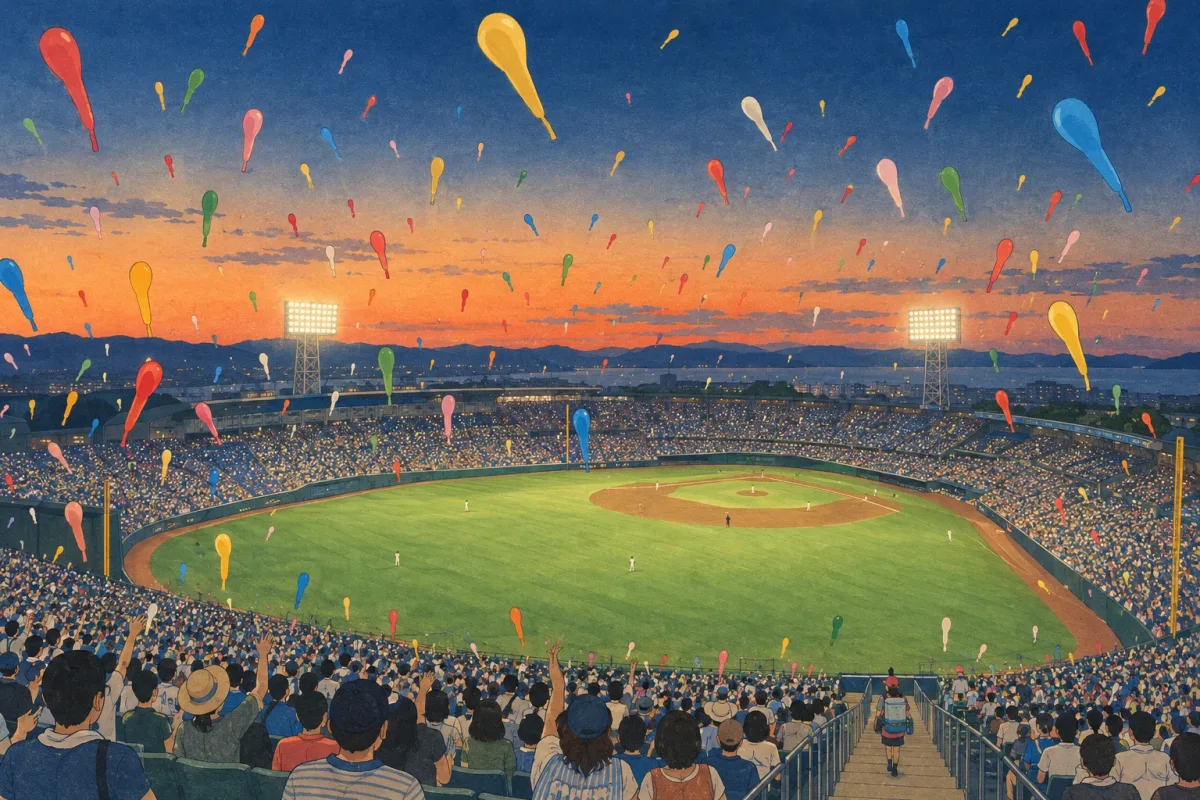
What makes watching baseball in Japan such fun is that on top of the game itself, the whole stand turns into one big event: nonstop cheering led by the ōendan (cheering squads) in the outfield seats, a cheering song for each player, balloons released in the seventh inning, and vendors who come right to your seat selling drinks. Even if you don't understand the language, the atmosphere alone is plenty.
When is the 2027 Japanese baseball season?
In the 2027 schedule NPB announced in November 2026, both the Central and Pacific Leagues open on Friday 26 March. The opening series are Giants v Dragons, DeNA v Yakult and Tigers v Carp in the Central League, and Fighters v ORIX, Lotte v Seibu and SoftBank v Rakuten in the Pacific League.
Each team plays 143 regular-season games: 125 against the other five teams in its own league, 25 against each, plus 18 interleague games, 3 against each of the six teams in the other league. Interleague play in 2027 starts on Tuesday 1 June, with 108 games in total.
In 2027, regular-season games run from late March to early October. From 9 October comes the Climax Series (CS, the playoffs between the top teams that decide who goes to the Japan Series), and from 23 October the Japan Series, where the champions of the two leagues fight for the national title. In other words, the window for watching a game is roughly the six-plus months from spring to autumn.
Incidentally, the Tigers' opening series in 2027 is scheduled for Kyocera Dome Osaka rather than Koshien. At the same time of year, Koshien hosts the spring high school baseball tournament (Senbatsu) from 19 March.
Where can you buy baseball tickets in Japan?
The basic route is each team's official website. Tickets are sold by the organising team (the home team), so once you have picked a game, check the website of that game's home team. Tickets for the Hokkaido Nippon-Ham Fighters, for example, can be bought through their official ticket site 'F-Chike' and Lawson Ticket, as well as at the in-store terminals in Lawson convenience stores and at the Fighters' official shops. Being able to buy tickets at a Japanese convenience store may come as a bit of a surprise to travellers.
Sometimes you can buy at the ballpark's ticket window. At Tokyo Dome, advance tickets for Giants regular-season and pre-season games are also sold at the Tokyo Dome ticket counter, up to eight per person per game, and when buying you need to show a GIANTS ID or membership card, or write down your name and contact details. Depending on sales through the ticket agencies, though, there may be no advance tickets at the window. For visitors from overseas, there is the Giants' official English site.
Watch out for popular games selling out. For the 2026 Japan Series, NPB pointed overseas fans to a sales page (Lawson Ticket) on its English site. Information during the season is updated on each team's website, so it is a good idea to check early once your itinerary is set.
Stay away from unofficial ticket resales. The Spectator Agreement shared by all 12 teams bans resale without the organiser's permission. Tickets for Giants home games are covered by Japan's law against unauthorised ticket resale, and breaking it can bring criminal penalties. The Fighters refuse entry to anyone with a ticket obtained other than through the official resale service or an authorised resale service.
What is different about watching baseball in Japan?
The biggest difference is the cheering. In the outfield seats there are licensed ōendan (cheering squads) that lead the cheering for the whole game. At Hanshin Koshien Stadium, cheering by authorised cheering squads is permitted in the outfield seats. Under ES CON FIELD's rules, ordinary spectators may not cheer with instruments such as trumpets and drums or lead the crowd in group cheering; that is left to cheering squads authorised under rules shared by all 12 teams. Each player has a cheering song, which the Tigers call 'hitting marches' and the Fighters 'player cheering songs'.
Remember too that the cheering sections are separate. At Tigers home games, the right-field outfield seats at Koshien are the 'Hanshin Tigers cheering seats', where cheering for any other team or wearing another team's caps or clothing is banned. On the other side, the left field has 'visitor cheering seats', where you may not cheer for anyone but the visitors, the Tigers included. Break the rules and you can be ejected, in which case your ticket is not refunded. ES CON FIELD has similar home and visitor cheering areas.
Then there are the famous 'jet balloons': long, thin balloons that everyone blows up in advance and releases into the sky together before the seventh-inning at-bats. The 'Lucky Seven' balloon release before the bottom of the seventh resumed at Koshien from the 2026 season. The condition is that you use the team's designated balloons and inflate them with the special pump that comes with them; blowing them up by mouth is banned. Balloons are not allowed, on the other hand, at Kyocera Dome Osaka, which the Tigers also use, or at the Fighters' ES CON FIELD.
Uriko (stand vendors) walking up and down the stands are another very Japanese ballpark sight. At Tokyo Dome, a draught beer from the vendors who come to your seat is 1,000 yen, a sour or chūhai (a fizzy alcoholic drink) is 750 yen, and a soft drink is 400 yen (as of November 2026). Tokyo Dome asks you not to photograph or film the vendors or give them presents.
What can't you bring into a Japanese ballpark?
At most ballparks you cannot bring in cans or bottles. Hanshin Koshien Stadium checks everyone's bags at the entrance and bans cans and bottles, dangerous items such as fireworks, and pets (except guide dogs and hearing dogs). There is no service to pour drinks from cans or bottles into paper cups for you, either.
At Tokyo Dome, besides bottles and cans, frozen plastic bottles, plastic bottles over 1,000 ml and alcoholic drinks are also banned. Inside Tokyo Dome everything is fully cashless, so cash cannot be used, and the whole dome is non-smoking. Have a card or a transport IC card ready.
The strictest is ES CON FIELD HOKKAIDO, where, on top of bottles, cans and plastic bottles, bringing in any food or drink is banned in principle (exceptions include snacks for children, allergy-friendly meals and your own refillable bottle). Flags, banners and instruments are not allowed in except by authorised cheering squads, and cheering boards must be no larger than 60 cm on each side.
There's more: at Koshien you cannot re-enter once you leave, and there are no lockers, no left-luggage counter and no car park. ES CON FIELD, on the other hand, lets you re-enter as long as you have your ticket. The rules really do vary from one Japanese ballpark to another, so always check the official website of the one you are going to.
What are Koshien Stadium and Tokyo Dome like?
Hanshin Koshien Stadium, built in 1924 (the 13th year of the Taisho era), is Japan's oldest full-scale baseball stadium. It has 47,359 seats. It is famous for the ivy covering its outer walls, which was planted in December of the year it was completed to turn the bare concrete walls green. The big stands between the infield and outfield are called the 'Alps Stand', a name said to come from the caption 'It's an Alps stand' that accompanied an illustration printed in a newspaper.
Koshien is both the home of the Hanshin Tigers and the spiritual home of high school baseball. In August 1924 the 10th National Middle School Baseball Championship (the forerunner of today's summer Koshien tournament) was held at the stadium for the first time, and curry rice and bento (boxed meals) were already on sale then. At Tigers games, the gates open about two hours before the first pitch.
Tokyo Dome, home of the Giants, opened in 1988 as Japan's first all-weather multipurpose stadium. It holds about 43,500 people for baseball. Its roof is an 'air-supported dome', a membrane held up by air pressure: the air pressure inside is kept 0.3% higher than outside to lift the roof. Because it has a roof, there is less need to worry about rain, which is good news for travellers.
Can you go and watch high school baseball in Japan?
Yes, you can. Koshien hosts national high school baseball tournaments every spring and summer. The 99th National High School Baseball Invitational Tournament (Senbatsu) in spring 2027 is scheduled to run for 13 days from Friday 19 March 2027 at Hanshin Koshien Stadium. The selection committee that picks the participating schools meets on 29 January.
The summer National High School Baseball Championship was held at Koshien for 18 days from 5 to 22 August in 2026. The schools that take part are the representatives that won their regional tournaments.
Ticket information is announced for each tournament on special pages run by the Japan High School Baseball Federation and Koshien Stadium, so check before you go.
Tips
- Look for tickets on the official website of the home team for the game you want to see. The 2027 season opens on Friday 26 March.
- Mind the cheering sections. In Koshien's right-field outfield seats, cheering for anyone but the Tigers or wearing other teams' merchandise is banned, so fans of the visiting team should choose the visitor cheering seats in left field.
- Cans and bottles are banned at almost every ballpark. At ES CON FIELD, bringing in food and drink at all is banned in principle, so go planning to enjoy the ballpark food.
- Inside Tokyo Dome everything is cashless. Have a credit card or a transport IC card ready.
- Buy tickets from official websites or official resale services. You may be refused entry with tickets from unofficial resellers.
Sources
- 2027年度 JERA セントラル・リーグ選手権試合 日程発表 | NPB.jp 日本野球機構 (opens in a new tab)
- 2027年度 パーソル パシフィック・リーグ選手権試合日程発表 | NPB.jp 日本野球機構 (opens in a new tab)
- 2027年度セ・パ交流戦試合日程発表 | NPB.jp 日本野球機構 (opens in a new tab)
- 2027年 試合日程(3月) | NPB.jp 日本野球機構 (opens in a new tab)
- 2027年 試合日程(10月) | NPB.jp 日本野球機構 (opens in a new tab)
- Teams | Nippon Professional Baseball Organization (opens in a new tab)
- Nippon Professional Baseball Organization (English) (opens in a new tab)
- これまでの歩み | 阪神甲子園球場 (opens in a new tab)
- よくあるご質問(甲子園球場について) | 阪神甲子園球場 (opens in a new tab)
- ご来場・ご観戦時のお願い | 阪神甲子園球場 (opens in a new tab)
- 観戦マナー | 阪神タイガース公式サイト (opens in a new tab)
- 阪神甲子園球場「ラッキーセブン」のジェット風船演出についてご注意とご協力のお願い | 阪神タイガース公式サイト (opens in a new tab)
- 東京ドームとは | 東京ドーム (opens in a new tab)
- チケット購入方法 | 東京ドーム (opens in a new tab)
- 売り子 | 東京ドーム (opens in a new tab)
- イベント来場時のお願い | 東京ドーム (opens in a new tab)
- チケット購入方法 | 北海道日本ハムファイターズ (opens in a new tab)
- 持ち込み・応援のルール | 北海道日本ハムファイターズ (opens in a new tab)
- 公益財団法人 日本高等学校野球連盟 (opens in a new tab)