Why Are Japanese Houses Rebuilt Instead of Renovated?
A wooden house over 20 years old is often treated as having a building worth zero. Earthquakes, building codes and an unusual used-home market explain why.
The short answer
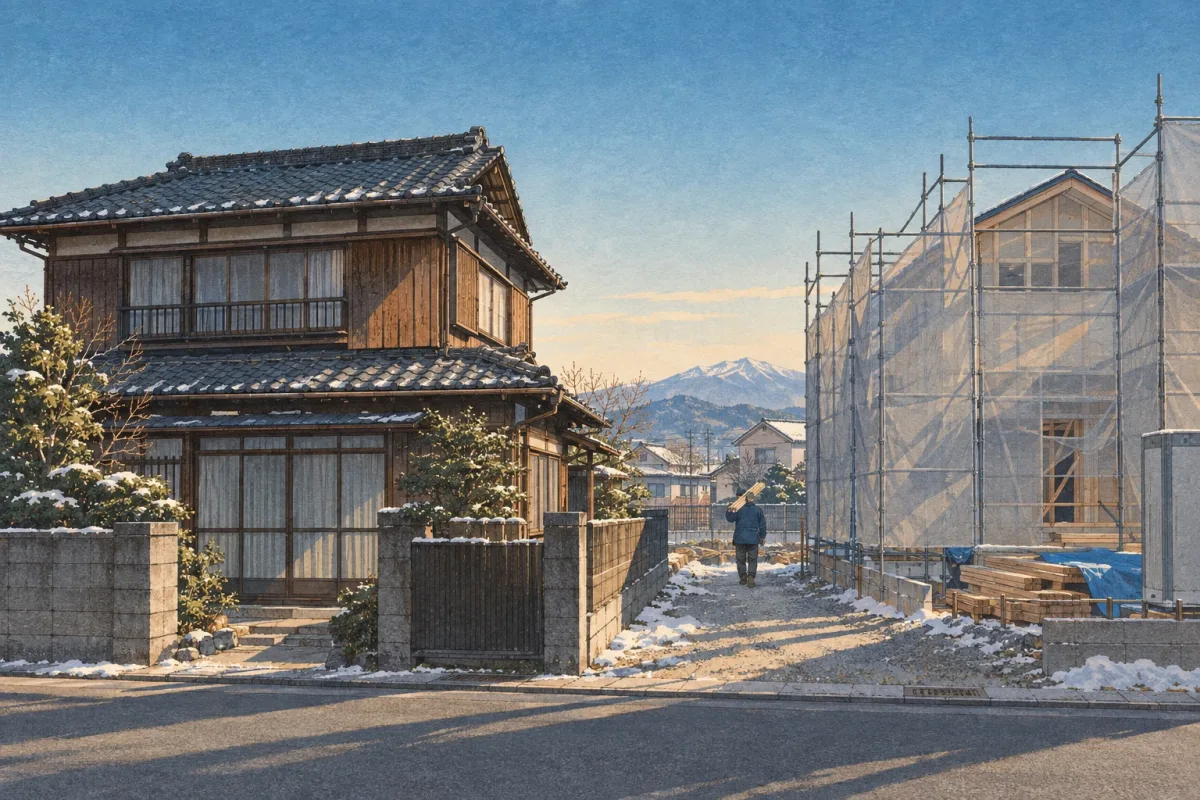
In Japan there is a long-standing practice of treating the building part of a wooden detached house as worth almost nothing once it is about 20 to 25 years old, so when people buy or sell a home they tend to think "the value is in the land". On top of that, earthquake-resistance standards have been tightened after each major quake, and people often decide that rebuilding an old house is safer than fixing it.
Recently, though, with a push from the government, more second-hand homes are being bought and sold and renovated, and the "lifespan" of a house is getting longer.
Houses used to be lived in for a short time
According to the Ministry of Land, Infrastructure, Transport and Tourism's (MLIT) white paper for fiscal 2009, houses that were demolished had stood for about 30 years on average, which it described as short compared with countries such as the United States. The white paper pointed out that tearing down a home bought at great expense after only a short time makes housing costs per year heavier, and adds demolition costs on top.
On the other hand, the Cabinet Office's Annual Report on the Japanese Economy and Public Finance for fiscal 2024 finds that the average age of demolished houses has been rising over the long term since the early 2000s. The idea that "Japanese houses are rebuilt every 30 years" is gradually becoming a thing of the past.
The custom that "a building is worth zero after 20 years"
One big reason rebuilding is so often chosen is the way second-hand homes are valued. MLIT documents explain that on the resale market, detached houses lose value uniformly with age, and there is a custom by which their market value reaches zero at around 20 to 25 years. They also note that renovating does not change how fast the value falls, and that in some cases the building even counts against the property.
The Cabinet Office's white paper also points out that, because sellers and buyers know different amounts about the quality of a building (information asymmetry) and because a home's performance is hard to judge, there is a custom of valuing the building at zero early on, especially for wooden detached houses. If upkeep is not rewarded, people have little reason to spend money maintaining a house. MLIT describes this as "a vicious circle in which there is no incentive to carry out maintenance or renovation".
The Cabinet Office white paper looks at the price of a used home as two parts, "land" and "building". Leaving aside changes in land prices, the land does not lose value with age, but the building loses value year by year, and once the building is treated as worth next to nothing, the home's price bottoms out at the value of the land alone. That is why it is so common for an old house to be sold, still standing, for what is in effect the price of the land, and for the buyer to knock it down and build a new one.
This way of valuing homes is changing too. The Cabinet Office's analysis found that the number of years before used condominium prices stop falling grew by nearly 10 years between 2013 and 2022, and the pace of decline eased from about 5% a year to about 3.5%. For used detached houses too, the age at which prices stop falling is said to be rising year after year. MLIT has also been revising valuation methods so that foundations and structural frames can be given a useful life longer than 20 years depending on their performance, and so that proper repairs restore value.
Earthquakes and stricter building standards
A factor particular to Japan is earthquakes. The earthquake-resistance standards in the Building Standards Act were overhauled in June 1981, and buildings designed to the rules after that are said to meet the "new earthquake-resistance standards". A report on the 2016 Kumamoto earthquakes compiled by a government committee found that wooden buildings built to the older standards collapsed at a markedly higher rate than those built to the new standards or later.
The same report found that among buildings meeting the new standards, wooden houses built from 2000 onwards, after the specifications for the joints connecting posts, beams and so on were made clearer, had a lower collapse rate. MLIT calls for buildings built to the old standards to be seismically retrofitted or rebuilt. Its documents estimate that there are about 9 million homes nationwide without adequate earthquake resistance, and state that "rebuilding to improve earthquake resistance is important, not just retrofitting". This is why, with an old house, some families compare the cost of strengthening it with the cost of rebuilding and choose to rebuild.
The Kumamoto earthquake report also found that even in the heavily damaged centre of Mashiki town, wooden houses rated "seismic grade 3", the highest grade under the Housing Performance Indication System, showed no major damage, and most were undamaged. In a country with many earthquakes, a home being "new" is easily linked with it being safe.
Used homes make up a far smaller share than in Europe and the US
According to MLIT documents, second-hand homes made up about 14.7% of all homes changing hands, new and used combined, as of 2013. In Western countries the figure is said to be about 70 to 90%, so Japan's level was about a fifth to a sixth of that. Renovation also accounted for only 28.5% of housing investment, which was described as small compared with Europe and the US.
The Cabinet Office white paper finds that although the share of people buying used homes has been rising in recent years, it is about 30% at most even by a generous estimate, below the level of the major developed countries (70% or more).
According to the white paper, more people are buying used homes because new homes have become more expensive, partly due to rising construction costs, and more people, especially those raising children, are choosing used homes as a more affordable option. MLIT's fiscal 2009 white paper had pointed out that the number of homes has consistently exceeded the number of households since the late 1960s. Now that Japan has gone from a time when homes were "in short supply" to one when there are "too many", there is growing pressure to rethink the cycle of building and demolishing.
Japanese housing is changing
The Ministry of Internal Affairs and Communications' 2023 Housing and Land Survey counted 9,002,000 akiya (empty homes), the highest number ever, and they made up 13.8% of all homes, also a record. With homes now in surplus, the government has set the policy goal of shifting to a society that "builds good homes, looks after them properly and uses them for a long time".
In practice, this has meant setting up "inspections" (building condition surveys) in which experts check the state of a building, a "long-life quality housing" scheme that certifies homes built to last, and insurance that covers defects in used homes. According to the Cabinet Office white paper, orders for home renovation have been on an upward trend since fiscal 2021 and reached about 4 trillion yen in fiscal 2023. MLIT documents also note that more people want to choose an existing home or are not set on a new one. "Renovation" in the sense of buying an old house and remodelling it to your own taste is becoming a familiar option too, especially among younger people.
Tips
- When buying or renting a used detached house, check whether it was built to the "new earthquake-resistance standards" introduced in June 1981. The date of the building confirmation (building permit) is a good guide.
- For a wooden house, another point to check is whether it was built in 2000 or later, when the specifications for joints were made clearer.
- Before buying a used home, ask for an inspection (building condition survey) to reveal hidden wear and defects.
- Older properties give the building a low value, and some are sold for close to the price of the land. Factor in the cost of earthquake strengthening when you weigh them up.
- In rural areas where empty homes are increasing, you may be able to find a cheap place to live through the local authority's akiya bank (a listing of empty houses).