Why Do Japanese People Bow, and How Low Should You Go?
A bow does greeting, thanks and apology in one movement. As a traveller, a simple light nod of the upper body is enough to get your feelings across.
The short answer
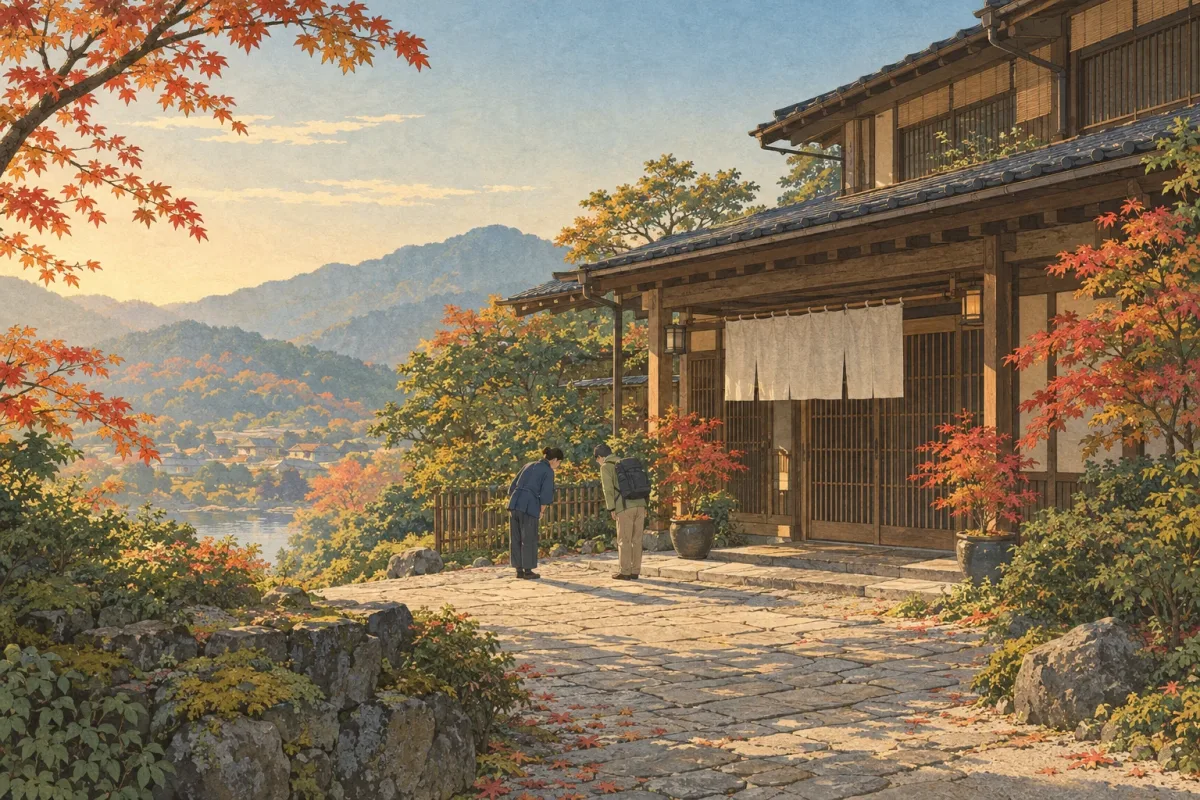
Ojigi (bowing) is how people in Japan say "hello", "thank you" and "sorry" with their body. What makes it distinctive is that the depth of the bow shows how strongly you mean it, and in business settings three levels are commonly described as a guide: about 15 degrees, about 30 degrees and about 45 degrees.
That said, travellers do not need to get the angles exactly right. If you can manage an eshaku, a light bow where you simply tilt your upper body a little, you will come across as perfectly polite in almost every everyday situation.
Where bowing came from
There are several theories about its origin. A commonly given explanation is that it began as a way of showing "I mean you no harm" by offering your head, a vulnerable spot, to the other person. According to an explainer on nippon.com, the custom came from China before the Nara period (8th century), and in the Middle Ages it was shaped into form as part of the etiquette of the buke (samurai households).
After the samurai took power with the Kamakura shogunate, samurai etiquette became more refined, and in the Muromachi period schools of etiquette arose, such as the Imagawa, Ise and Ogasawara schools. Of these, the Ogasawara school is still often named today as the classic model of bowing etiquette. In the Edo period further schools such as the Takeda and Kira schools were added. Incidentally, the word ojigi is said to have taken on its present meaning of "a greeting made by lowering the head" only in the late Edo period.
In the Meiji era, Western culture flooded in and samurai culture was quickly looked down on. The Ogasawara school, once samurai etiquette, shifted its role to girls' education (teaching manners to women). Even so, bowing itself did not disappear, and in 1941 the Ministry of Education of the time compiled the "Reiho Yoko" (Essentials of Etiquette), setting a standard for the manners taught across the country. In this way bowing spread from a samurai practice to an everyday greeting for the whole nation.
Angles as a guide: eshaku, keirei and saikeirei
Today's standing bow (ritsurei) is generally described in three types. Eshaku, at about 15 degrees, is a light greeting, for example when passing someone in a corridor or entering a shop. Keirei, at about 30 degrees, is for more formal occasions, such as welcoming customers or greeting people at a business meeting. Saikeirei, at about 45 degrees or more, expresses deep gratitude or a formal apology.
These numbers vary a little depending on the school or the explanation, though. Some guides, for instance, put keirei at 45 degrees and saikeirei at close to a right angle. What matters is not the exact angle but a sense of three levels: "light", "polite" and "very deep".
The trick to a graceful bow is to bend from the hips rather than just the neck, keeping your back straight. There is also an idea called "rei sansoku" (a bow in three breaths): breathe in as you lean forward, breathe out once you are fully down, and breathe in again as you straighten up. Matching the bow to your breathing is said to give a calm, unhurried bow and make it easier to keep in time with the other person.
A bow made while kneeling in seiza (sitting on your heels) on tatami mats is called zarei, and it has levels of depth too. As a guide, in the most formal zarei you lean so far forward that your chest nears your knees, in the medium one your face comes down to about 30 centimetres from the floor, and in the light one you lean about 30 degrees. The Ogasawara school even had a detailed practice called "kuhonrei" that divided respect into nine levels according to how you placed your hands and fingers, but since the Meiji era it has almost disappeared from daily life. You may see zarei when a nakai-san (a room attendant at a ryokan, a traditional inn) greets you, or at a tea ceremony experience.
How bowing is used in Japan today
Bowing is not a special ritual; it turns up all over everyday life. Shop staff lowering their heads when you come in or pay, and people greeting their boss or clients at work, are all part of the same family of bows.
The feelings a bow conveys fall broadly into three: respect, gratitude and apology. The same lowering of the head means "yoroshiku onegaishimasu" (roughly, "I look forward to working with you") when greeting someone, "thank you" after someone has done something for you, and "I'm very sorry" after a mistake. Combined with words, it makes clear which feeling you mean.
Especially in business, failing to bow in a way that suits the other person's position can be taken as rude, so many companies have new employees practise the angles and posture in their training. Even for Japanese people, bowing is less something that comes naturally than a manner to be learned and polished.
What often surprises visitors
The first thing is that a bow does not only mean "sorry". When athletes bow deeply to the stands after a match, for example, it may look as if they are apologising for losing, but in most cases they are thanking the crowd for its support.
The second is how bowing relates to handshakes. Shaking hands is not that firmly established in Japan, and a bow is the basic greeting even when meeting someone for the first time. When people do shake hands, they usually look the other person in the eye and grip firmly, and some guides say that bowing deeply while shaking hands at the same time is neither one thing nor the other and makes your sincerity harder to read. It is enough to match the other person and return one at a time: a handshake if they offer their hand, a light bow if they bow.
Bowing is not only a Japanese thing
The habit of showing respect by tilting the head or body is not unique to Japan. In Europe, too, it was once good manners for men to bow and for women to make a "curtsy", bending the knees slightly. Today this is limited to ceremonial occasions, but in the courts of Commonwealth countries the custom of bowing to the judge still survives.
On the other hand, some people do not bow to others for religious reasons. A Japanese bow is not an act of religious worship but an expression of greeting or thanks, so there is no need to force yourself to do it. Thanking someone politely in words, or just nodding lightly, is quite enough to show that you value them.
What should travellers and new residents do?
The Japan National Tourism Organization (JNTO) also advises that, unless the occasion is very formal, foreigners do not need to learn the rules of bowing in detail. It adds that simply lowering your head a little when greeting someone, or when entering or leaving a shop, is enough to get your feelings across.
If in doubt, start by adding an eshaku when you say thank you. When staff at your inn see you off, when someone gives you directions, or when someone offers you their seat on the train, just lowering your head a little as you say "arigatou gozaimasu" (thank you) makes a much warmer impression. If you work or live in Japan, the quickest way to learn is to watch when and how deeply people at your workplace bow, and gradually follow their lead.
Tips
- If in doubt, a light bow of about 15 degrees is enough. It feels natural paired with words of thanks.
- Rather than jerking your neck forward, tilt your upper body from the hips and keep your back straight for a graceful bow.
- Save a deep bow (30 to 45 degrees) for formal greetings and heartfelt thanks or apologies.
- If someone offers a handshake, just shake hands. You do not need to shake hands and bow deeply at the same time.
- You do not need to match a shop assistant's bow at the same depth. A light nod is not rude.