Why Do Japanese People Take Their Shoes Off Indoors, and What Are Toilet Slippers For?
Sitting and sleeping on the floor in a humid climate. The step at the entrance marks "inside" from "outside"; toilet slippers draw one more line within.
The short answer
For a very long time, life in Japanese homes meant sitting on the floor to eat and laying out a futon to sleep in the same room. The floor was, in effect, where you sat and where you slept, so not stepping onto it in shoes that had been walking outside became the natural thing to do. Building floors raised above the ground to suit the humid climate, and a way of thinking that clearly separates the "inside" and "outside" of the home, also play a part.
Toilet slippers mark off the toilet as a separate space even within the home, so that dirt is not carried into the other rooms.
Sitting and sleeping on the floor
According to nippon.com, in traditional Japanese homes people sat on the floor to eat and laid out futons to sleep in the same room, so keeping the room clean was important and footwear was not worn inside. Material from The Japan Forum (TJF) also explains that the habit of sitting directly on straw mats or cushions laid on the floor, and sleeping there, was "probably the first" reason for taking shoes off.
Japan's roads today are almost all paved, yet many people still feel uneasy about sitting or laying out a futon on a floor that has been walked on in outdoor shoes.
According to TJF's material, the habit of removing footwear indoors existed among the upper classes at least by the Heian period (roughly 794 to 1185) and later spread through all of society. From the Meiji era onwards, outdoor footwear changed from zori (flat sandals) and geta (wooden clogs) to shoes, but the habit of taking them off indoors did not change. Another reason given is that shoes easily make your feet sweaty in Japan's hot, humid climate.
There is a story that shows how strong this custom was. In the mid-19th century, Townsend Harris, the first American consul general, reportedly walked into the shogun's presence at Edo Castle without taking off his shoes, shocking the Japanese side. In schools, too, pupils change at the entrance from their outdoor shoes into indoor shoes called uwabaki.
Humidity and the feeling of "stepping up"
An explanation from Kokugakuin University puts geography first. In Japan, a hot, humid island country, houses developed with raised floors so that moisture could escape. A raised floor means a step at the entrance. That is why, in Japanese, entering someone's home is described as "ie ni agaru", literally "stepping up into the house".
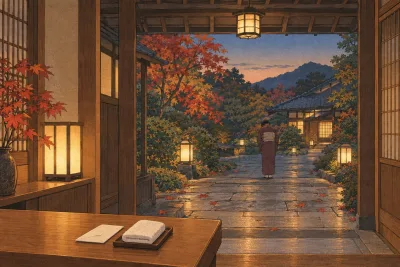
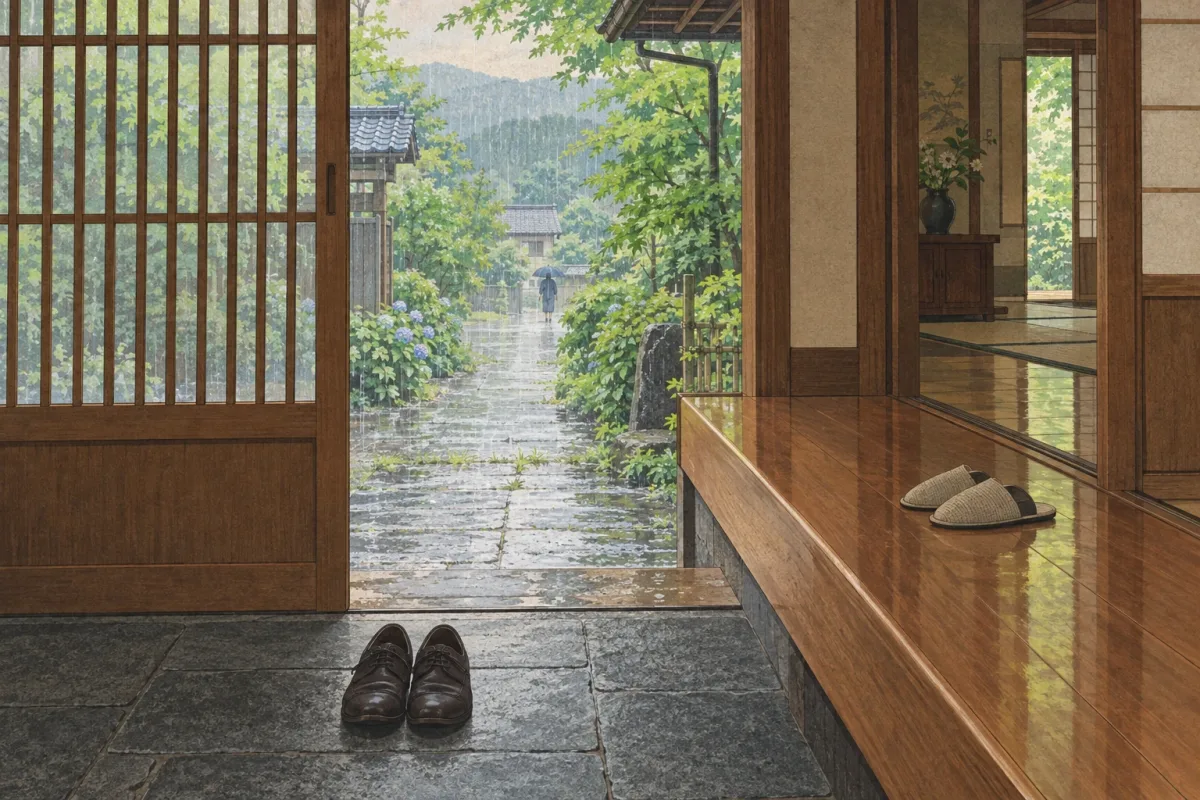
This stepped entrance is the genkan. It consists of the tataki, a floor of earth or tiles where you may stand in your shoes, and the agarikamachi, the raised edge one step up. According to nippon.com, even in concrete buildings such as flats, where there is no need to raise the floor, the genkan is still built with a step, which acts as the signal to take your shoes off here.
Kokugakuin University also points to a way of thinking in Japan that clearly separates "outside" and "inside". Nippon.com describes the genkan as a boundary between the worlds of "inside" and "outside", like the torii (the gate that marks a shrine) at a Shinto shrine. Looking back in history, only aristocrats' and samurai residences had a genkan; the nagaya (row houses) where ordinary people lived had none, and people stepped up over the threshold from the doma (an earth-floored work area) beside the entrance.
The genkan even shapes how the house is built. According to nippon.com, in many countries front doors open inwards for security, but in Japanese homes they normally open outwards so they don't hit the shoes left in the genkan. And the cupboard for shoes is still called a getabako (geta box), even though hardly anyone wears geta any more.
Toilet slippers: one more line on the inside
You step up into the house and put on slippers, and then find yet another pair when you go into the toilet. Plenty of foreigners are puzzled by this. Keeping dedicated slippers in the toilet or bathroom is said to be a custom not found in, for example, Britain.
At a seminar of the Japan Toilet Association, it was pointed out that the Heian-period picture scroll Gaki Zoshi (Scroll of the Hungry Ghosts) shows ordinary people wearing tall geta while relieving themselves. This is thought to have been to protect their feet from the filth on the ground. Until not so long ago, geta were kept in the toilet, and today they have become slippers. A researcher suggested that the feeling of wearing special footwear to avoid the toilet's dirt may have lived on in the Japanese all along.
There are hygiene reasons too. According to Lion, a maker of household products, when squat toilets were the norm the toilet floor was easily soiled with urine, and slippers were essential. Even now, urine splashing back from the toilet reportedly spreads over a radius of about 1 metre, and Lion explains that without slippers you may be spreading that dirt to other rooms on the soles of your feet.
The surprising history of slippers, and recent changes
Indoor slippers in Japan were actually born in the Meiji era. The story goes that in the early Meiji era (around 1868), foreigners living in the foreign settlement in Yokohama caused trouble by walking in their shoes into temples and shrines they were using as lodgings, so Tokuno Risaburo, a tailor in Tokyo, was asked to make something to wear over shoes, and that was the start. From around the 1900s (the Meiji 30s) slippers spread among wealthy people living in Western-style houses, and after the Second World War they caught on rapidly. In the 1970s Japan Airlines began handing out slippers to passengers on board, and some foreign airlines started doing the same on flights to and from Japan.
On the other hand, more and more homes now have no slippers in the toilet. A survey by Lion found that about half of households did not keep dedicated toilet slippers. According to cleaning experts, the reasons seem to include more barrier-free layouts without steps, which make the toilet feel less like a separate place, and better hygiene performance of toilets. Even so, some experts say it is still better to use slippers, to keep the toilet separate from living spaces and avoid spreading dirt.
Tips for visiting and staying
According to the Japan National Tourism Organization (JNTO), in almost all Japanese homes it is taken for granted that you take your shoes off in the genkan, and places such as Japanese restaurants, temples and onsen (hot springs) also have spots where you remove your shoes. When stepping up, it is polite to say "ojama shimasu" (literally "I'm intruding", said when entering someone's home).
In tatami rooms (rooms floored with woven straw mats), it is usual to take off your slippers too. Offices, hospitals and similar places may also have a spot where you change into indoor slippers. Nippon.com advises avoiding bare feet when entering someone's home, and suggests bringing a pair of short socks if you are visiting in sandals in summer.
Japanese has the expression "dosoku de agarikomu" (to barge in with your shoes on), used to describe insensitively trampling into someone's feelings or private affairs. You can see how the custom of taking off shoes has taken root even in the language.
Tips
- If there is a step at the entrance, that is the signal to take your shoes off here. In shops and ryokan (traditional inns) too, take them off if you see a step, a shoe cupboard or a row of slippers.
- It is polite to line up the shoes you have taken off with the toes pointing outwards (towards the door) and move them to one side.
- Don't walk onto tatami in slippers; take them off before the tatami.
- Wear toilet slippers only inside the toilet, and always take them off and leave them there when you come out. Walking out into the hallway or other rooms still wearing them is a classic mistake.
- On days when you visit someone's home or a temple, wear socks you won't mind showing and choose shoes that are easy to take off and put on.
Sources
- The "Genkan": Japan's Traditional Entryway and Footwear Etiquette | Nippon.com
- なぜ日本には玄関があり、敷居があるのですか? | 國學院大學
- Japanese Culture: Taking off shoes (A Day in the Life) | The Japan Forum (TJF)
- Japanese Manners Do's and Don'ts | Japan National Tourism Organization
- 第22回「うんと知りたいトイレの話」報告「快適さって何」 | 日本トイレ協会
- トイレスリッパは必要?実験でわかった意外な効果 | Lidea by LION
- トイレでスリッパを使わない家庭が増えている!? | 東京電力エナジーパートナー くらしのアイデア
- スリッパ - Wikipedia
- 靴を脱ぐ習慣 - Wikipedia
- 靴を脱ぐのは日本だけ? 玄関の歴史としつらえ | LIFULL HOME'S PRESS