Why Do Japanese Restaurants Display Plastic Food?
Those lifelike food models are a "3D menu" born in Japan about 100 years ago. Here is how they started and why they are still used today.
The short answer
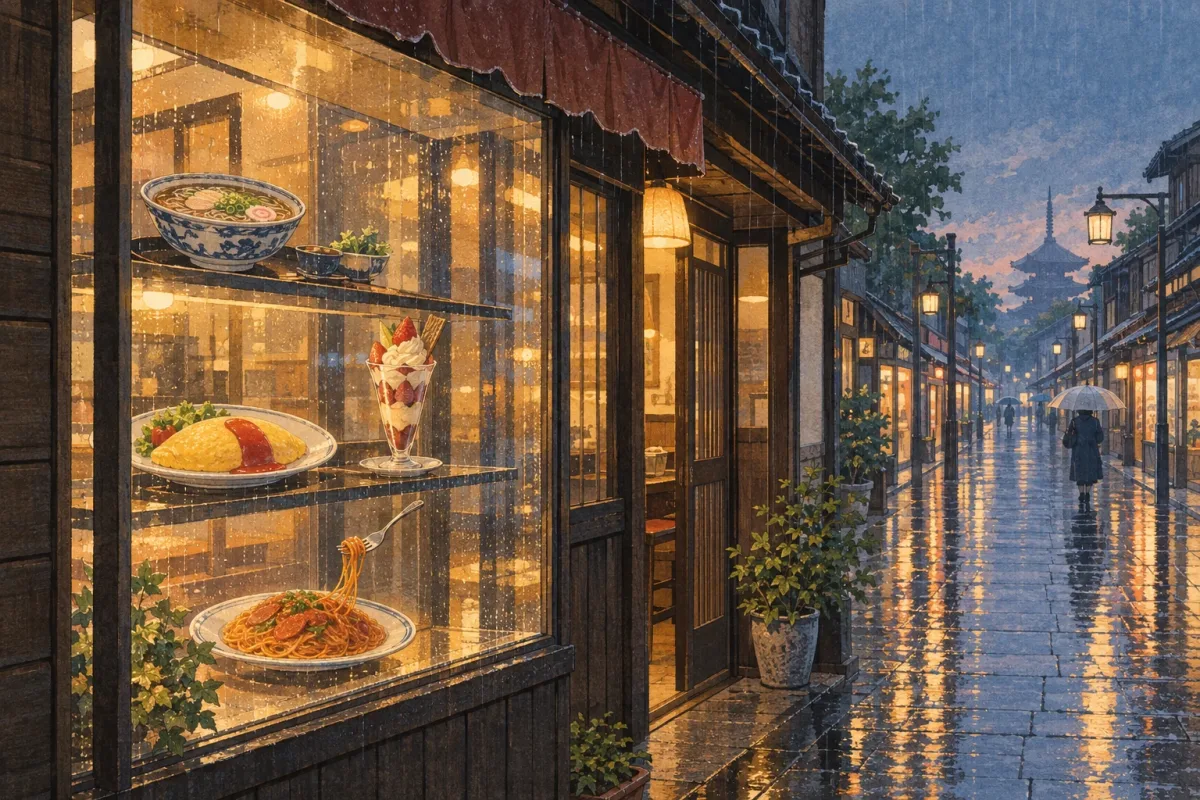
The lifelike dishes lined up in display cases outside restaurants are called shokuhin sanpuru (food samples), and they were born in Japan between the Taisho era and the early Showa era (the 1910s to 1930s). They show a dish's look, portion size and presentation at full scale, with its name and price alongside, so they work as a menu.
They caught on when eating out was spreading, as a clear way to show unfamiliar dishes and a way to display food at the shopfront without wasting real food. They also suit customers who want to know what will arrive before they order, which is why so many restaurants still use them.
Who invented them? Several places at once
Food samples do not have a single inventor. In Kyoto there is a record of a craftsman who made science specimens producing model dishes in 1917. In Tokyo in 1923 the Shirokiya department store lined up sample dishes outside its restaurant, supplied by Sudo Tsutomu, a technician who made anatomical models, who crafted them from wax. Then in 1932 Iwasaki Takizo founded Iwasaki Seisakusho in Osaka and turned food samples into a real business for the first time. No direct link between these has been confirmed, and they are thought to have appeared in different places at almost the same time.
Nose Yasunobu, a journalist who researches food samples, told The New Yorker that urbanisation lay behind them. People who moved to the cities for work started eating out, and Japan had had a habit since the Edo period of looking at the real dishes to decide what to eat, so samples that never went off fitted right in. The 1920s were also when Western-style food was spreading, and department store restaurants used samples to show what dishes like "spaghetti" or a "ham sandwich" actually were.
Spread nationwide by renting them out
According to the company, Iwasaki worked out that the samples were made of wax from a childhood memory of dropping melted wax into water to make it set like flowers, and developed his own method through trial and error. He was inventive about selling them too, winning customers by renting samples out by the month for around ten times the price of the real dish. Once the Sogo department store (then written with different characters) adopted them, orders poured in from other department stores.
During the war, paraffin (a type of wax), the raw material, was placed under state control, and in 1943 displaying food models was banned altogether. Iwasaki evacuated to his home town of Gujo Hachiman in Gifu Prefecture and restarted the business in Osaka after the war. In the 1970s synthetic resin replaced wax, which is sensitive to heat and fades easily, and samples became more detailed and realistic.
In 1958, after the war, Iwasaki exported 3,000 steak samples to the United States. They reportedly were not used to show dishes at all, but as promotional goods for a beer company.
Still handmade, one by one
Even the same dish differs from restaurant to restaurant in its tableware, presentation and portion, so food samples are basically handmade to order. Working from photos and specifications of the restaurant's dish, craftspeople take moulds, paint and finish them. According to Iwasaki, buying a sample of a single-portion dish outright costs roughly 6,000 to 10,000 yen and takes around three weeks, and because the colour and shine fade, it needs replacing after about a year. That is why the company still recommends renting over buying.
The techniques have been refined over time. Rice, for example, used to take a lot of work to mould, but in 1964 Fujita Suehiro patented a method inspired by pebbles on a riverbed, and mixing resin rice grains with adhesive and heaping them up is still how it is done. A 1994 article in The Seattle Times reported that a sample of tempura soba cost about 4,500 yen, far more than the real dish at about 1,000 yen. It also noted that the industry has no trade association and each company keeps its techniques secret.
According to The New Yorker, the Iwasaki group makes about 70% of the food samples sold in Japan. Interestingly, samples do not aim to be exactly like the real thing. To whet the appetite, they are slightly exaggerated, or they play up what is special about the restaurant's dish. This has even led to depictions of moments that could never happen in real life, such as spaghetti with a fork floating in mid-air.
What surprises visitors
Even if you cannot read Japanese, one look at the sample tells you what the dish is and how big it is. South Korea, in fact, encouraged food samples for foreigners who could not read menus in Hangul (the Korean alphabet) in the run-up to the 1988 Seoul Olympics, and they took root there. Outside Asia, however, they have not caught on. The French-cuisine chef Nakamura Katsuhiro suggests that Japanese diners expect the dish to arrive exactly as the sample shows, and that this may reflect a food culture that values that sense of reassurance.
Samples also serve as a record of regional food culture. Nose reportedly walked about 500 kilometres from Tokyo to Kyoto over 26 days, studying the samples at each restaurant, and pinned down that the boundary where the spring onion on hot noodles switches from the white negi of the east to the green negi of the west lies around Hakone.
Not every restaurant has them, though. Samples are mainly found at casual restaurants and chains whose menus rarely change; upmarket restaurants, whose ingredients and dishes change from day to day, often do without. More and more places now use photo menus instead.
Interest abroad is high too. The New Yorker reports that a food sample exhibition at Japan House, a cultural centre in London, drew about 200,000 visitors and became the venue's most popular show.
Look, buy and make your own
Kappabashi Dogu-gai, between Asakusa and Ueno in Tokyo, is a wholesale street where more than 170 shops selling kitchen tools and tableware line a stretch of about 800 metres, and food sample shops cluster there too. You can also find small souvenir samples such as keyrings and magnets. A New Yorker reporter spotted a discount tag on a sample, which should never go off, and on asking why, was told it was "an old design we don't make any more". Samples, too, get updated to follow trends. Every year around 9 October the Kappabashi Dogu Matsuri (a festival of the street's kitchenware shops) is held; in 2026 it is scheduled for 6 to 12 October.
In Iwasaki Takizo's home town of Gujo Hachiman in Gifu Prefecture, the Iwasaki group runs a hands-on workshop where you can try making samples from wax. And at some Japanese airports, such as Oita Airport, giant sushi samples ride round the baggage-claim conveyor belt to promote the local seafood.
Tips
- If you are not confident with the language, it is fine to take a member of staff out to the display case at the front and point at the sample you want.
- The card next to each sample shows the dish's name and price. Taking a photo of the name on your phone makes ordering at your table easier.
- For souvenirs, head to the specialist shops on Kappabashi Dogu-gai. Small samples such as keyrings are popular because they are easy to take home.
- If you want to try making a sample yourself, book a workshop in advance, for example in Gujo Hachiman in Gifu Prefecture.
- Samples are sometimes made to look a little more generous than the real thing. Don't be surprised if the portion or look isn't exactly the same.