Why Is Fruit So Expensive in Japan?
Peaches at several thousand yen each, melons over 10,000 yen. The prices come down to a culture of gift-giving and very labour-intensive growing.
The short answer
There are two main reasons fruit in Japan looks so expensive. One is a culture of giving fruit as a "special gift", which has created a market for luxury fruit that is perfect in both looks and taste. The other is that small farms on mountainous land grow the fruit carefully, piece by piece, by hand, in work that is hard to mechanise.
That said, gift fruit sold in department stores and specialist shops and everyday fruit in supermarkets are priced completely differently. The "several thousand yen for one piece" that shocks travellers belongs mainly to the world of gift fruit.
Fruit as "mizugashi", and as a gift
In Japan, fruit has long been called "mizugashi" (literally "water sweets") in kaiseki cuisine (the traditional multi-course meal served at occasions such as the tea ceremony) and treated as a kind of sweet. According to nippon.com, fragrant fruits such as peaches, nashi pears, grapes and persimmons were especially valued as "sweets".
The custom of giving seasonal fruit as ochūgen (a summer gift) or oseibo (a year-end gift) is also said to have been established since the early Edo period. Until just before the period of rapid economic growth (from the mid-1950s to the early 1970s), fruit itself was a luxury, eaten on days of celebration.
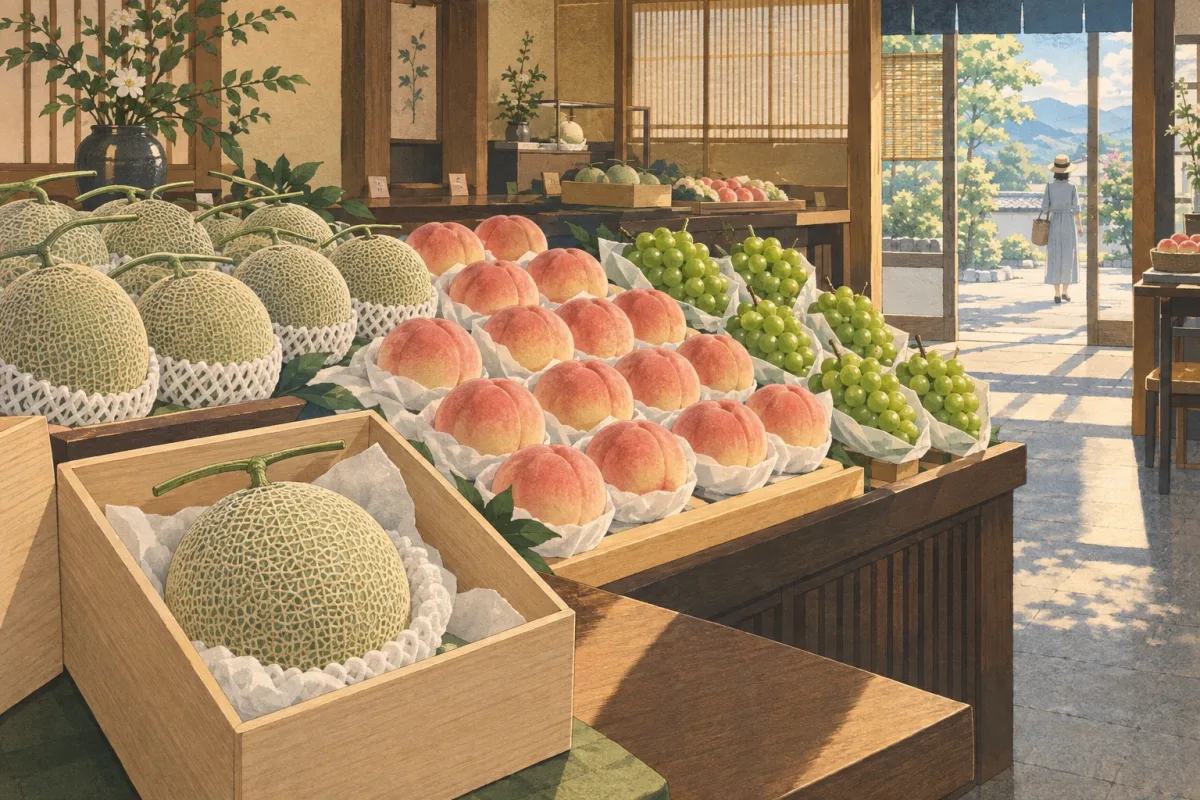
Sembikiya Sohonten in Nihonbashi, Tokyo, says it began in Edo (old Tokyo) as a "cut-price mizugashi shop" and became Japan's first specialist fruit shop under its third owner. When nippon.com visited, gifts made up 98% of the shop's sales. Because it is a gift, it goes without saying that the fruit must taste good; beauty of shape and colour, and even how evenly matched the grapes on a bunch are, are all expected too. That is how a musk melon can top 10,000 yen and a single white peach can cost several thousand yen.
These prices have long astonished foreigners. In a book from the early 1990s, the American columnist Dave Barry was amazed that a melon in a wooden box at a top department store cost 75 dollars. When nippon.com visited the shop, a British lawyer admired the beautifully even grapes but was taken aback by a white peach priced at 3,780 yen, saying that even at a luxury department store in London it would be "five pounds at most".
The way the fruit is bought is different too. As the owner of a long-established fruit shop in Zushi explained to nippon.com, even when buying from the same Tokyo Central Wholesale Market, an ordinary shop buys one case in good condition, whereas a luxury specialist has the very best picked out of around 30 cases and made up into a single case.
Labour-intensive growing and small farms
According to materials from the Ministry of Agriculture, Forestry and Fisheries, fruit trees are often grown on slopes, and work such as pruning (cutting branches to shape the tree) requires a high level of skill, so mechanisation has not progressed. Annual working hours per 10 ares (1,000 square metres) are about 12 hours for rice, but about 170 hours for mandarins, about 260 hours for apples and as many as about 307 hours for grapes.
More than 40% of mandarin orchards are on steep slopes of 15 degrees or more, and on terraced fields there are places even a light truck cannot reach. There are also many manual steps, such as "tekka" (thinning out the fruit) and managing pollination. A classic example is the musk melon's "ichiboku ikka" (one fruit per plant): only one melon is left on each plant so that all the nutrients go into it, boosting its aroma and sweetness.
According to nippon.com, most of Japan's fruit farmers are small family businesses, and in 2010 over 80% farmed 2 hectares or less. Since producing cheaply on a large scale is difficult, they moved towards putting in extra work to grow fruit that sells at a high price per piece.
Europe is different. According to nippon.com, the average orchard in France was 29 hectares (2010), and large operations of over 100 hectares are on the rise. In Europe, where water is often hard, fruit is produced in large quantities as an everyday necessity for water and vitamins, and much of it is processed into things like wine and jam, so appearance matters less. In Japan, by contrast, blessed with good-quality water, fruit came to be seen more as a treat, something enjoyed for pleasure, the explanation goes.
Fewer growers, rising prices
Japan's fruit production peaked in 1979 and has been falling ever since. The Ministry of Agriculture, Forestry and Fisheries explains that an ageing population and a lack of successors have weakened the production base, and both the area under cultivation and production are shrinking. Meanwhile, demand at home and abroad remains solid, and wholesale prices for Japanese-grown fruit are on an upward trend.
Today, about 40% of the fruit on the Japanese market is domestic and the remaining 60% or so is imported. However, about 60% of the imports are processed products such as juice, which is quite different from domestic produce, 90% of which is sold as fresh fruit. In other words, much of the fresh fruit you see in shops is Japanese-grown fruit that has taken a lot of work to produce.
On top of that, fruit growing has extreme peaks of work, such as at harvest time, which makes it hard to employ people all year round, so farms rely on temporary workers. With the population shrinking, finding those workers is also a major challenge. These labour and cost problems are also reflected in the price.
What surprises travellers
The first auction of the year for Yubari melons from Hokkaido makes the news every year, and in May 2026 a pair sold for a record 5.8 million yen. The previous record was 5 million yen in 2019. But this is a special price paid for good luck and publicity, and has nothing to do with shop prices.
Surprisingly, Japanese people themselves do not eat much fruit. According to the Ministry of Agriculture, Forestry and Fisheries, fruit intake per person per day is slowly falling, and the people who eat the most are those aged 70 and over. Consumers are also asking for fruit that is "cheap, even if it doesn't look perfect". In a Ministry of Agriculture estimate (2011) cited by nippon.com, the amount of fruit per person was about 149 kg in Italy and about 116 kg in France, but about 51 kg in Japan.
How to enjoy Japanese fruit the smart way
For everyday fruit, skip the department stores and specialist shops and go to a supermarket or a local yaoya (greengrocer). Even when they buy from the same market, gift shops pick out only the best-shaped fruit from huge quantities, which makes a big difference to the price.
Choosing fruit in its shun (the season when it tastes best) is another key. Then again, while you are here, buying just one top-grade piece and comparing it with ordinary fruit can be a uniquely Japanese experience. At long-established shops like Sembikiya, you can also enjoy luxury fruit as a plated dessert in a fruit parlour (a café serving desserts made with fruit).
Tips
- Buy fruit for everyday eating at supermarkets or greengrocers. Their prices are in a completely different range from specialist gift shops.
- Buy fruit in season and close to where it is grown, and you will find fruit that is both affordable and delicious.
- One way to taste luxury fruit is as a parfait at a specialist fruit parlour (a café serving desserts made with fruit).
- When visiting a Japanese home, seasonal fruit makes a welcome gift.