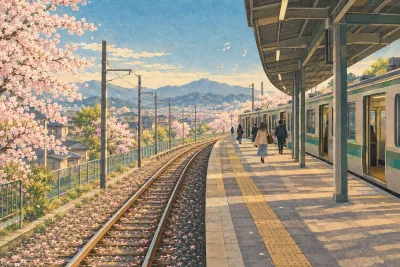
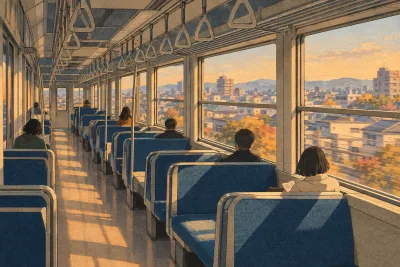
Why Do Japanese Trains Apologise for Being One Minute Late?
The apology is more than a formality. How a commuter society timed to the minute works, and the hard lesson behind all that punctuality.
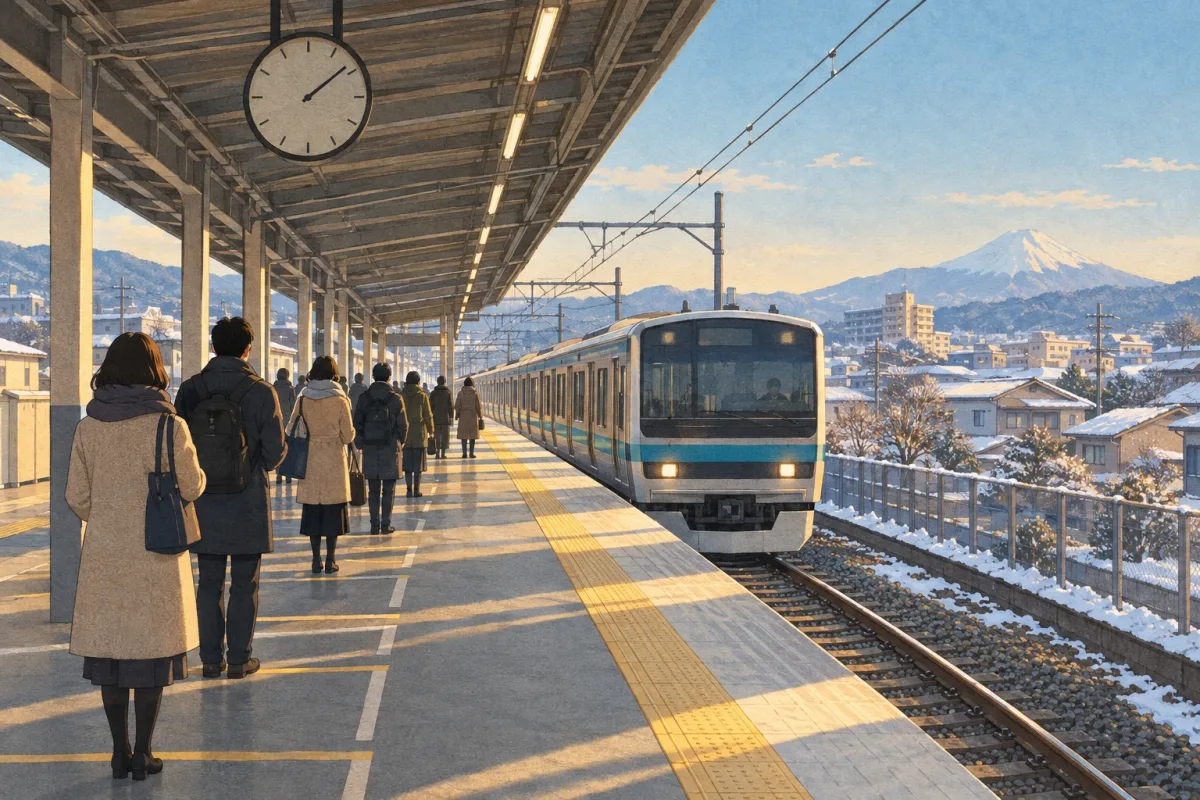
The short answer
The owabi (apology) you hear at Japanese stations and on trains is less an admission of legal responsibility and more a considerate acknowledgement that passengers' plans have been disrupted. In the big cities trains run every few minutes, and lines belonging to several companies are joined up and run as one, so a small delay quickly ripples across a wide area.
On top of that, many people plan their transfers and their commute to the minute. So, as rail companies see it, even one minute can be a real inconvenience. But there is also a history of chasing this punctuality so hard that it led to a major disaster.
60 million riders a day, in a society timed to the minute
According to Japan's Ministry of Land, Infrastructure, Transport and Tourism, around 60 million people use the railways in Japan every day. The Japan National Tourism Organization (JNTO) also notes that millions of people rely on the punctuality of public transport every day, and presents this as a sign of a culture that values being on time.
On commuter lines in Tokyo and Osaka, "through-running" is widespread: subways and suburban private railways connect their tracks and run the same trains across both. It saves passengers from changing trains, but it also means that a small delay on one line can spread to lines run by a different company.
The shinkansen (bullet train) figures show just how punctual things are. According to JR Central, the Tokaido Shinkansen runs 372 trains a day (fiscal 2023, including extra trains) and carries about 432,000 people a day. Even so, the average delay per train is 1.6 minutes (fiscal 2023, including delays from natural disasters such as typhoons). When holding a train for passengers connecting from conventional lines, the limit is about five minutes at most, except for services such as the last train, because keeping the many trains behind it on time comes first.
The Tokaido Shinkansen is especially punctual largely because it is a standalone line that neither branches off to other shinkansen lines nor runs onto conventional lines, and it uses only a few types of train. Even so, snow around Sekigahara in Gifu Prefecture in winter, and typhoons and heavy rain from summer to autumn, can cause delays. In other words, it is not that trains are never late; it is the result of steadily eliminating the causes of delay one by one.
What the apology and the delay certificate mean
When a train is late, on-board announcements often use phrases like "We apologise for the inconvenience to those of you in a hurry." Here, the "moushiwake gozaimasen" (we are very sorry) is used as a courtesy to the people being kept waiting rather than as an admission of the company's fault.
Another very Japanese system is the chien shomeisho (delay certificate). This is a paper or online document in which the rail company certifies that a train was late; commuters and students can hand it to their employer or school, which may then, for example, not count them as late. JR East posts the delays by time band on its website when ordinary trains on the covered lines are roughly five minutes or more late, and you can check back over the past 45 days. It is purely proof of a delay, and has nothing to do with fare refunds or compensation for losses. It is precisely because people have to explain lost time to their company or school that the rail companies are so sensitive to delays.
Handing out delay certificates at stations is said to be almost unheard of outside Japan. JR East's web version shows delays in 10-minute steps ("10 minutes", "20 minutes" and so on) for five time bands: first train to 7am, 7 to 10am, 10am to 4pm, 4 to 9pm, and 9pm to the last train. Tokyu Railways also posts delays of five minutes or more online for seven days; issuing them online is spreading among the major rail companies, and some, such as JR West in the Kyoto-Osaka-Kobe area, have dropped paper certificates altogether.
The "20 seconds early" departure that amazed the world
Japanese rail's fastidiousness made headlines worldwide in November 2017. A Tsukuba Express train left Minami-Nagareyama Station at 9:44:20, 20 seconds earlier than its scheduled 9:44:40, and the operator issued a formal apology notice to its passengers. The cause was that the crew had not properly checked the departure time, and reportedly no passengers complained.
The BBC reported that it is rare for Japanese trains to leave at anything other than the scheduled time, and that rail users in various countries shared the story with their own rail companies on social media. The fact that leaving too early, not only late, counts as something to apologise for is probably because the timetable itself is seen as a promise to passengers.
The dark side of punctuality: the Fukuchiyama Line accident
The obsession with being on time is not only a feel-good story, though. On 25 April 2005, in Amagasaki, Hyogo Prefecture, a JR West rapid train on the Fukuchiyama Line entered a right-hand curve with a 70 km/h limit at about 116 km/h and derailed, killing 107 people, passengers and the driver together, and injuring 562. At Itami Station just before, the train had overshot its stopping position and left a little over a minute late.
Factors identified behind the accident include timetables whose slack had been cut to compete with rival private railways, and "nikkin kyoiku" (day-shift re-education), a punitive programme imposed on crew who made mistakes, which put them under heavy psychological pressure. The government's accident investigation report also concluded that JR West's management practices are thought to have contributed to the accident. JR West says it has since added more slack to its timetables and taken measures on every point raised in the report. Japanese railways today stand on a hard lesson: punctuality matters, but it must never come before safety.
Right after the accident, JR West drew up a 40-point Safety Improvement Plan. In the spring 2006 timetable revision, for example, the Special Rapid Service's running time between Sannomiya and Osaka was extended from 19 to 20 minutes, and stops at busy stations were lengthened by about 10 seconds to a minute. Because the added slack left the company short of crew and trains, it reduced the number of trains on sections with few daytime passengers. It was a shift to choosing safety over speed and frequency.
Advice for travellers and residents
Japanese trains leave almost exactly on time, so the basic rule is to get to the platform with time to spare. Dashing aboard after the departure bell rings is dangerous, and is itself a cause of delays. Even when you hear an apology announcement, it is usually a delay of just a few minutes, so stay calm and check the service information on the station displays or the rail company's app.
If you work or study in Japan, it is reassuring to get into the habit of picking up a delay certificate (or checking it online) whenever you are held up. On days when you are connecting to a flight or the shinkansen, choosing a train one earlier to allow for delays on conventional lines will keep your travel plans intact.
Tips
- When connecting to an airport or the shinkansen, take a train one earlier to allow for delays on conventional lines.
- If a station display shows "遅延" (delay) or "運転見合わせ" (service suspended), check the rail company's app or website for the latest information.
- Don't dash aboard after the departure bell rings. In the cities the next train usually comes within a few minutes.
- If you are late for work or school because of a train, get a delay certificate. JR East and others let you check and print it online.
- The on-board apology announcement is a matter of courtesy. A delay of a few minutes is almost never a big problem.
Sources
- 鉄道のテロ対策(鉄道利用者数の記述を含む) - 国土交通省
- About the Shinkansen - Central Japan Railway Company
- 遅延証明書 - JR東日本
- Apology after Japanese train departs 20 seconds early - BBC News
- 福知山線列車事故後の安全性向上に関する取り組み - JR西日本
- 福知山線脱線事故調査報告書の検証等について - 運輸安全委員会
- Japanese Customs and Etiquette - Japan National Tourism Organization (JNTO)
- 遅延証明書 - Wikipedia
- JR福知山線脱線事故 - Wikipedia
- 東海道新幹線 - Wikipedia
- 直通運転 - Wikipedia