Why Does Every Train Station in Japan Have Its Own Departure Melody?
It began with complaints about noisy bells. How a small fix for station noise grew into a way for each town to introduce itself.
The short answer
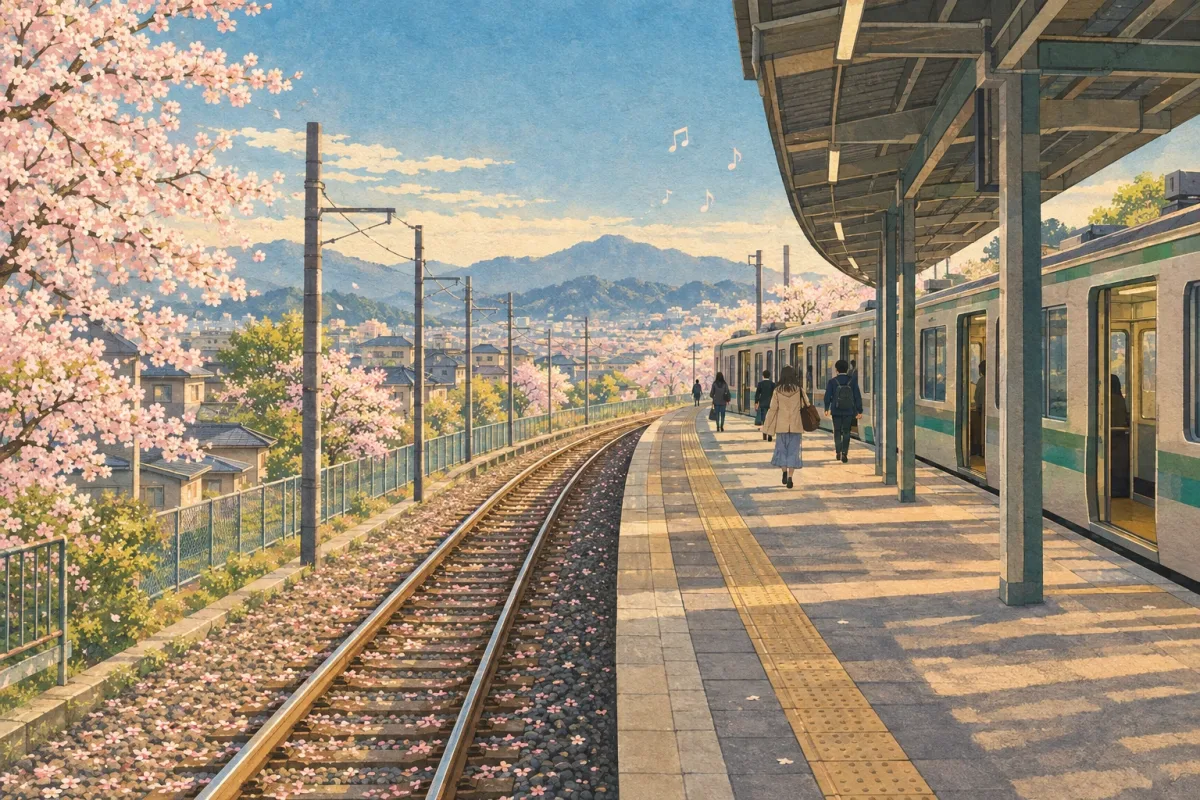
The short tune that plays at Japanese stations before the doors close is called a "hassha merodī" (departure melody), also known as "eki-mero" (station melody). They really took off on JR lines in the Tokyo area in 1989, when the shrill departure bells, which people found "too noisy", were replaced with sounds that were easier on the ear.
Then, from around the 2000s, more and more stations began using "gotōchi" (local) departure melodies, tunes connected to the town where the station is, and stations started to develop their own personalities. In reality, though, many stations still use generic melodies made by manufacturers, so not every station has an original tune.
From bells to melodies: it started with noise complaints
Departure signals on Japan's railways go back a long way. When the first railway opened between Shinbashi and Yokohama in 1872, drums and hand bells were used to signal to the crew. A bell to tell passengers that a train was departing is said to have first appeared in 1912, at Ueno Station. For many years, stations in the Japanese National Railways (JNR) era used electric bells that rang like an alarm clock, or electronic buzzers.
The turning point was the break-up and privatisation of JNR in 1987. That same year, a column in the Asahi newspaper criticising Japanese stations for their noisy announcements caused a big stir. In 1988 the departure bell was scrapped at JR Chiba Station, and in March 1989 melodies developed by the musical instrument maker Yamaha came into use at JR Shinjuku and Shibuya stations. Newspapers at the time reported that the station melodies brought "peace of mind". At Shinjuku, it is said that even the acoustics of the whole station were taken into account, so that the melodies would not clash when played on many platforms at once.
Some experts explain that the departure melodies carried a message: rather than a bell that hurries people and encourages kakekomi jōsha (running to jump on a train just before it leaves), they wanted people to take things a little more calmly.
There are even older "originals"
The oldest station melody on record is said to be "Kōjō no Tsuki" (The Moon over the Ruined Castle), which Bungo-Taketa Station in Oita Prefecture started playing in 1951. The town is where the song's composer, Rentaro Taki, spent his boyhood, and it began when local people brought a record to the station and played it over a loudspeaker at departure time. Since 1988, a recording sung by a local children's choir has been used.
Among private railways, Keihan Electric Railway started using a melody in August 1971. It was the idea of the company president at the time, and it was composed by the engineer in charge of the departure bell equipment. Remembering the reveille bugle he had heard at a naval school, he wrote a brisk tune that climbs upwards, and it remained in use until June 2007. There is also a story that before that, when Keihan limited expresses left their starting station on the hour, the NHK time signal was played to send them off. At JR East too, a departure melody was introduced at Sendai Station in November 1988, before the Tokyo area.
In other words, the idea of sending off trains with a town's song existed before the Tokyo-area station melodies.
"Generic" melodies and "local" melodies
Station melodies fall into two broad types. One is the "generic melody" made by audio equipment manufacturers and the like. When the melodies spread across the Tokyo area in the 1990s, many stations adopted tunes supplied by the makers of their announcement systems to keep costs down. The same tune is used at several stations, so if you listen carefully you will notice, "I've heard this one at another station."
The other is the "gotōchi melody", a tune that belongs to that particular town. Some were chosen for surprising reasons. At Oimachi Station on the JR Keihin-Tohoku Line, Vivaldi's "The Four Seasons" was used from 1993; it is said to have been introduced because the stationmaster at the time liked it, and the full story is unclear. It is said to be the first case in the Tokyo area of a piece that was not originally written as a departure melody being used as one (it was changed to a different tune in May 2025).
How local melodies are chosen
Most local melodies come from requests by local shopping associations, local governments, chambers of commerce and similar groups. A classic example is Takadanobaba Station on the JR Yamanote Line, where the theme song of "Astro Boy" (Tetsuwan Atomu) has played since 2003. It is there because in the original manga Astro Boy was born at the Ministry of Science in Takadanobaba, and because Tezuka Productions, which made the anime, was nearby. It was meant to be used for a limited time only, but it is still playing today. At Kamata Station on the Keihin-Tohoku Line, "Kamata Kōshinkyoku" (the Kamata March) has been used since 1997, because a film studio once stood there.
At JR Kawasaki Station in Kanagawa Prefecture, "Ue o Muite Arukō" ("I Look Up as I Walk") by Kyu Sakamoto, a singer from Kawasaki, became the departure melody on the Tokaido Line platforms on 10 December 2016. The local chamber of commerce and others collected about 4,000 signatures and petitioned the city and JR, and the first day it was used was reportedly chosen to match Sakamoto's birthday. At Keikyu Kawasaki Station, the same song plays as the melody that tells you a train is approaching.
In Osaka in 2015, JR West chose a tune for each station on the Osaka Loop Line to capture the character of its neighbourhood. Tsuruhashi Station, known for its yakiniku (Korean-style grilled meat) restaurants, got a song about all-you-can-eat; Tennoji Station, in honour of the bell at Shitennoji temple, got "Ano Kane o Narasu no wa Anata" (It's You Who Rings That Bell); and Osakajokoen Station, which calls to mind the Siege of Osaka, got the sound of a horagai (a conch-shell trumpet used as a signal in battle). (The tunes may have changed since.)
How station melodies work today
The melodies are played by station staff or conductors pressing a button on the platform. The buttons are often in plain view of passengers, but pressing one if you are not staff could count as obstructing railway business, and some stations have warning notices on them.
The length varies from station to station. At busy city stations with lots of trains, such as Kawasaki, they are trimmed to about 10 seconds, while at rural stations with few trains a longer melody of 20 to 30 seconds may play at a leisurely pace.
Meanwhile, changes are under way. In 2018, on part of the Joban Line local service, JR East ran an experiment playing the melodies at a lower volume from the trains' own speakers, because platform melodies could be heard as far as the stairs and ticket gates and were encouraging people to run for trains. From around 2024, starting at Yokohama Station, there has also been a move to replace generic melodies with tunes the company manages itself. At Hakodate Station in Hokkaido, the long-loved "Tabidachi no Kane" (The Departure Bell) was retired at the end of March 2024.
What surprises visitors from abroad
A travel writer who has written a book on station melodies says departure melodies are probably a railway culture unique to Japan, because in many countries there is not even a departure bell: when it is time, the train simply pulls out quietly.
Even so, it seems few foreign visitors notice the station melodies yet. At Shimoyoshida Station on the Fujikyu line, a popular spot for photographing Mount Fuji, a song by Fujifabric, a rock band from the area, has played as the approach melody since December 2021, and there is even an explanation panel on the platform in English, Chinese and Thai. But most people are reportedly too busy photographing Mount Fuji. Next time you hear music at a station, take a moment to listen.
Tips
- The departure melody is the signal that the doors are about to close. Once it starts, do not run and jump on; waiting for the next train is safer and better manners.
- Never touch the melody buttons on the platform. If anyone other than staff presses them, it could count as obstructing railway business.
- An easy way to enjoy them is to visit stations with local melodies, such as Takadanobaba on the Yamanote Line (Astro Boy) or JR Kawasaki ("Ue o Muite Arukō").
- Even at the same station, the tune can differ from platform to platform. Comparing them is another way to enjoy them.
- Tunes do get replaced. If there is a particular station melody you want to hear, check the latest information before you set off.
Sources
- 日本独自の鉄道文化「駅メロ」: 耳に心地よく、ご当地PRにも活用 | nippon.com
- 坂本九さんの歌碑と駅メロディ | 川崎市
- 発車メロディーに「上を向いて歩こう」 JR川崎駅が10日から | 産経ニュース
- 大阪環状線 発車メロディ 選曲理由 | JR西日本(2015年)
- 駅の発車メロディが駆け込み助長? 常磐線各駅停車で停止実験 | 乗りものニュース
- この発メロのご時世に…上野駅と新大久保駅が「ベル」であり続けるワケ | 乗りものニュース
- 発車メロディ - Wikipedia
- Japan's Unique Railway Departure Melodies - Japan Railway Journal | NHK WORLD-JAPAN