Why Do People in Japan Queue So Neatly?
"The Japanese are just well-mannered" doesn't explain it. It comes from systems built to run packed cities, plus a habit of going along with them.
The short answer
People queue neatly at Japanese stations and shops, and national character is not the only reason. In extremely crowded cities, where huge numbers of people have to share limited space and time, rail companies and others have made "where and how to queue" visible at a glance, and most people have gone along with it. That has had a big effect.
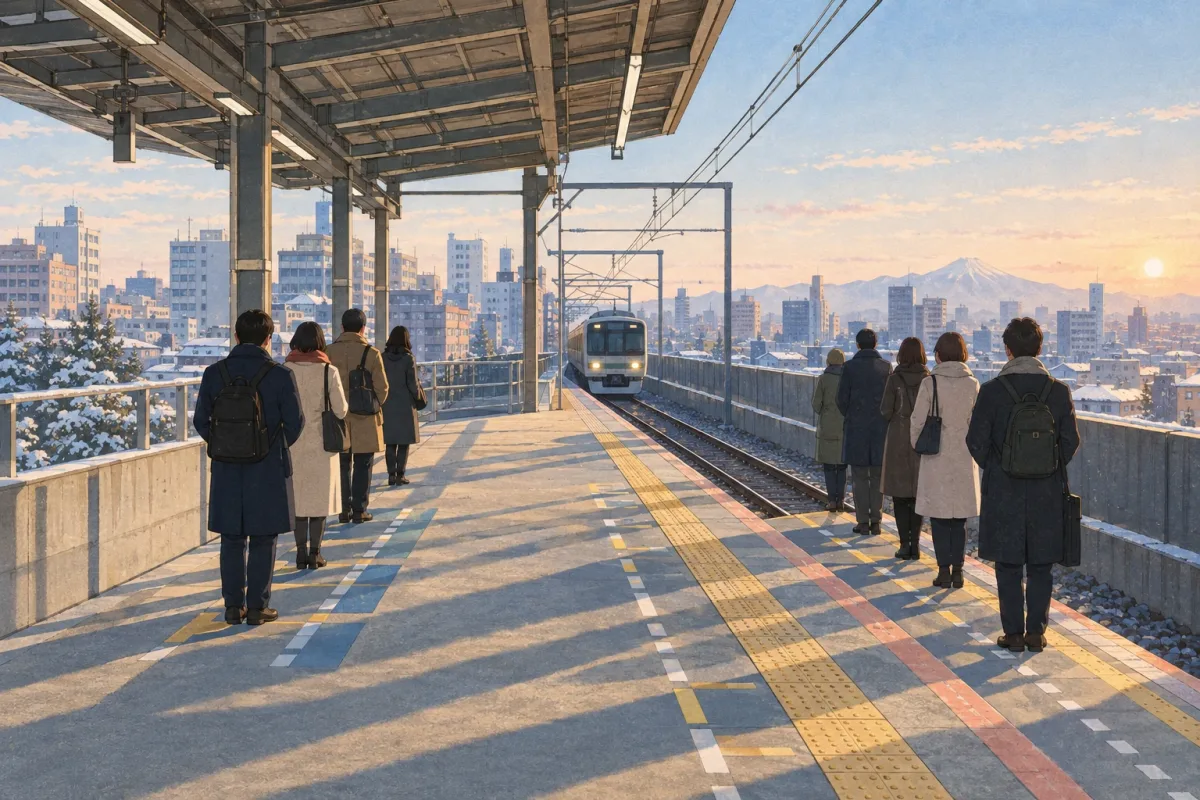
Because where to stand is clearly marked on the floor, even first-timers can join the queue without confusion. It works both ways: the system makes queuing easy, and because everyone queues, the system runs smoothly.
Packed trains gave rise to orderly boarding
In Japan's big cities, the morning rush of commuters and students is squeezed into roughly two hours, from about 7 to 9am. At major terminal stations trains arrive and leave one after another, and the platforms overflow with people. In recent years crowding is said to have eased thanks to added capacity from the rail companies and the spread of flexitime, remote working and staggered commuting, but the morning rush is still part of everyday life.
In these conditions, keeping trains that come every few minutes running to timetable means getting people on and off quickly. So the rail companies have long encouraged seiretsu josha (orderly boarding). It has three basics: queue at the marked boarding position, let people off first, and don't push in.
The Association of Japanese Private Railways' glossary also explains that forceful queue-jumping is one cause of trouble between passengers, and that orderly boarding is a matter of manners that depends on everyone's cooperation. Queuing is not just politeness; it is also teamwork to keep the trains from running late.
Floor markings show you how to queue
Walk along a Japanese station platform and you will notice coloured lines, arrows and numbers painted at your feet. Major private railways and others put markings at main and intermediate stations showing where the train doors will stop, and letting people form separate queues for different kinds of train, such as local and express services.
In other words, hardly anyone has to decide where to queue for themselves. Ways of moving, such as forming queues on either side of the door and leaving the middle free for people getting off, also become obvious once you look at the markings. It is because of these "no confusion" touches that hundreds of people can get on and off in an orderly way in a short time. And because trains in Japan stop almost exactly at set positions on the platform, the markings actually work.
Shop tills have queuing systems too
It is not just stations. In front of the tills at konbini (convenience stores) and supermarkets you will often see footprint stickers or lines on the floor saying "please wait here". They help keep a gap between you and the person in front and let other shoppers pass through the queue, and they became even more widespread as distancing markers when the coronavirus pandemic hit.
There are different ways of queuing, too. Besides a separate queue for each till, a single queue where people are called to whichever till frees up next, known as a "fork queue", is also common. With a fork queue, nobody gains or loses depending on which till clears first, so there is less of that unfair "the next queue moved faster" feeling. The cashier will call "next customer, please", so just follow that and you'll be fine.
Escalator rules are changing too
Escalators come up a lot when people talk about queuing. For a long time in Japan it was a widespread habit to stand on one side and leave the other side free for people walking. But this habit has a problem. People who can only hold the handrail on one side, because of an injury or disability for example, cannot stand on the side that is supposed to be kept free, and may not be able to ride safely.
The city of Nagoya explains that walking on escalators not only risks injuring the walker but can also put other users in danger, especially older people and people with disabilities. The "consideration" of leaving one side free for people in a hurry had in fact become a danger for others.
So in October 2021 Saitama Prefecture brought in an ordinance asking people to stand still on escalators. Nagoya brought in an ordinance to the same effect in October 2023, requiring people to stand still whichever side they are on. Neither ordinance carries penalties; the idea is to change attitudes by having escalator operators remind users. Queuing rules, too, are being revised as times change.
Scenes that surprise people from abroad
Japanese queuing made a strong impression on the world during the Great East Japan Earthquake in March 2011. According to AFP, images of people calmly queuing outside shops that were running low on goods, amid enormous damage, with no looting or rioting, were widely featured abroad. An editorial in the US Wall Street Journal praised the Japanese for keeping their composure amid the chaos, and Professor Joseph Nye of Harvard University said that the tragedy had shown an attractive side of Japan. An expert at CSIS, a US research institute, also said that the resilience the Japanese people showed in the crisis would shape Japan's future.
On the other hand, it would be going too far to think the Japanese never break a queue by nature. Disputes over queue-jumping do happen at crowded stations, which is exactly why rail companies keep reminding people about manners. It is probably closer to the truth to see a neat queue as the result not only of Japanese character but of systems, reminders and consideration for others, all built up over time.
A queuing guide for travellers and newcomers
On a station platform, look for the markings at your feet and queue for the train you are catching. When the train arrives, step to the side of the door to let people off first, and get on once everyone is off. If you have a large suitcase, it is also considerate to avoid the busiest times where you can, so you don't block the flow of the queue.
At shops and events, there may be a member of staff at the end of the queue holding a placard reading "saikōbi" (end of the queue). Cutting into the middle of a queue is obviously frowned upon, and so is joining a friend who is already queuing, which amounts to pushing in, so be careful. On escalators, the basic rule now is to follow local signs and stand still.
If you can't tell whether there is a queue, ask someone nearby "Narande imasu ka?" (Are you queuing?) and they will usually be happy to tell you. And if someone steps in front of you, calmly saying that there is a queue behind rather than accusing them makes it easier for them to realise, and keeps the atmosphere pleasant.
Tips
- On station platforms, check the lines and numbers at your feet and queue for the train you are catching.
- When the train doors open, the rule is to stand to either side and let people off before you get on.
- In big cities, trains at rush hour (around 7 to 9am on weekdays) are more comfortable if you avoid travelling with bulky luggage.
- The basic rule on escalators is to stand still. In Saitama Prefecture and the city of Nagoya it is written into local ordinances.
- If you can't tell where the queue ends, ask "Saikōbi wa doko desu ka?" (Where is the end of the queue?) and someone will show you.