Japan is Nippon
Why Do All Sumo Referees Share the Same Two Names?
Sumo referees (gyoji) don't work under their real names: every one takes a professional name with the surname Kimura or Shikimori. The top two names, Kimura Shonosuke and Shikimori Inosuke, have been handed down since the Edo period, and the referee who is promoted takes them over.
The short answer
The referee who judges bouts in Grand Sumo (ozumo, the professional sumo run by the Japan Sumo Association) is called a gyoji. As of November 2026 there were 41 gyoji, and every single one of them has the surname Kimura or Shikimori.
That's not because they're related. The same list also gives each referee's real name, which shows that a gyoji name is a working name, much like a wrestler's shikona (the name he fights under in the ring).
What's more, the two names at the very top, Kimura Shonosuke and Shikimori Inosuke, are closer to job titles than personal names. When a promoted referee takes one of them over, it's called shumei (succeeding to a name), and the name Kimura Shonosuke had passed through 36 holders between the Edo period and 2013.
How senior are Kimura Shonosuke and Shikimori Inosuke?
Just like wrestlers, gyoji have a banzuke (ranking). From the top, they are tate-gyoji, sanyaku gyoji, makuuchi gyoji, juryo gyoji, makushita gyoji, sandanme gyoji, jonidan gyoji and jonokuchi gyoji.
The highest-ranked referee takes the name Kimura Shonosuke and the next one Shikimori Inosuke, and these two are called tate-gyoji. Only a tate-gyoji may judge a bout involving a yokozuna (grand champion, the highest rank for wrestlers), and only Kimura Shonosuke judges the last bout of the day (musubi no ichiban).
A referee's name can change as he rises through the ranks. For example, a gyoji pictured in a nishiki-e (colour woodblock print) from the last years of the Edo period, Kimura Shotaro the 10th, later, in 1877 (Meiji 10), succeeded to the name Kimura Shonosuke the 14th. Taking a new name on promotion works much like shumei among kabuki actors.
How to tell a referee's rank: his tassel and his feet
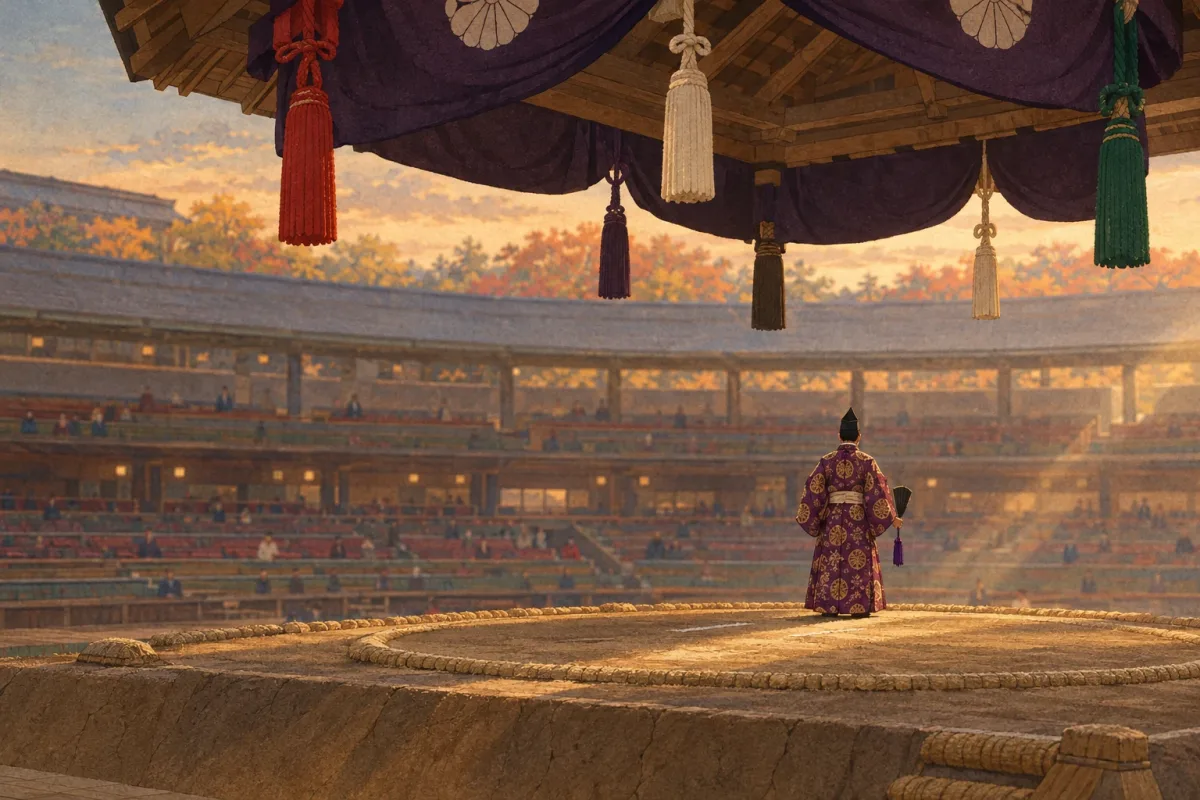
The fan-like object a gyoji holds is called a gunbai (war fan). A referee's rank shows in the colour of the fusa (the decorative cord tassel) on his gunbai. Tate-gyoji use all purple or purple and white, sanyaku rank vermilion, makuuchi rank red and white, juryo rank blue and white, and those below blue or black.
There's a difference at their feet too. Senior referees wear tabi (white split-toe socks) and zori (straw sandals), while junior ones go barefoot. Sanyaku rank and above wear white tabi with zori, and makuuchi and juryo rank wear white tabi only.
Even what hangs at the waist follows rules. Referees of sanyaku rank and above wear a small box called an inro at the waist (on the right hip), and only the two tate-gyoji may carry a short sword. Keep an eye on the referee's waist during a TV broadcast and you can see how important that bout is.
Sometimes the gunbai itself is handed down. A gunbai presented by the Hisamatsu family of the Matsuyama domain at the end of the Edo period passed through the hands of several referees, and since 1960 (Showa 35) it has gone from one Shikimori Inosuke to the next as the Shikimori Inosuke yuzuri-uchiwa (the 'handed-down fan'). So it isn't only the names that pass down the generations, but the tools as well.
Why does a sumo referee dress like an old-time samurai?
The gyoji steps into the ring in a brilliantly coloured robe and a black hat, looking nothing like a referee in any other sport. The costume is modelled on how samurai dressed in the Kamakura period, about 800 years ago, and the black hat resembles the ones worn by Shinto priests.
They haven't always looked like this, though. From the Edo period onwards referees judged bouts in asa-gamishimo (hemp kamishimo, formal samurai wear), and only in May 1910 (Meiji 43) did they switch to today's hitatare (a robe) and eboshi (a tall hat). Two reasons have been handed down: the eboshi hid the hair of referees who had cut off their topknots (mage), or the hitatare simply allowed for more splendid decoration.
Gyoji costumes are made from threads of many colours in various weaves, and the Sumo Museum goes as far as calling them works of art. Gyoji are said to have first appeared in the Sengoku (Warring States) period, so you could say they keep a piece of old Japan alive on the ring.
What does a sumo referee actually do during a bout?
Under the judging rules, the gyoji leads the whole proceeding from the moment both wrestlers step up onto the ring until the bout is over and they step down, and he is the one who decides the result. The gyoji enters the ring with the wrestlers and calls out their names in a distinctive chanting style.
The gyoji is part of the build-up as well. Shikiri (the warm-up routine in which the wrestlers stare each other down and settle their breathing) has a time limit of four minutes in the makuuchi division and three in juryo. When time is up, the timekeeper among the five judges (shinpan) raises a hand to tell the gyoji, and the gyoji signals to the wrestlers with a nod. The tachiai (the charge that starts the bout), however, begins by mutual agreement between the two wrestlers; nobody gives a starting command.
If a wrestler charges without both hands properly touching the ring, the gyoji or the judges stop it and make them start again. During the bout, the gyoji never takes his eyes off the wrestlers and keeps urging them on with calls. The Japan Sumo Association's mascot manga, Hakkiyoi! Sekitori-kun, takes its name from one of these calls.
When the bout is decided, the gyoji raises his gunbai towards the winner's side. The final say isn't his alone, though. The five judges seated around the four sides of the ring are all former wrestlers; if they have doubts about the call, they climb into the ring to confer and can overturn the gyoji's decision or order a torinaoshi (a rematch). This conference is called a mono-ii.
A referee's work outside the ring
Judging isn't a gyoji's only job. The lettering on the banzuke, the ranking sheet published before each tournament, is also written by the gyoji, in a distinctive style called Negishi-ryu, with thick strokes and very little space between them.
Past referees include Kimura Shonosuke the 30th, a fine calligrapher who wrote the banzuke for many years, and Kimura Shonosuke the 34th, who was known for his administrative skill. Writing, paperwork and training younger referees: the gyoji are also sumo's behind-the-scenes specialists.
At a tournament, during the break after the yokozuna's ring-entering ceremony (nakairi), a tate-gyoji sometimes reads out the next day's bouts (on some days this is skipped, depending on how the day is running). It is also a gyoji who hands the bow to the wrestler at the yumitori-shiki (the bow ceremony after the final bout, in which a wrestler twirls a bow).
How can I watch the Kyushu tournament and other Grand Sumo tournaments? (as of November 2026)
Grand Sumo holds six tournaments (basho) a year, each lasting 15 days. The 2026 November Tournament (the Kyushu basho) is being held at Fukuoka Kokusai Center from Sunday 8 to Sunday 22 November. Tickets are sold out, but there is an official face-value resale (a system for reselling tickets at the original price). Any other resale is prohibited.
If you go in person, doors open at 8:45 (10:30 on days 13 and 14, and 10:00 on the final day, senshuraku), and the lower-ranked bouts start in the morning. As a rough guide, the juryo ring-entering ceremony is around 14:15, the makuuchi ring-entering ceremony around 15:40, the yokozuna ring-entering ceremony around 15:55, makuuchi bouts from around 16:10, and the yumitori-shiki around 17:55. You can get to the venue by Nishitetsu bus from Hakata Station or Tenjin.
The next tournament is the January Tournament at the Ryogoku Kokugikan in Tokyo, from Sunday 10 to Sunday 24 January 2027. Advance tickets go on sale at 10:00 on Saturday 5 December 2026 through Ticket Oosumo, Ticket Pia, in store at 7-Eleven and elsewhere. There is also an English-language booking site, TICKET OOSUMO ENGLISH. Ticket prices are being revised from the January 2027 tournament, so check the official website for the latest prices.
To watch at home, there's coverage on NHK BS (from 13:00) and NHK General TV (from 15:00), and ABEMA streams online from the first bout to the last. In English, NHK WORLD's GRAND SUMO offers live coverage with English commentary plus highlights. In Fukuoka, the Fukuoka Convention & Visitors Bureau is holding SUMO CULTURE LIVE FUKUOKA 2026 at Fukuoka International Congress Center on eight days during the Kyushu tournament: a free event where you can watch the broadcast with commentary from English-speaking volunteers.
Tips
- When you watch a bout, look at the colour of the tassel on the referee's gunbai. Purple means a tate-gyoji, vermilion sanyaku rank and red and white makuuchi rank, so you can tell his rank at a glance.
- The last bout of the day (musubi no ichiban) is normally judged by Kimura Shonosuke. Whether you're at the venue or watching on TV, it's your chance to see the top-ranked referee in action.
- Kyushu tournament tickets tend to sell out. If you can't get one, check the official face-value resale, and don't buy resold tickets anywhere other than the official service.
- The moment during the break (nakairi) when a tate-gyoji reads out the next day's bouts is rarely shown on TV, so it's a treat for people at the venue.
- If you'd like to enjoy sumo in English, NHK WORLD's English commentary and the English-speaking volunteers' commentary at Fukuoka's SUMO CULTURE LIVE FUKUOKA are handy.
Sources
- 行司一覧 - 日本相撲協会公式サイト (opens in a new tab)
- SUMO (English introduction brochure) - Nihon Sumo Kyokai (opens in a new tab)
- 行司装束(相撲博物館 展示紹介) - 日本相撲協会公式サイト (opens in a new tab)
- 相撲博物館 過去の展示(2013年)「行司の最高位 木村庄之助」 - 日本相撲協会公式サイト (opens in a new tab)
- 相撲博物館 過去の展示(2010年)「行司装束展」 - 日本相撲協会公式サイト (opens in a new tab)
- 相撲の歴史 - 日本相撲協会公式サイト (opens in a new tab)
- ハッキヨイ!せきトリくん - 日本相撲協会公式サイト (opens in a new tab)
- Sumo Q&A - GRAND SUMO Highlights - NHK WORLD (opens in a new tab)
- GRAND SUMO Highlights - NHK WORLD (opens in a new tab)
- 年間日程表 - 日本相撲協会公式サイト (opens in a new tab)
- 令和八年十一月場所(福岡)入場券情報 - 日本相撲協会公式サイト (opens in a new tab)
- 令和八年十一月場所(福岡) 土俵上のタイムスケジュール - 日本相撲協会公式サイト (opens in a new tab)
- 令和八年十一月場所(福岡) アクセス - 日本相撲協会公式サイト (opens in a new tab)
- 令和八年十一月場所(福岡) 自宅で楽しむ - 日本相撲協会公式サイト (opens in a new tab)
- 令和九年一月場所(東京)チケット購入方法 - 日本相撲協会公式サイト (opens in a new tab)
- How to Buy - Nihon Sumo Kyokai Official Grand Sumo Home Page (opens in a new tab)
- SUMO CULTURE LIVE FUKUOKA 2026 - Fukuoka Convention & Visitors Bureau (opens in a new tab)