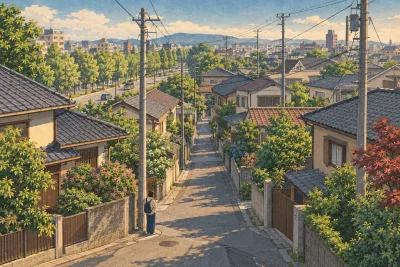
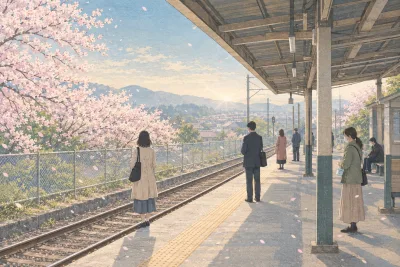
Why Do Young Children in Japan Ride the Train Alone?
Young pupils with randoseru backpacks riding trains alone: behind it lie low crime, school travel systems and a habit of community watch.
The short answer
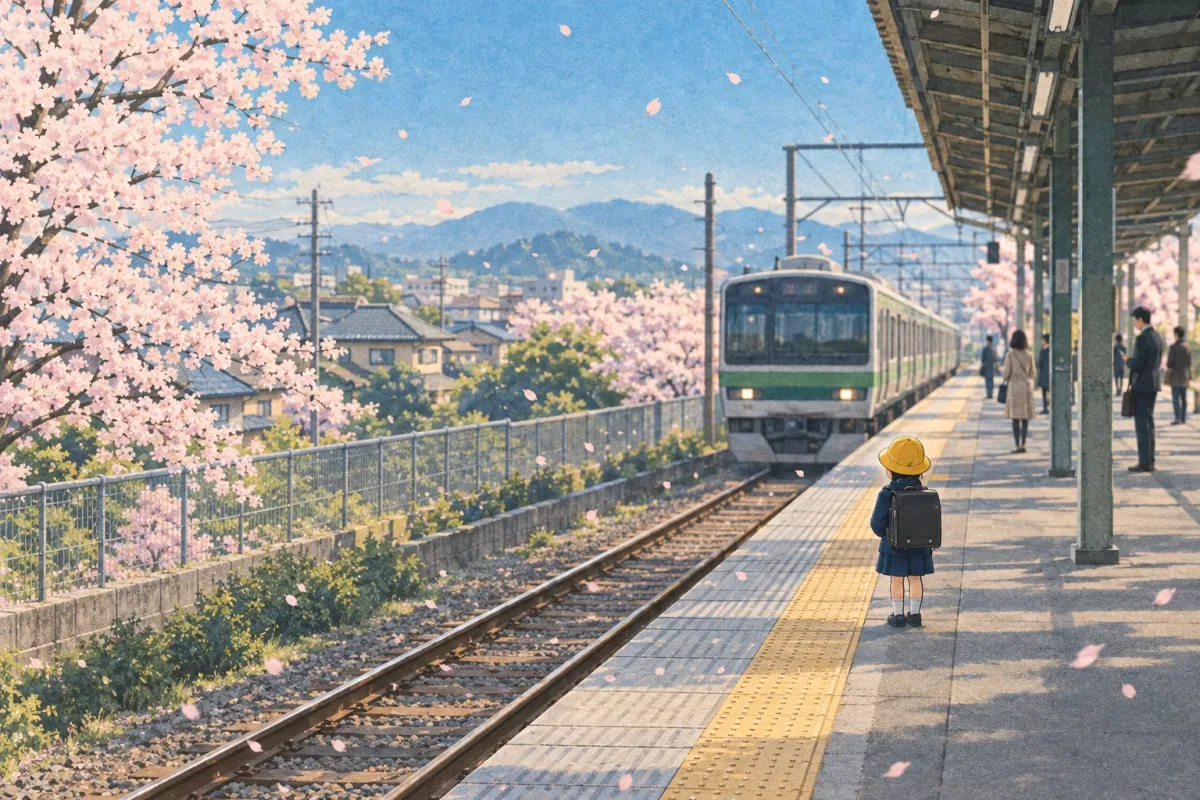
In Japan, once children start elementary school it is normal for them to travel to school without an adult. Most walk to their local public elementary school, but children in the cities who attend private or national elementary schools travel alone by train or bus.
This is possible because relatively low crime combines with other factors: streets that give pedestrians priority, adults watching over school routes, and people and places in the community that children can turn to when they need help. Even so, it has been pointed out that Japanese children's freedom to get around has also narrowed compared with their parents' generation.
The "six-year-old train commuter" that amazed the world
In 2015, a video of a six-year-old girl commuting alone by train to a private elementary school in Japan went viral in the United States and was picked up by several foreign media outlets. According to NewSphere, the surprise was all the greater because in North America parents can even be arrested for letting children under a certain age walk alone or leaving them in a car.
In 2022, Nippon TV's long-running show Hajimete no Otsukai ("My First Errand", first aired in 1991, which follows small children going shopping alone for the first time) was released worldwide on Netflix as "Old Enough!", and major American media covered it one after another. According to nippon.com, Time magazine explained that Japan's very low crime rate and strict gun control are among the reasons a show like this can exist.
The same article notes that in the United States it is illegal to leave children home alone if they are under 14 in Illinois, under 10 in Oregon and under 8 in Maryland. Meanwhile, the writer Christine Gross-Loh, who has lived in both Japan and the US, told The New York Times that in Japan children are expected to travel to school on their own as soon as they start elementary school.
Reason 1: a system for children to travel to school on their own
At many elementary schools in Japan, children carrying a randoseru (the backpack used by elementary school pupils) go to and from school without a parent. In some areas there is also shudan toko (group walking to school), where children from the same neighbourhood gather at a set spot and walk together, led by the oldest pupils.
Group walking to and from school spread from the Showa 30s (roughly 1955 to 1964) onwards, when traffic accidents rose so sharply that people called it the "traffic war". In 1961, following national measures to prevent traffic accidents, the then Ministry of Education issued a directive on preventing traffic accidents. In other words, children travelling to school on their own is not a case of leaving them to it; it is also a system put together for safety.
After gaining experience walking to school this way, children who attend private schools and the like move on to commuting by train. Under the fare rules of JR Central and others, elementary school pupils count as "children" and pay half the adult fare. Infants below school age travel free when accompanied by an adult, but an infant travelling alone needs a child's fare.
Reason 2: the whole community keeps watch
According to a National Police Agency white paper, the police put effort into patrolling school routes during the hours children travel to and from school, and send retired police officers to schools as "school supporters". Elementary schools also hold crime-prevention classes where children think for themselves about what to do in dangerous situations.
The "Kodomo 110-ban no Ie" (Children's 110 House, 110 being the police emergency number) stickers you see around town mark homes and shops that will temporarily shelter a child who feels in danger and runs in, and call the police. The police support these volunteers by giving them stickers and manuals.
The cultural anthropologist Dwayne Dixon, who has studied Japanese youth, observes (via NewSphere) that Japanese children learn early on that they can ask anyone in the community for help. In this view, children's independence rests not on "managing everything alone" but on "being able to rely on those around you when in trouble".
Reason 3: pedestrian-friendly streets and places to turn to
A New York Times article cited by nippon.com points out that in Japan pedestrians come first, and cars tend to drive slowly in side streets full of junctions. The international comparison discussed below also found that the traffic environment is what most affects children's freedom to get around, so towns that are easy to walk around are a big factor.
Another support is the koban (a small neighbourhood police box). There are more than 6,000 nationwide, and as a rule police officers staff them in shifts around the clock. Many people drop in to ask for directions, and for children too they are a familiar "place you can go when you're in trouble". Stations have staff as well, so children commuting by train are in an environment where it is easy to ask an adult for help, for example if they get on the wrong train.
Is Japan special?
In fact, Japan is not the only place where it is normal for children to get around alone. In an international comparison of 16 countries published in 2015 by the Policy Studies Institute (PSI) in the UK, Japan was one of the countries studied, but the country with the most freedom on almost every measure was Finland. This study found that the biggest factor affecting children's freedom was traffic, while fear of strangers had a relatively small effect. The same research series also showed that in England in 1971, 55% of children under 10 were allowed to go alone to places within walking distance, but by 2010 almost none were. Children's freedom depends less on national character than on the times and the environment.
An NPR article cited by nippon.com also says that in Mexico and many European countries it is nothing special for children to go shopping or to school on their own. A Japanese researcher who carried out a nationwide survey reported that children's freedom to get around differs from prefecture to prefecture, and that on every measure it is narrower than in their parents' childhood.
According to the National Police Agency, criminal offences against children under 13 have been on a downward trend since 2002, but they have not disappeared. It is probably closer to the truth to see Japan not as "completely safe" but as a place that lowers the risks through systems and people keeping watch.
What travellers and residents should know
During the morning rush, an elementary school pupil in uniform changing trains alone is a perfectly ordinary sight in Japan. There is no need to assume they are lost and speak to them, but if they are crying or look like they are in trouble, the surest thing is to tell the station staff.
If you are raising children in Japan, rather than suddenly putting them on a train alone, a good place to start is walking the same route together many times and checking together the places they can run to for help (a koban, the station ticket office, a "Kodomo 110-ban no Ie").
Tips
- On a crowded train, make a little room near the doors so small children can get on and off easily.
- If you see a child who seems to be in trouble, it is safer to tell station staff or the officer at a koban than to take them somewhere yourself.
- On JR and other railways, elementary school pupils pay half the adult fare. Up to two preschool children travel free with each adult, but the third needs a child's fare.
- If you live in Japan, check with your child where the "Kodomo 110-ban no Ie" stickers and the koban are along their school route.
- A child riding a train alone is nothing unusual in Japan. If they don't seem to be in trouble, the best thing is to quietly keep an eye out.
Sources
- Netflix配信で海外でも話題に:「はじめてのおつかい」が米国の親心をつかんだワケ - nippon.com
- 平成29年警察白書 第2項 子供の安全を守るための取組 - 警察庁
- おとなとこども - JR東海
- Children's Independent Mobility: An International Comparison (Policy Studies Institute report summary)
- Overview of children independent mobility in Japan - EAJS 2023
- “6歳児が1人で電車通学!?” 海外が「尋常でない独立性」と驚く理由とは? - NewSphere
- 集団登下校 - Wikipedia
- 交番 - Wikipedia