Japan is Nippon
Why Does Japan Still Use 1-Yen Coins?
Because Japanese shops must show prices including consumption tax, odd amounts like 1,078 yen come up every day, and 1-yen coins are essential for the change. Far fewer new ones are made now that cashless payment has spread, but the 1-yen coin is still legal money in everyday use.
The short answer
The ichi-en-dama (1-yen coin) is Japan's lowest-value coin. It's made of aluminium and weighs exactly 1 gram. It has been issued since 1955 (Showa 30), and it has stayed in use in almost the same form for more than 70 years.
The main reason the 1-yen coin hasn't disappeared is the way prices are set in Japan. Shops are required to display the zeikomi kakaku (the price including tax), meaning including consumption tax (Japan's sales tax), and the rate is 10% as standard and 8% for food and some other items. So a 980-yen item costs 1,078 yen and a 100-yen food item costs 108 yen: prices that run down to the single yen are completely normal.
At the same time, as cashless payment has spread, the number of new 1-yen coins made has in some years fallen to a few thousandths of its peak. Even so, the 1-yen coin is still legal money, and the production plan for fiscal 2026 was raised sharply. For travellers, it's also the slightly annoying small change that piles up in your wallet.
What is the 1-yen coin like?
The 1-yen coin's official name is the 1-yen aluminium coin. It is 20.0 mm across and weighs 1.00 g, making it the lightest of Japan's six coins (1, 5, 10, 50, 100 and 500 yen).
The front shows a wakagi (young tree) and the back shows the number 1. The young tree does not depict any particular species, and the Japan Mint (the national body that makes coins) simply calls it a 'young tree'. Incidentally, the Mint treats the side with the year of minting on it as the back.
Before today's 1-yen coin there was a brass 1-yen coin, introduced in 1948 (Showa 23). It was 20 mm across with a design of tachibana (a kind of Japanese citrus), but it was hard to tell apart from the 5-yen coin, which was also brass, so a hole was put in the 5-yen coin to distinguish them.
Coins stay in use for a long time unless they are damaged and withdrawn, and wear and dirt start to show after roughly 30 years. That's why your wallet may contain 1-yen coins dated in the Showa era.
Are 1-yen coins still being made?
The Japan Mint's published figures for coins minted by year show huge swings in 1-yen production. In 1955, the first year, about 381,700,000 were made, and at the peak in 1990 (Heisei 2) about 2,768,950,000. In total, about 44.3 billion 1-yen coins were made between 1955 and 2025.
From the 2000s, however, production fell sharply: about 456,000 in 2011 (Heisei 23) and about 595,000 in 2025 (Reiwa 7). Compared with the 1990 peak, that is roughly one 4,600th.
In many years, these small numbers are exactly the same as for the 5-yen and 50-yen coins of the same year; in 2025, for example, all three were about 595,000. Every year the Japan Mint sells collectors' mint sets containing all six coins from 1 to 500 yen in a case (about 119,000 sets for the Reiwa 7 year), and in years like these the 1-yen coins are probably made mainly for the sets.
How many coins to make is decided each fiscal year by the Ministry of Finance, based on how coins are circulating, and revised during the year when needed. The fiscal 2026 plan initially set 20 million 1-yen coins, and in May 2026 this was raised to 132 million (the same figure as in the latest plan as of November 2026). The Ministry of Finance's announcement does not give a reason for the increase.
Why are Japanese prices odd amounts like 1,078 yen?
Japan requires sogaku hyoji (total-price display): when a shop shows a price in advance, it must show the amount including consumption tax. As a rule, the price on the shelf tag or the menu is exactly what you pay at the till.
Consumption tax is 10% at the standard rate, and 8% at the reduced rate that applies to food (excluding alcohol and eating out) and to newspapers on subscription, among other things. A 980-yen household item before tax costs 1,078 yen with tax, and a 100-yen onigiri (rice ball) before tax costs 108 yen. So prices that go down to the single yen appear almost every day, and if you pay in cash you get 1-yen coins back in your change.
An outline approved by the Cabinet on 15 September 2026 puts forward a plan to cut consumption tax on food to 1% for two years, from 1 April 2027 to 31 March 2029. If the bill passes the Diet (Japan's parliament), a 100-yen food item before tax would cost 101 yen with tax, so prices in single yen look set to stay part of daily life (as of November 2026).
Is there a limit to how many 1-yen coins you can pay with?
Yes. Article 7 of the Act on Currency Units and Issuance of Coins states that coins are legal tender only up to 20 times their face value. In practice that means up to 20 coins of each type, so for 1-yen coins, a shop cannot refuse up to 20 coins (20 yen) in a single payment.
Put the other way round, if you try to pay with 21 or more 1-yen coins, the shop is allowed to refuse. The reason is that large numbers of coins take time to store and count, which is a burden on whoever receives them.
However, nothing stops you paying with more than 20 if the other party agrees. Banknotes (Bank of Japan notes), on the other hand, are 'legal tender without limit' under the Bank of Japan Act, so there is no cap on how many you use.
Do you lose money paying saved-up 1-yen coins into a bank?
Depositing a small number of 1-yen coins can actually be a losing deal. At Japan Post Bank (the bank of the Japan Post group) ATMs, deposits that include coins carry an ATM coin handling fee: 110 yen for 1 to 25 coins, 220 yen for 26 to 50 and 330 yen for 51 to 100 (as of November 2026).
What is more, coin deposits cannot be accepted at all if the amount in coins is no more than this fee. In other words, depositing twenty-five 1-yen coins (25 yen) would cost a 110-yen fee, so you can't deposit them at all. The ATMs take up to 100 coins at a time, and deposits and withdrawals involving coins are only possible on weekdays from 7:00 to 18:00. ATMs in stations and shopping centres, and small ATMs such as those in FamilyMart, don't take coins at all.
At the counter, too, Japan Post Bank has a coin handling fee: free for 1 to 100 coins, 550 yen for 101 to 500, 1,100 yen for 501 to 1,000, and 550 yen more for every further 500 coins. Other banks often set coin fees as well, so check your bank's official website.
Also, deliberately damaging or melting coins is prohibited under the Act on Control of Damaging Coins, and offenders face imprisonment of up to one year or a fine of up to 200,000 yen. Best not to use 1-yen coins as craft materials.
How can travellers use up their 1-yen coins?
The quickest way is to pay the odd amount at the till with 1-yen coins. For 1,078 yen, for example, instead of handing over 1,100 yen, give a 1,000-yen note, a 50-yen coin, two 10-yen coins, a 5-yen coin and three 1-yen coins, and you get no change. By law a shop has to accept up to 20 of each type of coin, so if you use a few at a time they'll dwindle naturally.
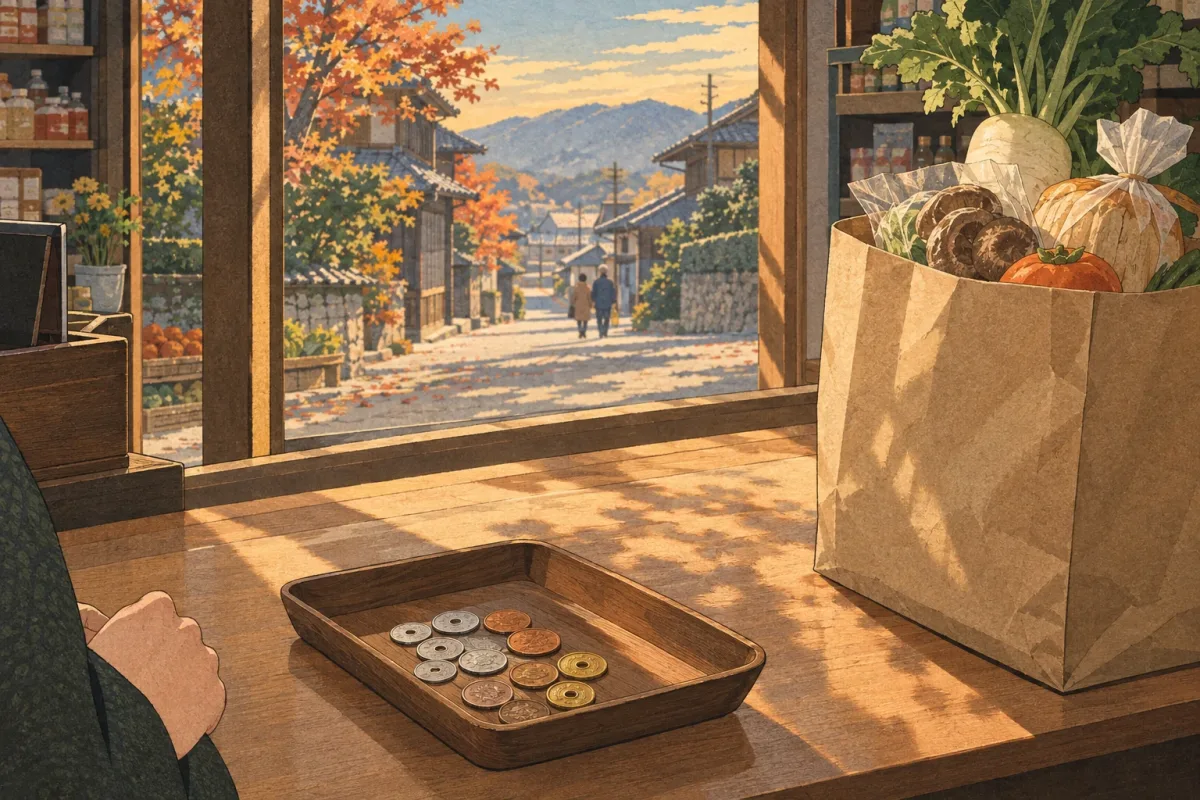
At Japanese tills, staff will almost always wait while you slowly count out small coins. If there's a queue behind you and you feel rushed, spread the coins out on the tray (the small dish for placing money on), which makes them easier for staff to check.
Many people also use small change for osaisen (money offered to the gods or Buddhas) when they pray at a shrine or temple, and putting in a 1-yen coin is not considered rude. Whatever you can't use up before you go home, you could keep a few as souvenirs. A 1-gram aluminium coin, packed with the story of how Japan sets prices and how consumption tax works, makes a rather fun keepsake.
Tips
- Pay the odd part of the bill with 1-yen coins first. For 1,078 yen, hand over 1,000 yen plus 78 yen in coins, and you won't end up with more small change.
- As a guide, use no more than 20 1-yen coins in a single payment. The law says a shop may refuse 21 or more.
- Paying saved-up 1-yen coins into a bank ATM can cost you more in fees than they're worth. At Japan Post Bank ATMs, up to 25 coins costs 110 yen, and amounts at or below that can't be deposited.
- Crafts that involve drilling or bending coins are prohibited under the Act on Control of Damaging Coins. If you take some home as souvenirs, keep them as they are.
- As a rule, the price on the tag includes tax. You'll be charged exactly the amount shown at the till, so it's easy to have the right coins ready, down to the last yen.
Sources
- 通常貨幣一覧 | 財務省 (opens in a new tab)
- 造幣局 : 貨幣Q&A (opens in a new tab)
- 年銘別貨幣製造枚数【令和7年銘】 | 造幣局 (opens in a new tab)
- 造幣局 : 通常貨幣セット&ミントセット (opens in a new tab)
- 令和8年度の貨幣の製造枚数を定めました : 財務省 (opens in a new tab)
- 報道発表(貨幣の製造枚数の改定(令和8年5月25日)) : 財務省 (opens in a new tab)
- 報道発表(貨幣の製造枚数の改定(令和8年9月11日)) : 財務省 (opens in a new tab)
- 通貨の単位及び貨幣の発行等に関する法律 | e-Gov法令検索 (opens in a new tab)
- お金には使用できる枚数の制限があるのですか。 | 財務省 (opens in a new tab)
- No.6902 「総額表示」の義務付け | 国税庁 (opens in a new tab)
- No.6303 消費税および地方消費税の税率 | 国税庁 (opens in a new tab)
- 飲食料品に係る2年間の消費税率引下げについて(リーフレット、令和8年9月) | 国税庁 (opens in a new tab)
- ATMご利用時間・料金 | ゆうちょ銀行 (opens in a new tab)
- その他の料金 | ゆうちょ銀行 (opens in a new tab)