Why Is Cash Still So Common in Japan?
Low crime, low interest rates and card fees for shops all explain Japan's love of cash. But in the last few years, things have been changing fast.
The short answer
Cash has long been popular in Japan for reasons such as the relatively low risk of theft when carrying it around or keeping it at home, and years of low interest rates that meant money in the bank earned almost nothing. For shops, the fees and equipment costs of cashless payment have also been a barrier.
The situation is changing fast, though. According to the Ministry of Economy, Trade and Industry (METI), cashless payments made up more than 40% of payments in 2024. The image of Japan as "a country where only cash works" is starting to look a little dated.
Japan as a "cash superpower", in numbers
According to the Nikkei newspaper's report on a Bank of Japan paper published in 2017, the amount of cash in circulation (notes and coins) at the end of 2015 was equal to 19.4% of nominal GDP (gross domestic product). That stands out even compared with 10.6% in the eurozone, 7.9% in the United States and 3.7% in the UK. Material compiled by the Ministry of Finance in 2023 also notes that Japan's currency in circulation as a share of nominal GDP is high compared with other major countries.
Interestingly, it is not that people do not have cards. The same Bank of Japan paper found that people held an average of 7.7 credit cards, debit cards, e-money cards and so on each, more than the 4.1 in the United States. Many people carried several cards for points and discounts but actually paid in cash. Nor is it that people use cash because they have no bank account: a survey by the Japanese Bankers Association, cited in the Ministry of Finance material, found that over 99% of Japanese residents have a deposit account with some financial institution.
Why cash has been so popular
One factor the Bank of Japan pointed to is "tansu yokin" (literally "wardrobe savings": money kept at home rather than in the bank). This is thought to reflect Japan's relative safety, which means keeping cash at hand carries little risk of theft, and a long period of low interest rates, which meant deposits earned almost no interest.
People's feelings play a part too. A report compiled by the Bank of Japan's Osaka branch in February 2026, drawing on a survey by the Nippon Institute for Research Advancement (NIRA), lists reasons given by people who "want to pay in cash whenever possible", such as "there's no need to pay any other way", "I'm worried about security, loss or theft" and "I end up spending too much". With cash, you can see how much you have left, and that feels reassuring.
Back in 2008, the Bank of Japan also estimated that 10,000-yen notes lying unused in homes and elsewhere averaged 30 trillion yen in 2007. Because the value of notes in circulation kept growing faster than the economy after that, the Bank of Japan considered it "highly likely that tansu yokin has increased further". Cash has served not only as a way to pay but also as a way to save.
The shops' side of the story matters too. The same report quotes businesses saying that on top of payment fees, the costs of upgrading POS tills and maintaining equipment add up. It also points out that there are so many payment methods that it is hard to know which ones to accept. In areas where most shops have already adopted cashless payment, the report notes a view that the remaining shops see little benefit because few of their customers want to pay cashless. On the other hand, in the Kansai region, customers keen on points rewards often ask, "Why can't I use it here?", and many shops reportedly start accepting cashless payment as a result.
It has changed a lot in the last few years
In 2018 the government set out its "Cashless Vision", with a target of raising the share of cashless payments to around 40% by 2025. Helped along by points-reward schemes when the consumption tax was raised and the My Number points scheme, the share reached 42.8% in 2024 according to METI, hitting the target ahead of schedule. Credit cards account for over 80% of this, and "code payments", where you scan a QR-style code with your phone, have grown to about 10%.
From the 2025 figures onwards, METI began using a new domestic indicator that removes the "imputed rent" of owner-occupied homes (rent that is not actually paid but is counted as spending on paper) from the total, and announced a share of 58.0% for 2025. Because the definition has changed, the figures cannot simply be compared, but the next target is 65% by 2030.
According to the Bank of Japan's Osaka branch report, the rise in foreign visitors and the greater interest in contactless payment during the COVID-19 pandemic also helped. The report quotes a view that almost every new restaurant opening in Osaka Prefecture accepts some kind of cashless payment. At Expo 2025 Osaka, Kansai, the site was run without handling any cash at all. As many as 73 payment methods were available, and the report quotes the organisers as saying that having no cash let them serve huge crowds and made closing the tills after hours dramatically quicker.
Under the new indicator, cashless payments in 2025 broke down as 82.7% credit cards, 10.2% code payments, 3.7% e-money and 3.4% debit cards. In Japan, "cashless" still largely means "credit card", and although phone payments are growing, they remain only about a tenth of the total.
What confuses travellers and newcomers
Cashless payment may have spread, but be aware that it does not work the same way everywhere. The Bank of Japan's Osaka branch report also lists as a problem that consumers can use only the payment methods a particular shop has adopted, so unlike cash, they cannot be used the same way everywhere. Some shops take cards but not code payments, or the other way round.
Many shops are also said to adopt only code payments, which have relatively low fees, to avoid the cost, so there may be times when a foreign-issued credit card cannot be used. Some small independent shops, and shops where few customers want to pay cashless, still accept cash only.
There are regional differences too. According to figures compiled in the Bank of Japan's Osaka branch report from the Ministry of Internal Affairs and Communications' National Survey of Family Income, Consumption and Wealth, the share of household spending paid cashless (2024) averaged 39.4% in the Kanto region and 36.8% in Kansai, against an average of 31.9% in other regions. It has risen everywhere compared with five years earlier, but it is safest to assume that the further you get from the big cities, the more you will need cash.
Tips
- Cashless is becoming the norm, but carrying a few thousand to about 10,000 yen in cash just in case will put your mind at rest.
- Check the stickers at the shop entrance or by the till first; they show which payment methods are accepted.
- Transport IC cards (such as Suica) work not only on trains and buses but also in konbini (convenience stores) and vending machines, which is handy for small payments.
- If you live in Japan, getting a bank account and a Japanese credit card or code-payment app also lets you earn points rewards.
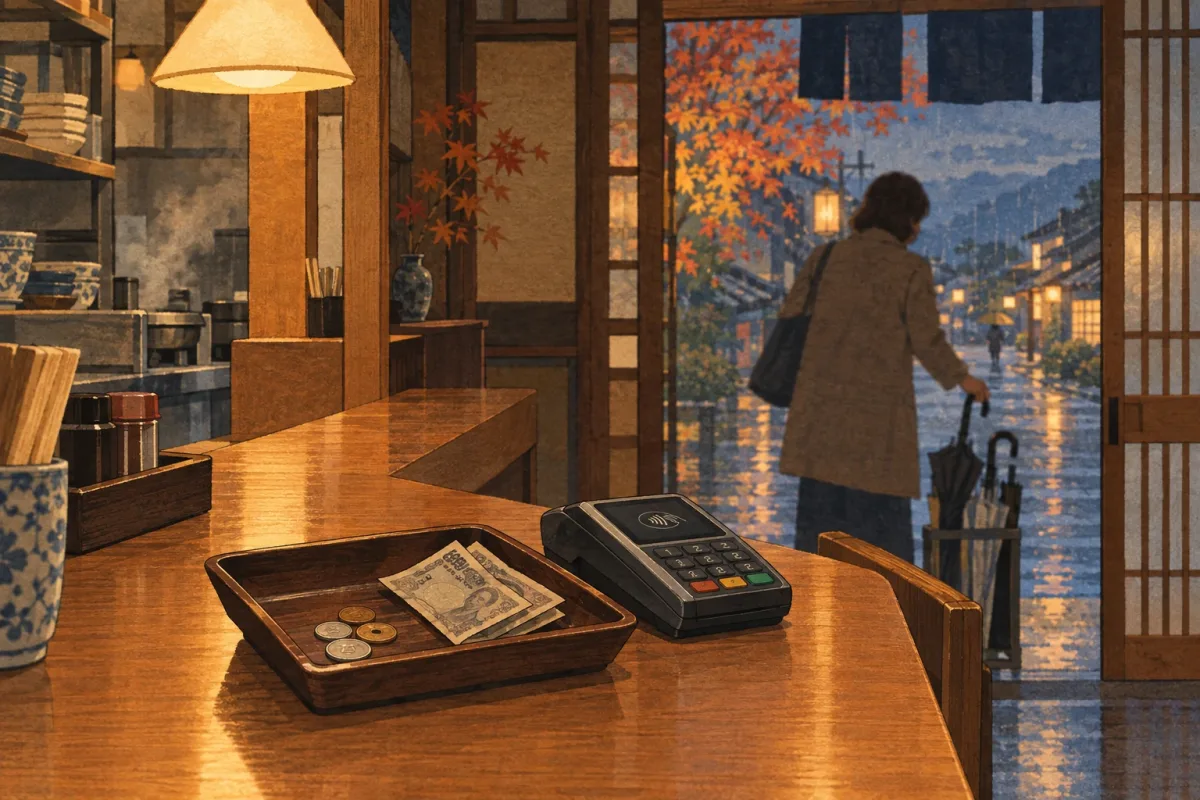
- When paying in cash, it is usual to place the money on the small tray (called a "karuton") at the till.