What Can You Actually Do at a Japanese Convenience Store?
Withdraw cash, send luggage to the airport, pay bills, get official certificates: a Japanese konbini is a mini town hall, post office and bank in one.
The short answer
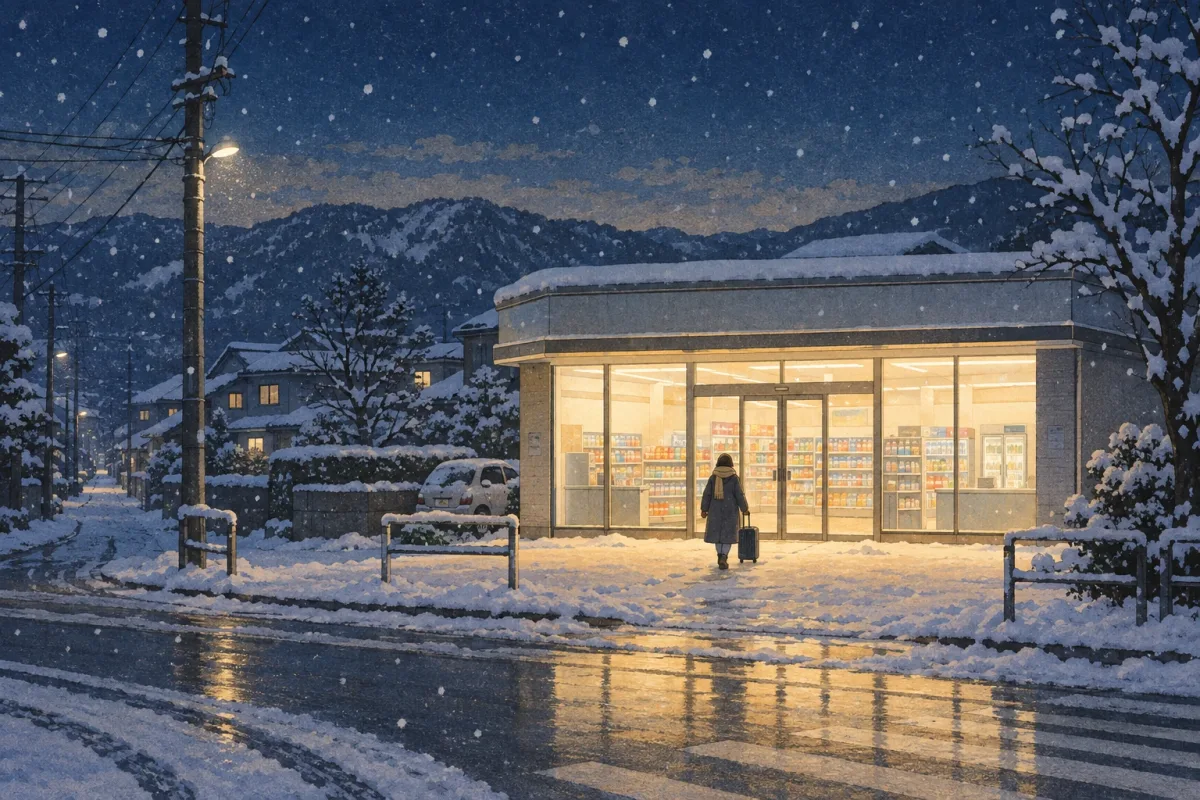
A Japanese konbini (convenience store) is far more than a place to buy snacks and everyday bits. You can withdraw cash from the ATM, send and collect parcels, pay electricity and gas bills and taxes, make copies and prints, pick up concert tickets, and even get official certificates such as a residence certificate using your My Number Card.
There are more than 56,000 of them across the country, and many stay open long hours, so for travellers and residents alike they are the place to run to when something goes wrong.
Japanese convenience stores in numbers
According to the Japan Franchise Association (JFA), its seven major member chains had 56,054 stores at the end of December 2025. In 2025 they took 12.0583 trillion yen in sales and recorded a total of 16.34142 billion customer visits, with an average spend of 737.9 yen per visit.
The association named the record number of foreign visitors and the Osaka-Kansai Expo as some of the reasons sales grew in 2025. The best sellers included onigiri (rice balls), "counter items" such as the fried food kept by the till, sweets and snacks, drinks and ice cream.
Japan's first 7-Eleven opened on 15 May 1974 in Koto ward, Tokyo. Over the half-century since, konbini have steadily added to the list of things you can do there: parcel drop-off began in 1981, bill payment on behalf of utility companies in 1987, and bank ATMs in 1999.
Most of the big chains started life as a new format run by large supermarket groups: 7-Eleven by the Ito-Yokado group, Lawson by Daiei and FamilyMart by Seiyu. The usual explanation is that rules such as the Large-Scale Retail Store Act of 1974 made it hard for supermarkets to open big stores, so they began opening small shops that the rules did not cover.
Money: ATMs and payments
For travellers, the ATM is the real lifesaver. Having one is now standard at the big chains. The Seven Bank ATMs in 7-Eleven stores, for example, let you withdraw Japanese yen with cash cards and credit cards issued abroad. After inserting your card you can switch the screen to English, Chinese, Korean, Thai, Vietnamese, French, German and other languages.
With a card issued abroad you can take out up to 100,000 yen per withdrawal (30,000 yen for magnetic-stripe transactions). You may see a screen asking whether to be charged in Japanese yen or in your home currency. You can also top up "Welcome Suica", a transport IC card (a rechargeable travel card).
If you live in Japan, paying utility bills is part of life. At 7-Eleven you can bring the haraikomihyo (a payment slip with a barcode) that arrives in the post and pay at the till for electricity, gas, water and phone bills, the NHK licence fee, National Pension contributions, various taxes and more. Note, though, that these slips can only be paid in cash or with nanaco, the chain's own e-money; credit cards and transport IC cards are not accepted.
Parcels, copies and tickets
A konbini also works as a parcel counter. 7-Eleven handles Yamato Transport's TA-Q-BIN service, for parcels up to 160cm in total length, width and height and up to 25kg. With "Airport TA-Q-BIN" you can send your suitcase ahead to the airport. Refrigerated and frozen "Cool TA-Q-BIN" parcels are not handled, however. Parcels are collected from the store only about once or twice a day, so for anything urgent, or when you must hit a delivery date and time exactly, it is safer to take it straight to the carrier's own office.
The multi-function copier in the store does copies, photo and document printing, scanning and fax. At 7-Eleven, an A4 black-and-white copy costs 10 yen a sheet and colour costs 50 yen. You can also buy and print concert and event tickets, and collect things you have bought online.
Some stores offer extras too, such as coin laundries, parcel lockers, bike sharing, power bank rental and short-term luggage storage.
Even official paperwork
For residents, one surprisingly handy service is "konbini kofu" (certificate issuing at convenience stores). Using your My Number Card (Japan's personal identification number card), you can get documents such as a copy of your juminhyo (residence certificate) or a seal registration certificate from the multi-function copier. The service started at 7-Eleven in 2010, and according to J-LIS (Japan Agency for Local Authority Information Systems), it was available at about 56,000 stores nationwide as of the end of March 2025.
Which certificates you can get depends on the city, town or ward you live in. Being able to get a certificate while the town hall counter is closed is a big plus, but check in advance that your local authority takes part.
A "safe haven" for the neighbourhood
Konbini have another, little-known role. In 2000 the National Police Agency asked them to become "local bases for safety and peace of mind", and since 2005 the industry has run the "Safety Station (SS)" programme nationwide. Around 57,000 stores now take part.
Under the programme, if a woman or child in danger from stalking, violence or the like runs into the store, staff protect them inside and call the police if needed. Staff call 110 or 119 when there is a crime, an accident or someone suddenly taken ill, and in a disaster the stores are to stay open as far as they can under agreements with local authorities, offering toilets, tap water and information to people who cannot get home.
As for toilets: until the late 1990s many stores kept them for staff only, but after Lawson opened its toilets to the public in 1997 the other chains followed. Recently, though, more stores have started closing their toilets late at night and at other times, because of security concerns and the way they were being used.
Small rules travellers should know
If you eat what you have bought in the store's "eat-in" corner, you pay the full 10% consumption tax rather than the reduced rate that applies to takeaway, so tell the staff at the till that you will eat in. When buying alcohol or cigarettes your age will be checked, and they are not sold to anyone under 20. The eat-in area is for sitting down with the bento (boxed meal) or drink you have just bought, so studying, napping or staying for an extremely long time may be refused. Some stores close their eat-in area late at night, and some have removed it altogether.
Almost every konbini used to be open 24 hours, but that policy has changed: as of 2024 about one store in ten had shortened its opening hours. So do not assume a konbini will always be open.
Tips
- When you need cash, look for an ATM in a 7-Eleven or similar store. Cards issued abroad work, and you can switch the screen to English and other languages.
- If the ATM asks whether to be charged in Japanese yen or your home currency, compare with your own card company's rate and pick whichever works out better.
- Send big luggage ahead with "Airport TA-Q-BIN" and your journey gets much easier (leave a few days' margin).
- If you plan to eat in the store, say so at the till: the consumption tax rate is different.
- Residents can pay utility bill payment slips at a konbini, but assume you will need to pay in cash.
- Many konbini let you use the toilet, but some close them late at night and others have no customer toilet at all.
Sources
- コンビニエンスストア統計調査年間集計(2025年1月から12月)| 日本フランチャイズチェーン協会
- To withdraw Japanese yen: Easily accessible Seven Bank ATMs | Seven Bank
- 各種料金のお支払い | セブン-イレブン
- 宅配サービス | セブン-イレブン
- コピー | マルチコピー機でできること | セブン-イレブン
- サービス | セブン-イレブン
- コンビニエンスストア等における証明書等の自動交付【コンビニ交付】利用できる店舗情報 | 地方公共団体情報システム機構
- SS(セーフティステーション)活動とは | 日本フランチャイズチェーン協会
- 日本のコンビニエンスストア - Wikipedia
- コンビニエンスストア - Wikipedia