Japan is Nippon
Aoi Matsuri
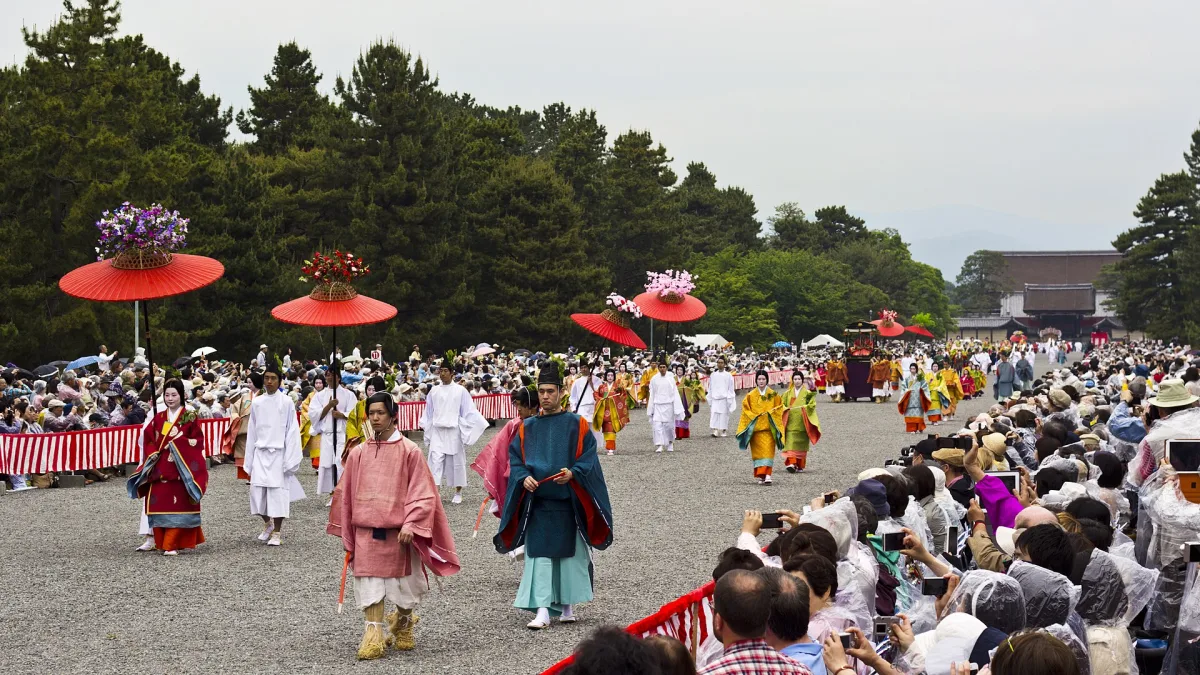
About 500 people in Heian court dress walk 8 km through Kyoto, keeping alive a 1,000-year-old festival of the capital that appears in The Tale of Genji.
Kyoto
- KyotoKyoto City: from the Kyoto Imperial Palace via Shimogamo Shrine (Sakyo Ward) to Kamigamo Shrine (Kita Ward), about 8 km
Recent years
| Year | Dates | Visitors | Notes |
|---|---|---|---|
| 2026 | 15 May | about 37,000 (Kyoto Prefectural Police figure) | The 68th Saio-dai took the role. Blessed with fine weather, the festival went ahead as planned. |
| 2025 | 15 May | — | The 67th Saio-dai took the role. It went ahead as planned, and crowds of spectators, including overseas visitors, lined the route. |
| 2024 | 15 May | about 35,000 | The 66th Saio-dai took the role. It went ahead as planned. |
| 2023 | 16 May (postponed from the 15th) | about 40,000 (Kyoto Prefectural Police count) | The procession, cancelled every year since 2020 because of COVID-19, returned for the first time in four years. It was postponed by a day because the weather looked likely to turn. |
When and where is it held?
The Aoi Matsuri is the reitaisai (the most important annual festival, held on a fixed date every year) of two shrines in Kyoto: Shimogamo Shrine (officially Kamo-mioya Jinja) and Kamigamo Shrine (Kamo-wakeikazuchi Jinja). It is counted as one of Kyoto's three great festivals, alongside the Gion Matsuri (July) and the Jidai Matsuri (October).
The main event is the procession called Roto no Gi, held on 15 May every year. The date is fixed whatever day of the week it falls on. If it rains, the procession is postponed to the 16th, and if it rains on the 16th as well, it is cancelled. Whether it goes ahead or is postponed is decided at around 6 pm the day before and announced on Kyoto Kanko Navi, the official website of the Kyoto City Tourism Association, and on social media.
From the start of May, a series of events called zengi (preliminary rites) takes place at both shrines in the run-up to the 15th. On 3 May, Shimogamo Shrine holds yabusame, in which archers shoot arrows from galloping horses, and on 5 May Kamigamo Shrine holds the Kamo Kurabeuma, in which two horses race against each other. Both offer a different kind of thrill from the procession.
Roto no Gi: the 8 km procession
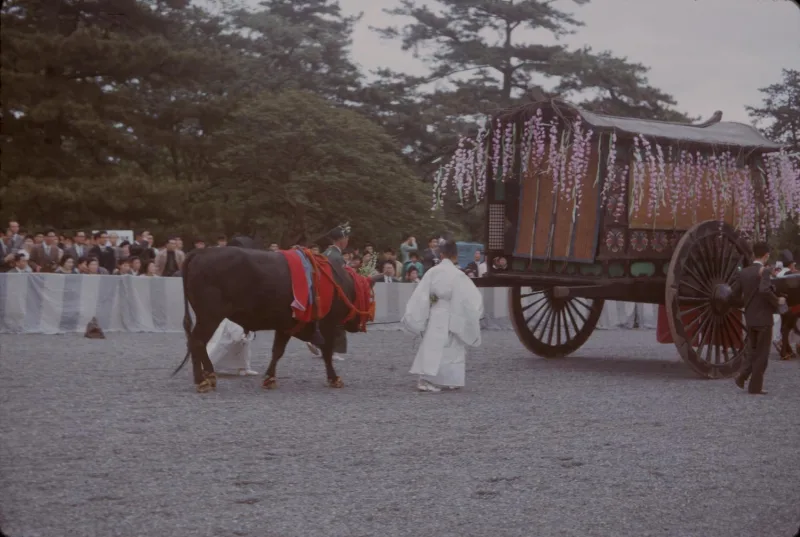
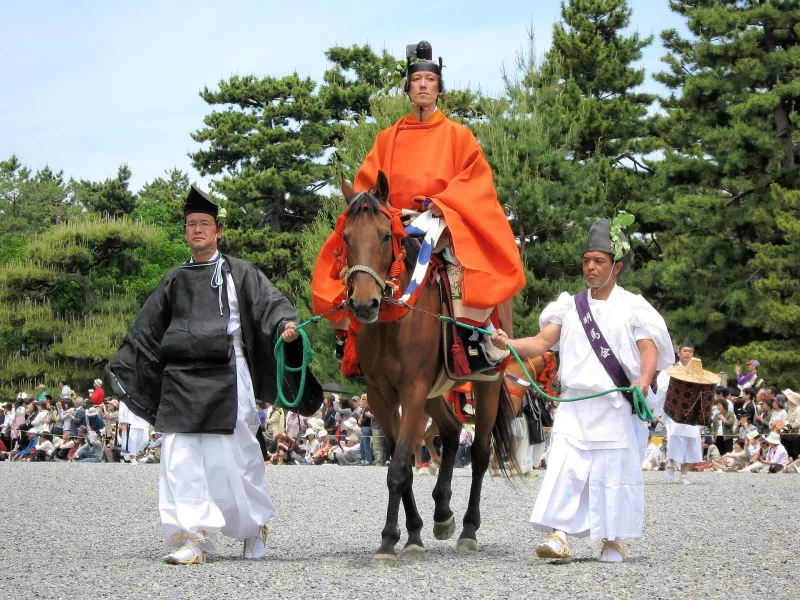
Roto no Gi recreates the journey of the chokushi (the emperor's envoy) on his way to worship at the two shrines. It involves just over 500 people, 36 horses, 4 oxen, 2 gissha (ox-drawn carriages) and 1 palanquin, and stretches for about 1 km in total.
The procession leaves the Kenreimon Gate of the Kyoto Imperial Palace at 10:30 am and travels along Marutamachi-dori and Kawaramachi-dori, reaching Shimogamo Shrine at around 11:40. After ceremonies at the shrine, it sets off again at around 2:20 pm, travels along Shimogamo-hondori, Kitaoji-dori and the Kamo River embankment, and arrives at Kamigamo Shrine at around 3:30 pm (times are when the head of the procession is expected to pass). The whole route is about 8 km.
At each shrine, a ceremony called Shato no Gi is held: the envoy reads out the gosaimon, a ritual address similar to a norito (Shinto prayer), and presents offerings. Horses are also led around before the deity, and dancers perform a dance called Azuma Asobi as an offering.
What to look out for: the Saio-dai and the ox carriages
The procession is divided into the main procession, centred on the Konoe Tsukai-dai, who stands in for the imperial envoy, and the Saio-dai procession of women, centred on the Saio-dai. The main procession includes kebiishi, officials in charge of policing and justice, mounted musicians carrying instruments and more, recreating Heian-period court posts just as they were.
The Saio-dai is the heroine of the Aoi Matsuri. In the Heian period, an unmarried woman of the imperial family served the gods as the "Saio", but this practice died out in the Kamakura period. In 1956, to liven up the festival, the women's procession was revived by choosing a stand-in from among Kyoto's residents, and she is called the Saio-dai, meaning "in place of the Saio". She wears the junihitoe, the formal court dress of many layered robes, and rides in an oyoyo, a palanquin carried by bearers.
Look out, too, for the vehicles and props: the ox carriage (goshoguruma) decorated with wisteria, moving slowly with creaking wheels, and the furyugasa, large parasols topped with artificial flowers such as peonies. Note that nobody rides in today's ox carriages; they are pulled along as decorations for the procession.
1,500 years of history, and the name "Aoi"
According to the Kamo Kyuki, records handed down at the shrines, the festival began around 1,500 years ago, in the reign of Emperor Kinmei. The legend goes that storms went on and on and the crops failed, so a divination was ordered, which revealed a curse by the Kamo deities. A festival was held, with horses wearing bells made to run, and the weather settled and the harvest was plentiful. In 819, it became a state event, one of the important rites of the imperial court.
Among Heian aristocrats, the festival was so well known that simply saying "the festival" meant the Aoi Matsuri, and it appears in The Pillow Book and The Tale of Genji. The Tale of Genji includes the "carriage quarrel" scene, in which the ox carriages of Aoi no Ue, Hikaru Genji's principal wife, and of his lover Lady Rokujo clash over a spot from which to watch the procession.
The festival was originally called the Kamo Sai. After the Onin War it lapsed for about 200 years, and it is said that it came to be called the Aoi Matsuri after its revival in 1694, when the palace blinds, the ox carriages, the costumes and so on began to be decorated with aoi leaves. The plant used is futaba aoi (a kind of wild ginger), which is also the crest of both shrines; combined with sprigs of katsura (the katsura tree), it is fixed all over the procession as "aoi-katsura". The festival was also interrupted in the early Meiji era and from the Second World War into the post-war years.
Where and how to watch
The procession travels along public roads, so you can watch from the roadside. The Kyoto City Tourism Association sets up paid seating in two places, at the starting point in the Kyoto Imperial Park and along the approach to Shimogamo Shrine, which suits those who want to sit and watch at leisure. At both, the procession takes a little under an hour to pass.
Large crowds from Japan and overseas gather every year; according to the Kyoto Prefectural Police, about 37,000 people came to see Roto no Gi in 2026. In the Kyoto Imperial Park, crossing the paths is restricted while the procession passes, and at Shimogamo Shrine, entry to and exit from the grounds are closed for a period for security. Get to your chosen spot early.
The nearest station to the Kyoto Imperial Park is Marutamachi on the Karasuma subway line, and for the approach to Shimogamo Shrine, Demachiyanagi on the Keihan line is convenient. There is no parking for cars or coaches at Shimogamo Shrine on the day. At Kamigamo Shrine, flying a drone over the grounds requires the shrine's prior permission, not just on the festival day.
Tips
- If rain is forecast, check the announcement on Kyoto Kanko Navi at around 6 pm the day before. The procession is postponed to the 16th, and cancelled if it rains on the 16th too.
- With the timetable in hand, you can see the procession twice in one day: at the Kyoto Imperial Park and Shimogamo Shrine in the morning, then on the Kamo River embankment or at Kamigamo Shrine in the afternoon.
- The approach to Shimogamo Shrine runs through a forest called Tadasu no Mori, so you can watch the procession pass through fresh spring greenery.
- Rather than only the procession, consider planning your trip around the preliminary rites too, such as the yabusame on 3 May or the Kamo Kurabeuma horse race on 5 May.
- The Kyoto Imperial Park has long stretches of gravel paths, so wear comfortable shoes.
Sources
- 京都観光Navi(京都市観光協会)「葵祭 どんな祭?」 (opens in a new tab)
- 京都観光Navi(京都市観光協会)「葵祭 行ってみよう!」(行列コースと時間) (opens in a new tab)
- 京都観光Navi(京都市観光協会)「葵祭 深く知る」 (opens in a new tab)
- 京都観光Navi(京都市観光協会)「葵祭 よくある質問」 (opens in a new tab)
- 賀茂別雷神社(上賀茂神社)「賀茂祭(葵祭)のご案内」 (opens in a new tab)
- 産経ニュース「初夏の都大路で王朝行列『路頭の儀』 京都で葵祭、3万7000人が観覧」(2026年5月15日) (opens in a new tab)
- 毎日新聞「王朝行列 時超えて 葵祭、壮大に」(2025年5月16日) (opens in a new tab)
- 京都新聞「京都三大祭り『葵祭』が新緑の都大路を彩る」(2025年5月15日) (opens in a new tab)
- 毎日新聞「葵祭『路頭の儀』 500人の王朝行列、古都を歩く 3万5000人を魅了」(2024年5月15日) (opens in a new tab)
- 朝日新聞「葵祭の斎王代『祭りのパワー感じた』 王朝行列、4年ぶりの平安絵巻」(2023年5月16日) (opens in a new tab)
- 日本経済新聞「新緑の京都で葵祭 4年ぶり、華やかに行列」(2023年5月16日) (opens in a new tab)