Japan is Nippon
Sanja Matsuri
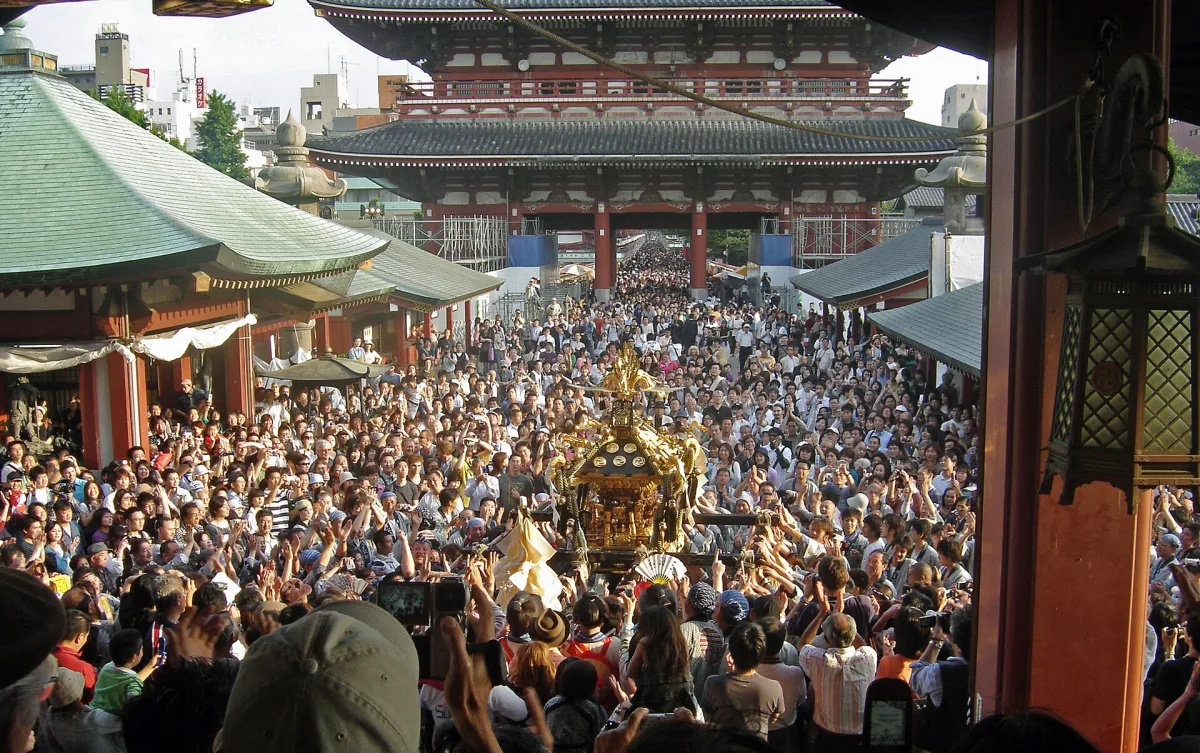
Around 100 mikoshi pour out from a small shrine beside Sensoji over three days. The dawn miyadashi is the best way to feel old downtown Tokyo's energy.
Tokyo
- TokyoAsakusa Shrine (next to Sensoji), Asakusa, Taito Ward, and the streets of its 44 parishioner neighbourhoods
Recent years
| Year | Dates | Visitors | Notes |
|---|---|---|---|
| 2026 | 15–17 May | — | The festival opened with the grand procession and the Binzasara Mai; on the 16th about 100 neighbourhood mikoshi made their joint procession along with the Konomiya, and the miyadashi took place early on the 17th. |
| 2025 | 16–18 May | about 1,800,000 | Rain fell on the second day. The final day's miyadashi was held in sunshine, with more than 1,000 parishioners gathering. The arrangement begun the year before, separating the fan clubs' katsugidashi from the miyadashi, was continued. |
| 2024 | 17–19 May | — | The Konomiya, a shrine mikoshi carried by children, appeared for the first time. A new arrangement began in which the fan clubs' katsugidashi was held separately from the parishioners' miyadashi, and about 2,000 parishioners took part in the miyadashi. |
| 2023 | 19–21 May | — | Held at its usual scale for the first time in four years after being scaled down because of COVID-19. It was also the first time in four years that parishioners carried the shrine's main mikoshi through the streets. The first day's grand procession was cancelled because of rain. |
When and where is it held?
The Sanja Matsuri is the reitaisai (the most important annual festival, held at a fixed time each year) of Asakusa Shrine in Asakusa, Taito Ward, Tokyo. Asakusa Shrine stands right next to the main hall of Sensoji Temple, and during the festival the whole of Asakusa becomes the venue.
It is held every year over three days, Friday to Sunday, centred on the third Saturday of May. In 2026 it ran from 15 to 17 May. It is led by the 44 neighbourhood associations of Asakusa Shrine's ujiko (parishioners: the residents of the area the shrine protects), and according to the shrine about 1.8 million people come over the three days.
The nearest station is Asakusa, on the Tokyo Metro Ginza Line, the Toei Asakusa Line and the Tsukuba Express.
How the three days unfold
On the first day, Friday, the 'grand procession' winds through Asakusa to announce the start of the festival, with floats carrying hayashi (festival music) players, kiyari work songs sung by the kashira (leaders of the traditional firefighter-builders), geisha dances and more. Afterwards the Binzasara Mai is offered at the shrine. This dance turns the movements of rice planting into a performance: dancers scatter red and white paper as if sowing seed rice and play an instrument called a sasara to pray for a good harvest.
On the second day, Saturday, after the main festival rites at the shrine, comes the joint procession of neighbourhood mikoshi (Chonai Mikoshi Rengo Togyo), when about 100 mikoshi from the 44 neighbourhoods gather at the shrine. Each mikoshi is purified in turn before heading back to its own neighbourhood. Since 2024 there has also been the Konomiya, carried by children.
On the final day, Sunday, the shrine's three miyamikoshi (the shrine's own main mikoshi) take centre stage. The day begins early with the miyadashi, when they are carried out of the grounds; the three then split up to the south, east and west and spend the whole day touring the parishioners' neighbourhoods, and the festival ends after dark with the miyairi, when they return to the shrine.
The biggest moment: the miyadashi
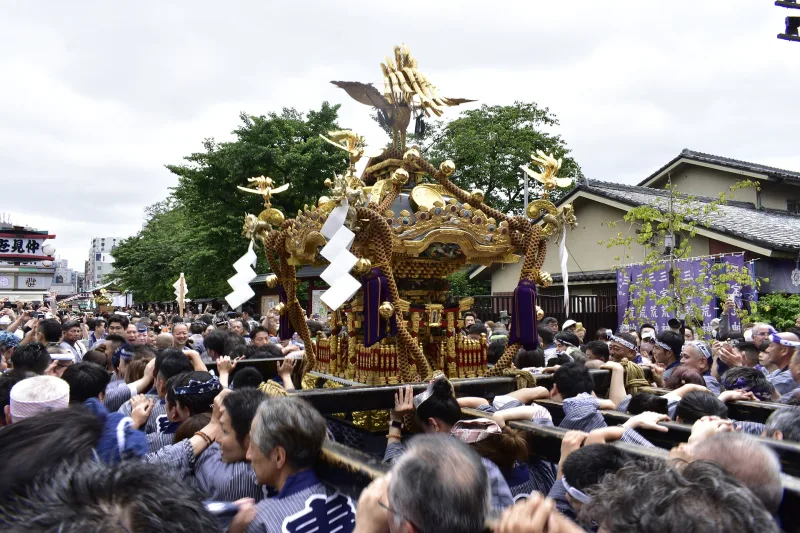
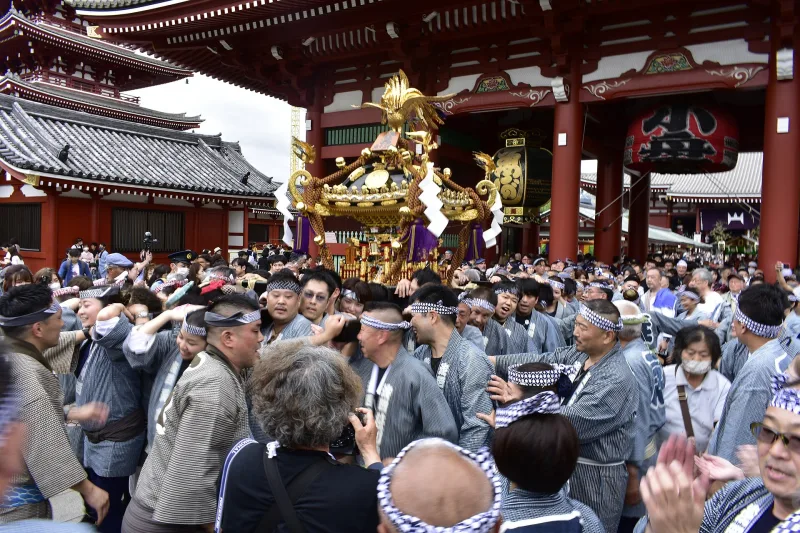
The miyadashi starts every year at around 6.30 to 7am on the Sunday. At the signal of an ippon-jime (a single clap made by everyone together on a call), the parishioners hoist the Ichinomiya, Ninomiya and Sannomiya mikoshi onto their shoulders and, chanting calls such as 'Oisa!' and 'Soiya!', advance into the grounds of Sensoji. About 2,000 parishioners joined the miyadashi in 2024.
The bearers shake the mikoshi violently up and down and from side to side. This is called tamafuri ('shaking the spirit'), and it has long been believed to strengthen the power of the god riding in the mikoshi, bringing good harvests and good catches and driving away illness.
The miyadashi gets extremely crowded. In the past there was trouble such as bearers from groups of mikoshi enthusiasts known as 'fan clubs' (dokokai) climbing onto the mikoshi, and in 2008 the miyadashi was even cancelled. Since 2024 the fan clubs' 'katsugidashi', when they carry mikoshi in the grounds, has been held at a different time from the parishioners' miyadashi, and reports say this has prevented chaos. If you go to watch, it is best to stand a little way back so you don't get caught up in the bearers' movements.
The name 'Sanja' and 700 years of history
According to legend, two brothers, Hinokuma no Hamanari and Takenari, pulled up a statue of Kannon (the Buddhist deity of mercy) in their net while fishing in the Sumida River (then called the Miyato River), and a local man of standing, Haji no Matsuchi, enshrined the statue in his home. This is said to be how Sensoji began, and Asakusa Shrine was later founded to worship these three men as gods. 'Sanja' ('three shrines') refers to these three gods, and each of the three shrine mikoshi carries one of them.
Until the end of the Edo period the festival was one with Sensoji, and it was called the Kannon Festival or the Asakusa Festival and held in March. In the 'boat festival', said to have begun in 1312, the mikoshi were put on boats and carried up the Sumida River. Back then the stars were the neighbourhoods' lavish dashi (festival floats); the current form, with mikoshi carried around the streets, dates from when the festival moved to May in the Meiji era.
Before the war there were seven mikoshi, including ones donated by the shogun Tokugawa Iemitsu, but all were destroyed in air raids during the Second World War. The present shrine mikoshi were donated by the parishioners in 1950 and 1953. In 2012, to mark 700 years of the Sanja Matsuri, the funatogyo, in which the mikoshi are carried on boats on the Sumida River, was held for the first time in about half a century. The shrine is also planning a funatogyo in March 2028, 1,400 years after Sensoji's principal image appeared.
Tips
- To see the miyadashi, head to the area around Asakusa Shrine and Sensoji early on Sunday morning. It gets very crowded, so watch from a safe distance from the bearers.
- If you want to see lots of mikoshi, Saturday is best, when about 100 neighbourhood mikoshi come out.
- The grand procession and the Binzasara Mai dance on the first day are a chance to watch traditional performing arts in a calmer setting. The procession may be cancelled if it rains.
- On the final day the shrine's mikoshi split up to the south, east and west and tour the neighbourhoods all day. Even if you miss the miyadashi, you may come across them in the streets during the day.
Sources
- 浅草神社「三社祭とは」 (opens in a new tab)
- 浅草神社「示現会(宮神輿 堂上げ・堂下げ、舟祭の歴史)」 (opens in a new tab)
- 浅草神社「舟渡御特設ページ」(2028年の舟渡御) (opens in a new tab)
- GO TOKYO(東京の観光公式サイト)「三社祭」 (opens in a new tab)
- 東京新聞「浅草・三社祭が開幕」(2026年5月15日、2025年の人出約180万人) (opens in a new tab)
- 朝日新聞「東京・浅草の三社祭 宮出しで最高潮」(2026年5月17日) (opens in a new tab)
- 東京新聞「三社祭の『宮出し』 1000人を超す氏子が集結」(2025年5月18日) (opens in a new tab)
- 朝日新聞「浅草・三社祭、早朝の宮出しで最高潮」(2025年5月18日) (opens in a new tab)
- 東京新聞「浅草・三社祭、今年も最終日の18日に同好会が『担ぎ出し』」(2025年5月17日) (opens in a new tab)
- 東京新聞「浅草・三社祭『宮出し』で最高潮に」(2024年5月19日) (opens in a new tab)
- 朝日新聞「東京・浅草の三社祭、早朝の宮出しに大歓声」(2024年5月19日) (opens in a new tab)
- 朝日新聞「初の子供宮神輿 元気に『わっしょい』」(2024年5月18日) (opens in a new tab)
- 朝日新聞「下町に初夏の訪れ、4年ぶりに通常開催 浅草・三社祭始まる」(2023年5月19日) (opens in a new tab)
- 読売新聞「浅草神社の三社祭、4年ぶりに『本社神輿』練り歩く」(2023年5月21日) (opens in a new tab)
- ウォーカープラス「700年目の“三社祭”の魅力」(2012年) (opens in a new tab)