Japan is Nippon
Kanda Matsuri
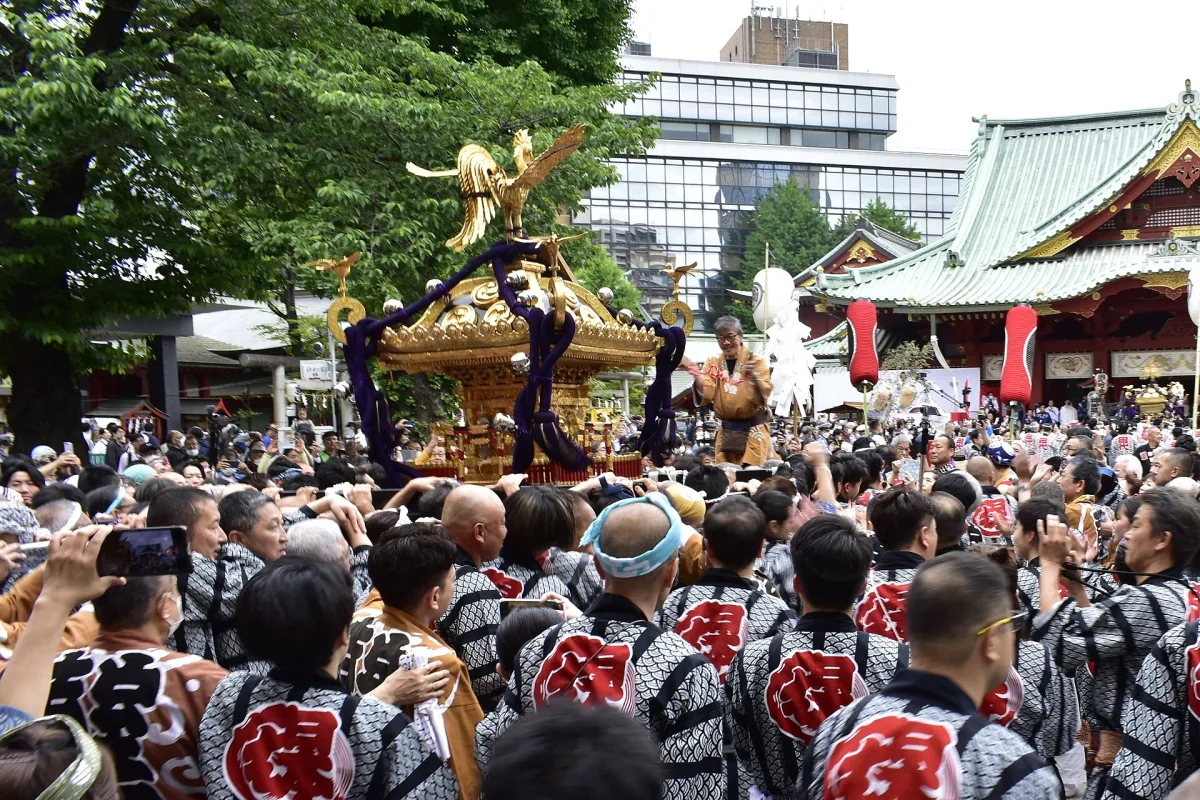
The "festival of the realm" once watched by the shogun: every two years, over 200 mikoshi (portable shrines) wind through central Tokyo to Kanda Myojin.
Tokyo
- TokyoKanda Myojin in Sotokanda, Chiyoda, and its 108 parish neighbourhoods, including Kanda, Nihonbashi, Otemachi, Marunouchi and Akihabara
Recent years
| Year | Dates | Visitors | Notes |
|---|---|---|---|
| 2025 | 8–15 May (Shinkosai on the 10th, mikoshi miyairi on the 11th) | — | A main festival year. In the Shinkosai on the 10th, a grand procession of sacred palanquins, mikoshi and floats toured about 30 kilometres through Otemachi, Nihonbashi, Akihabara and beyond, and was joined by the tsukematsuri in front of Mitsukoshi in Nihonbashi, swelling to several thousand people. The following year, 2026, was a kagematsuri (off-year festival), with no Shinkosai or mikoshi miyairi. |
| 2023 | 11–17 May (Shinkosai on the 13th, mikoshi miyairi on the 14th) | — | Held at full scale for the first time in four years, since 2019. On the 13th the Shinkosai and miyairi went ahead in occasionally heavy rain. It was the 150th anniversary of Ebisu-sama (Sukunahikona-no-Mikoto) being enshrined, and mounted warriors from the Soma Nomaoi took part in the tsukematsuri. |
| 2021 | May | — | A main festival year, but because of COVID-19 measures only the shrine rituals were held, by those directly involved. The Shinkosai, mikoshi miyairi and other events were cancelled. |
| 2019 | 9–15 May (Shinkosai on the 11th, mikoshi miyairi on the 12th) | — | Held as a commemorative Kanda Matsuri celebrating the Emperor's enthronement. |
When and where is it held?
The Kanda Matsuri is the festival of Kanda Myojin (officially Kanda Shrine) in Sotokanda, Chiyoda, Tokyo. The shrine's ujiko (the residents of the area a shrine protects) span 108 neighbourhood associations, including Kanda, Nihonbashi, Otemachi, Marunouchi and Akihabara, and during the festival this whole area becomes the venue.
The honmatsuri (main festival), with its big processions and mikoshi (portable shrines), is held once every two years, in mid-May of odd-numbered years. Even-numbered years are called kagematsuri ("shadow festival"): there are rituals at the shrine, but no processions through the streets and no mikoshi miyairi. Indeed, 2026 was a kagematsuri, so there was no Shinkosai or mikoshi miyairi.
The main festival is built around the reitaisai (the shrine's most important annual ritual) on the 15th, with the big events concentrated on the Saturday and Sunday just before it. In 2025, the Senzasai, which moves the spirits of the deities into the mikoshi, took place on the evening of Thursday the 8th; the Shinkosai and tsukematsuri on Saturday the 10th; the neighbourhood associations' mikoshi miyairi on Sunday the 11th; and the reitaisai on the 15th. The next main festival is expected in 2027, but as of October 2026 the dates have not been announced.
The Shinkosai: a day-long grand procession
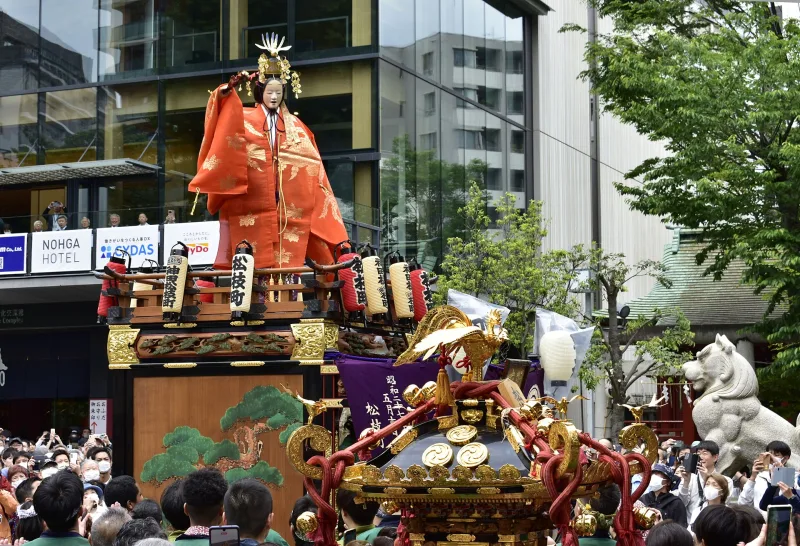
The Shinkosai is the most eagerly watched event of the Kanda Matsuri. The three deities of Kanda Myojin, Daikoku-sama (Onamuchi-no-Mikoto), Ebisu-sama (Sukunahikona-no-Mikoto) and Masakado-sama (Taira-no-Masakado-no-Mikoto), each ride in a horen (a palanquin with a phoenix on its roof) or a mikoshi, touring the 108 neighbourhoods to purify the town.
The procession leaves the shrine early in the morning, accompanied by floats such as the Kanko-dashi, which carries a drum, and the Shishigashira-dashi (lion-head float), and covers a route of about 30 kilometres. Along the way it stops for a ritual at the Masakado-zuka in Otemachi (a mound dedicated to Taira-no-Masakado, and the original site of Kanda Myojin), then tours the Nihonbashi area. In the evening the tsukematsuri joins it in front of the Mitsukoshi main store in Nihonbashi, and the procession swells to several thousand people. It passes along Chuo-dori and through Akihabara's Electric Town, returning to the shrine at around 7pm.
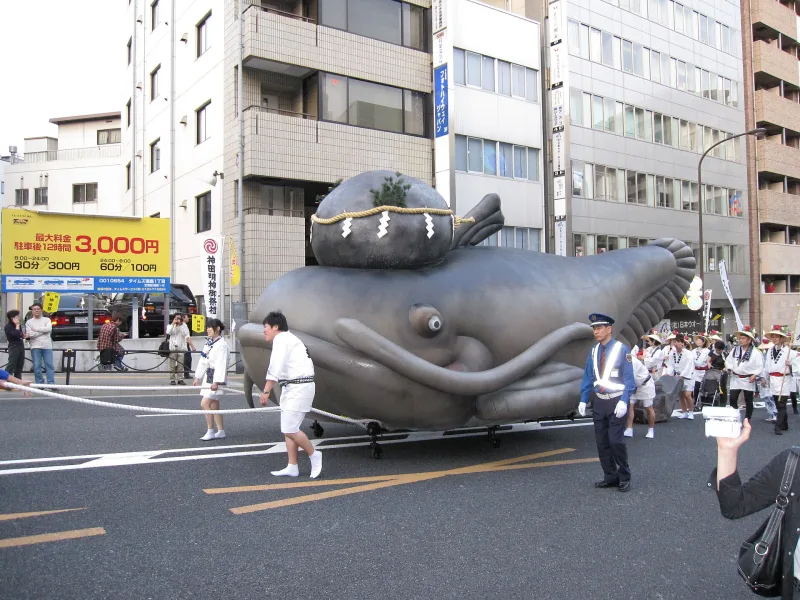
The tsukematsuri is a modern revival of the most popular attractions of the Kanda Matsuri in the Edo period (1603–1868). It features hikimono (giant papier-mâché figures pulled along on floats), costume parades, daikagura (acrobatic street performance) and more, and the line-up changes from year to year. In 2023, mounted warriors from the Soma Nomaoi in Minamisoma, Fukushima Prefecture, took part as special guests.
Mikoshi miyairi: 200 portable shrines converge
The Sunday after the Shinkosai is the day of the mikoshi miyairi, when each neighbourhood association carries its own mikoshi to Kanda Myojin to pay its respects. More than 200 neighbourhood mikoshi, large and small, enter the shrine grounds one after another from morning until night. The chants and energy of the bearers, dressed in matching hanten (short festival jackets), are said to be the highlight of the Kanda Matsuri.
Each neighbourhood association is given an approximate time and order for its miyairi, which are announced on the official website, though times and order may change. On the day of the Shinkosai itself (the Saturday), mikoshi from the Nihonbashi neighbourhoods also make their miyairi from the evening into the night.
A history as the "festival of the realm"
According to tradition, Kanda Myojin was founded in 730 in today's Otemachi, around the Masakado-zuka. In the Edo period it moved to its present site as Edo Castle expanded, and as the sochinju of Edo (the shrine protecting the whole city) it was worshipped by everyone from the shogun to ordinary townspeople.
The festival was held every year until the early part of the Edo period, but it eventually began alternating year by year with the Sanno Matsuri of Hie Shrine, and the pattern of a main festival every two years continues to this day. Under the protection of the Tokugawa shogunate, the procession of mikoshi and dozens of floats even entered the grounds of Edo Castle and was watched by the shogun, which is why it came to be called the tenka matsuri ("festival of the realm"). It is also counted among Japan's three great festivals and Edo's three great festivals.
In the Meiji era (1868–1912), the festival moved from September to May, partly because of typhoons, and with the spread of overhead electric wires the tall floats could no longer travel the streets. After that, it became common for each neighbourhood association to carry its own mikoshi. The newly made horen was destroyed by fire in the Great Kanto Earthquake of 1923, and the Shinkosai in its current form was first held in 1952, after the Second World War.
Tips and things to keep in mind
The processions and mikoshi move along public roads, so you can watch from the roadside. On miyairi day, the neighbourhood mikoshi parade through the streets of Kanda on their way to the shrine, so you can come across them not only in the shrine grounds but also on the streets leading to it.
The Shinkosai route can be downloaded from the official website, which also gives approximate times for the main rituals. Times may change, though, so leave yourself some slack on where and when you want to be. The procession passes through Akihabara in the evening, so you could watch it in Nihonbashi or Otemachi during the day and in Akihabara in the evening, enjoying it from different spots.
Tips
- The main festival (honmatsuri) is held only in odd-numbered years. If you visit in an even-numbered year there is no big procession or mikoshi miyairi, so check the year before you plan your trip.
- To see as many mikoshi as possible, go on the Sunday for the mikoshi miyairi; for the grand procession of the sacred palanquins and the floats of the tsukematsuri, go on the Saturday for the Shinkosai.
- You can check the Shinkosai route and rough timings in advance on the Kanda Matsuri official website.
- Kanda Myojin is about a 5-minute walk from Ochanomizu Station (JR and Tokyo Metro) and about a 7-minute walk from Akihabara Station.
Sources
- 神田明神「令和七年神田祭」特設サイト(日程、令和8年は陰祭の告知) (opens in a new tab)
- 神田明神「過去の神田祭」 (opens in a new tab)
- 神田明神 令和5年神田祭特設サイト「神田祭の歴史」 (opens in a new tab)
- 神田明神 令和5年神田祭特設サイト「神幸祭」 (opens in a new tab)
- 神田明神 令和5年神田祭特設サイト「神輿宮入」 (opens in a new tab)
- 神田明神 令和5年神田祭特設サイト「神幸祭神輿宮入」 (opens in a new tab)
- 神田明神 令和5年神田祭特設サイト「附け祭」 (opens in a new tab)
- 神田明神 令和5年神田祭特設サイト「例大祭」 (opens in a new tab)
- 神田明神 令和5年神田祭特設サイト「宮司挨拶」 (opens in a new tab)
- 神田明神 平成31年(令和元年)天皇陛下御即位奉祝記念神田祭 特設サイト (opens in a new tab)
- Wikipedia「神田祭」(補助) (opens in a new tab)
- 神田明神「アクセス」 (opens in a new tab)
- 朝日新聞「2年に1度の神田祭『神幸祭』、みこしかつぎ豪華に都心練り歩く」(2025年5月10日) (opens in a new tab)
- 朝日新聞「『神田祭がないと生きていけない』 4年ぶりの神輿、熱気復活」(2023年5月13日) (opens in a new tab)