Japan is Nippon
Hirosaki Cherry Blossom Festival
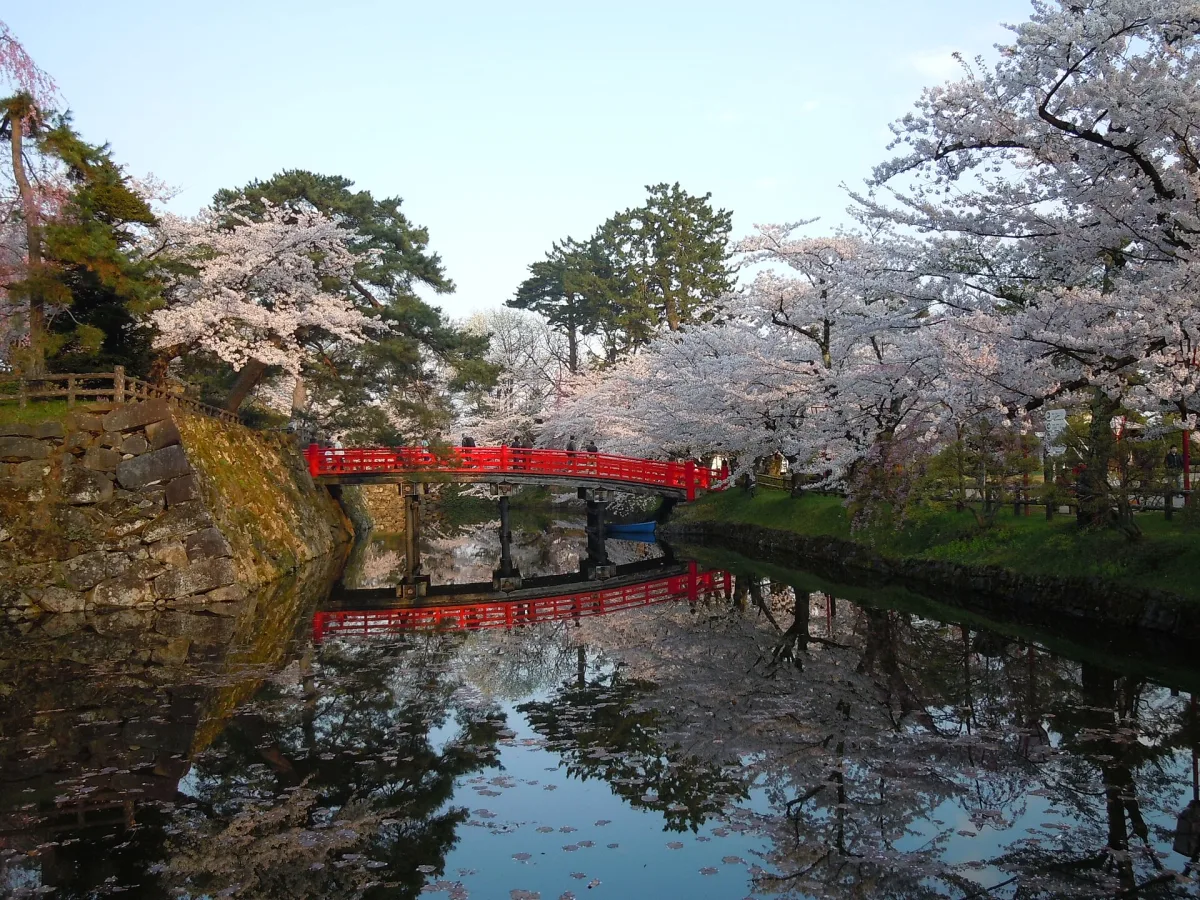
About 2,600 cherry trees of 52 varieties ring Hirosaki Castle's moats and keep in Aomori. Tended with apple-growing know-how, each bud bears extra blossoms.
Recent years
| Year | Dates | Visitors | Notes |
|---|---|---|---|
| 2027 | 16 April – 5 May (planned) | — | Planned to run for 20 days. If early blooming is expected, an earlier start will be discussed again. Food stalls are to have shorter opening hours in May. |
| 2026 | 10 April – 5 May | 2.28 million (city estimate) | Opened to match the early blossom, the earliest start since the war, and ran for a record 26 days. Strong winds right after full bloom scattered the petals in one go, and visitor numbers came in slightly below the year before. |
| 2025 | 16 April – 5 May | 2.31 million (city estimate) | The blossom forecast moved earlier, so the opening was brought forward by two days. The festival ran for 20 days. |
| 2024 | 12 April – 5 May | 2.45 million (city estimate) | Learning from the previous year, the opening was moved a week earlier, giving what was then a record 24-day festival. It was the first festival since COVID-19 was reclassified as a Class 5 infectious disease, and overseas visitors increased too. |
| 2023 | 15 April – 5 May (full festival from 21 April) | 2.04 million (city estimate) | The Somei Yoshino opened on 7 April, the earliest on record, and were in full bloom before the festival began. It started in a scaled-down "semi-festival" mode, and blossom-viewing parties were allowed for the first time in four years. |
When and where is it held?
The Hirosaki Cherry Blossom Festival takes place every year in Hirosaki Park in Hirosaki, Aomori Prefecture, timed to the cherry season: it runs from mid-April until 5 May, Children's Day. The park is the site of Hirosaki Castle from the Edo period (1603–1868), now a national historic site. The festival is organised by four bodies: Hirosaki City, the Hirosaki Chamber of Commerce and Industry, the Hirosaki Tourism and Convention Bureau and the Hirosaki City Products Association.
The opening day is set each year according to how the blossom is coming along, and it is brought forward when the trees flower early. In 2026 the cherries were early, so the festival opened on 10 April, seven days ahead of plan, and ran until 5 May: 26 days, the longest ever. The 2027 festival has been announced for 20 days, from Friday 16 April to Wednesday 5 May (a public holiday), though the dates may change depending on the blossom.
During the festival the best cherry spots are specially lit from sunset until 10pm, and food stalls line the paths inside the park. More than two million people come every year; the city estimated 2.28 million visitors in 2026.
Cherry blossom said to be the best in Japan
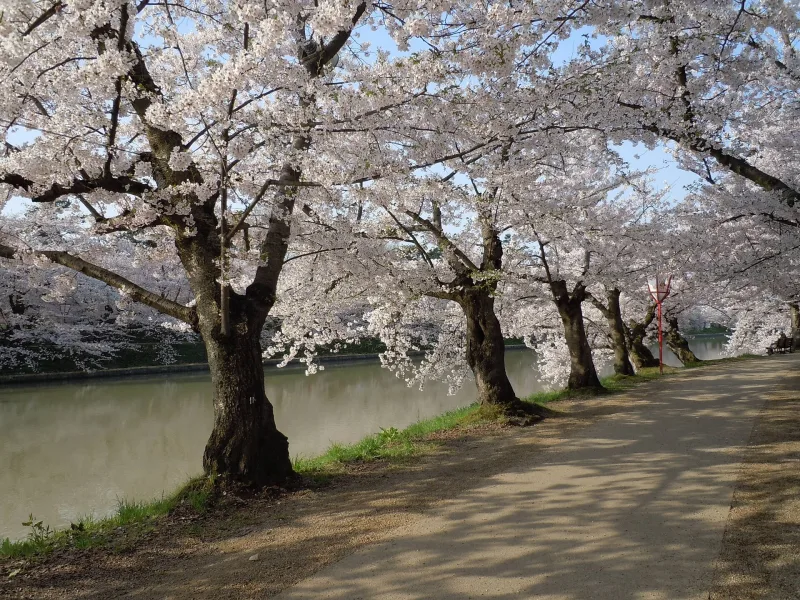
Hirosaki Park has about 2,600 cherry trees of 52 varieties, mainly Somei Yoshino (Japan's best-known cherry variety), along with weeping cherries, double-flowered yaezakura and more. What locals are proudest of is how the trees bloom. A typical cherry produces three or four blossoms from each flower bud, but the trees in Hirosaki Park produce four or five. Stand under a branch in full bloom and the flowers are packed so densely you can hardly see the sky.
Behind this is a way of caring for cherry trees known as the "Hirosaki method". It draws on the techniques used to grow apples, Aomori's signature crop, and thanks to it even old Somei Yoshino trees more than 100 years old still flower abundantly. The people who look after the park's cherries are called sakuramori, "cherry guardians".
The fun carries on after the Somei Yoshino have fallen. The park has about 700 trees of 40 varieties that flower later, and seven particularly striking double-flowered varieties among them are promoted as the "Hirosaki Seven Cherries" (Hirosaki Shichizakura). These include Ukon, with its yellow blossoms, and Hirosaki Yukiakari, a variety born in Hirosaki, which come into their best one after another until around the early-May holidays.
A history that began with saplings 300 years ago
The first record of cherries being planted at Hirosaki Castle dates back to 1715, when a samurai of the Hirosaki domain had 25 saplings, including kasumizakura (a wild mountain cherry), brought from Kyoto and planted in the castle grounds. In 1882 a former samurai of the domain, Kikuchi Tatee, donated 1,000 Somei Yoshino trees. One of them still flowers today as "the oldest Somei Yoshino in Hirosaki Park" and is designated a natural monument of Aomori Prefecture.
The festival itself began in 1918, when the local merchants' association held the first kanokai (cherry-viewing gathering) for a week from 3 May. It was suspended in the war years of 1944 to 1946, officially resumed in 1947, and took the name Hirosaki Cherry Blossom Festival in 1961. In 2020 it was cancelled because of the spread of COVID-19, and the park was closed as well.
The festival used to be known for full bloom falling during Golden Week, the string of public holidays in early May. In recent years, though, the blossom has been coming earlier, and since 2014 full bloom has always arrived before 29 April. The city has responded by bringing the opening forward and promoting the late-flowering double cherries, so that the second half of the festival is still worth a visit.
Highlights and how to enjoy them
One of the most popular views is the "cherry blossom tunnel", which runs for about 360 metres along the east side of the West Moat (Nishibori). About three days after full bloom, fallen petals carpet the surface of the outer moat, creating what is called hanaikada (petal rafts). In the Honmaru, the castle's inner citadel, you can see Hirosaki Castle's keep, which survives from the Edo period, framed by yae-beni-shidare (double-flowered red weeping cherries).
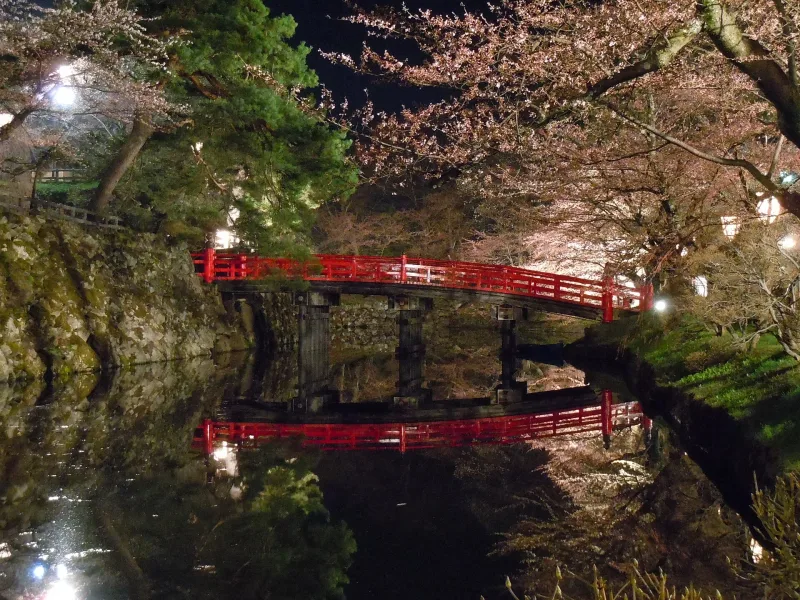
At night the illuminated cherries, including those around Shunyo Bridge over the West Moat, are reflected in the water. During the festival there are also events you can only enjoy at this time of year: sightseeing boats around the moats, rowing boats, rickshaws, and the Shinomaru performance stage, where you can hear the Tsugaru shamisen (a powerful style of three-stringed lute music from this region).
Walking a full circuit of the park takes about two hours. The Honmaru and Kita-no-Kuruwa (the northern enclosure) and the Hirosaki Castle Botanical Garden are paid areas, though you can enter the Honmaru and Kita-no-Kuruwa outside the set charging hours. Note that the castle keep has been temporarily moved while its stone walls are repaired; it could not be visited inside in 2026, and there are plans to return it to its original position around November 2026.
Crowds and etiquette
The busiest days are when full bloom coincides with a weekend. In 2026, 350,000 people came on a single day, 19 April, just after full bloom; in 2024 it was 330,000 on 20 April. If you want to take your time, it is best to avoid the weekend straight after full bloom.
During the festival you cannot bring bicycles into the park. You cannot walk pets there either, but they can come in if they are in a cage or pet buggy or carried in your arms (not inside buildings). Flying drones without permission is prohibited. Some ticket booths and other places in the park accept cash only, so it is wise to carry some.
The park is about a 30-minute walk from JR Hirosaki Station. The roads around it get very congested during the festival, so if you are driving, check the parking information in advance.
Tips
- If you want to catch the Somei Yoshino at full bloom, check the city's "Hirosaki Park Cherry Blossom Information" updates on how the trees are flowering before you fix your dates.
- Even a little after full bloom there is plenty to see: the hanaikada (petal rafts) on the outer moat and the late-flowering "Hirosaki Seven Cherries".
- The evening illuminations run from sunset until 10pm (in 2026 extended to 11pm for part of the festival). The park feels completely different by day and by night.
- Crowds peak on the weekend just after full bloom. If your schedule allows, go on a weekday.
- Some ticket booths in the park take cash only, so bring a little cash with you.
Sources
- 弘前観光コンベンション協会「【公式】弘前さくらまつり」 (opens in a new tab)
- 弘前観光コンベンション協会「弘前桜物語 ~七にまつわる桜の物語~」 (opens in a new tab)
- 弘前市「弘前公園さくら情報(令和8年)」 (opens in a new tab)
- 弘前公園総合情報サイト「弘前公園の桜」(株式会社コンシス運営) (opens in a new tab)
- 弘前さくらまつり情報サイト「弘前さくらまつりについて」(株式会社コンシス運営) (opens in a new tab)
- 朝日新聞「弘前さくらまつり、来場者は228万人 会期は戦後最長も昨年より減」(2026年5月8日) (opens in a new tab)
- 陸奥新報(Yahoo!ニュース)「弘前さくらまつりの人出、前年より3万人減」(2026年5月) (opens in a new tab)
- 陸奥新報(Yahoo!ニュース)「27年度会期は4月16日~5月5日/弘前さくらまつり」(2026年10月) (opens in a new tab)
- 朝日新聞「弘前さくらまつり人出231万人 14万人減、会期短く天候も影響か」(2025年5月8日) (opens in a new tab)
- なびたび北東北(陸奥新報)「弘前さくらまつり 245万人/23年比41万人増」(2024年5月) (opens in a new tab)
- 朝日新聞「GWに葉桜、温暖化にあの手この手 弘前さくらまつり対策、成果は?」(2024年5月15日) (opens in a new tab)
- 朝日新聞「弘前さくらまつりが準体制で開幕 宴会も4年ぶりに解禁」(2023年4月16日) (opens in a new tab)
- Wikipedia「弘前さくらまつり」 (opens in a new tab)