Japan is Nippon
What Is Noh, and How Can a Beginner Watch It in Japan?
Noh is Japan's classical theatre, more than 650 years old, in which masked actors tell a story through chanted song and dance. For a first visit, try the National Noh Theatre in Sendagaya, Tokyo: every seat has an English subtitle screen, and a front seat for a regular performance costs 5,800 yen (p
The short answer
Noh is a form of music-drama in which actors wearing omote (the masks used in Noh) move the story along through dance and utai (words delivered in a melodic chant, half sung, half spoken). Noh and kyogen are classical theatre forms that are still performed today, more than 650 years after they took shape. Noh is considered the oldest form of Japanese theatre still in existence.
Noh is performed on the same stage as kyogen, a comic form, and the two together are called nogaku. In 2008 UNESCO inscribed nogaku on the Representative List of the Intangible Cultural Heritage of Humanity (it was originally proclaimed in 2001).
People tend to assume Noh is slow and difficult, but once you know what to look out for, you can enjoy it perfectly well without understanding the words. This article covers how Noh came about, how to read the stage and the masks, why it feels so slow, subtitles and tickets at the National Noh Theatre, takigi noh (outdoor Noh performed by torchlight) and theatre etiquette.
When was Noh created, by whom, and how is it related to kyogen?
The roots of Noh and kyogen lie in sangaku, a type of entertainment that came to Japan from China in the Nara period (the 8th century). Sangaku included acrobatics, songs, dances and comic sketches. It then developed through ties with temples and shrines and through contact with other performing arts, and until the Edo period it was known as sarugaku.
Noh much as we know it today was perfected by Kan'ami and his son Zeami. The two gave Noh its present form in the 14th century, and there are about 250 plays in the repertoire. Noh and kyogen came under the protection of the shogunate and became an art of the samurai class, and in the Edo period they became the ceremonial performing art of the Tokugawa shogunate. The Japanese government designated nogaku an Important Intangible Cultural Property in 1957.
Kyogen is a dialogue-based form of theatre performed on the same stage as Noh. In kyogen the story moves forward through the characters' conversation; it takes everyday events of its time as its subject and uses exaggerated gestures to bring out the comedy in the kind of people you might meet anywhere. Kyogen was originally performed as an interlude between one Noh play and the next, and performances still combine Noh and kyogen today.
More than 200 Noh plays and more than 200 kyogen plays are performed today. A Noh play lasts roughly 60 to 90 minutes and a kyogen play about 15 to 30 minutes. Special celebratory performances sometimes stage five Noh plays and four kyogen plays over a whole day, but these days most programmes are shorter, with one or two Noh plays and one kyogen.
What should you look for on a Noh stage? The stage, masks and music
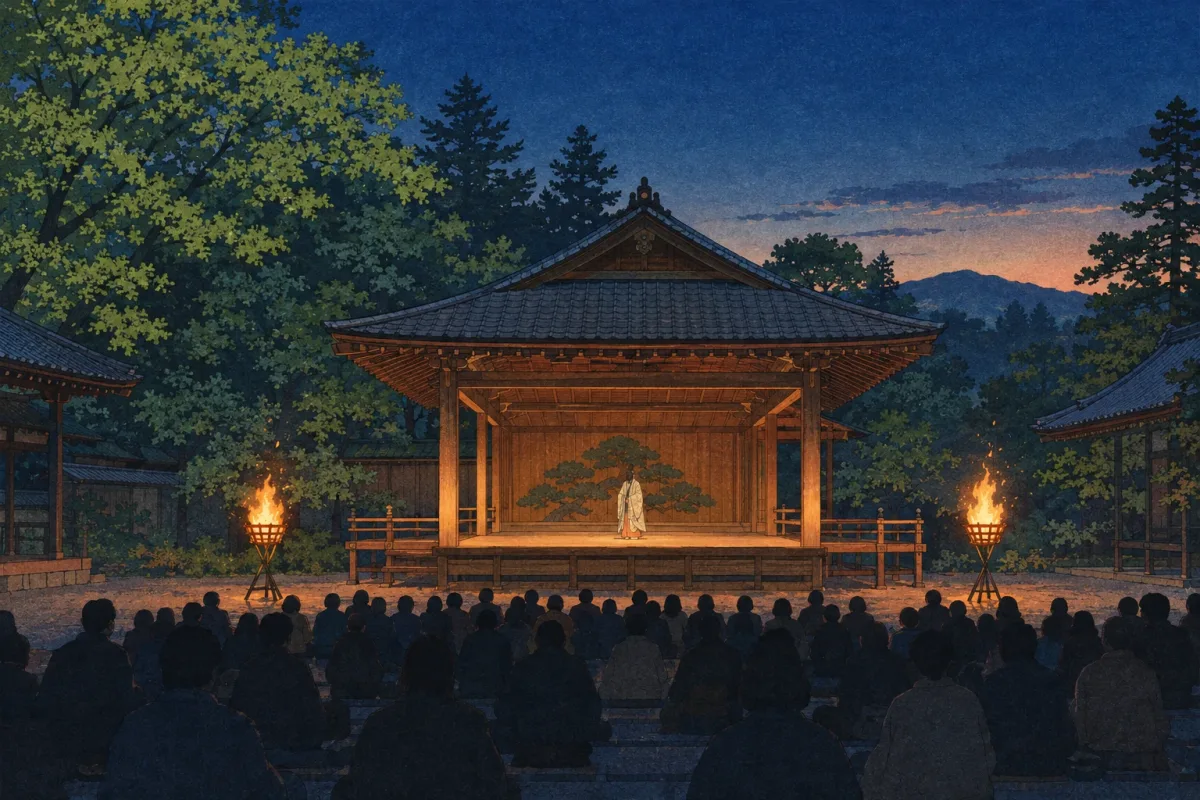
The Noh stage is square and juts out into the audience, with no curtain, no lighting effects and no large sets. The only thing you could call decoration is the magnificent pine tree painted on the kagami-ita (the backdrop at the rear of the stage). The main stage at the National Noh Theatre is 5.4 m square, and the pillars at its four corners do more than hold up the roof: they are also markers that let actors, whose view is narrowed by their masks, check where they are. Noh theatres have a roof over the stage even though they are indoors because they keep the form of the days when Noh was performed on outdoor stages.
The walkway that runs diagonally back from the main stage is called the hashigakari. It is not only the actors' way on and off the stage but also stands for the path between this world and the next. The hashigakari at the National Noh Theatre is 13.5 m long. At its far end is the kagami-no-ma (mirror room), where the lead actor puts on the mask while looking at himself in a large mirror and takes on the role.
The lead role in Noh is called the shite, who usually plays a being not of this world, such as a god, a spirit, a ghost or a demon, wearing a mask. The opposite role, the waki, is a living man, such as a travelling monk or a samurai, and normally wears no mask. At the side of the stage sits the jiutai, a chorus in two rows, which chants the scene and the characters' feelings.
The music is provided by the hayashi, made up of four instruments: the flute, the kotsuzumi (a small hand drum played on the shoulder), the otsuzumi (a larger hand drum held at the hip) and the taiko (a stick drum). A Noh mask shows an infinite range of expressions depending on the actor's skill, the angle you see it from and the way the light falls on it. Watch how the mask's expression shifts when the actor turns his head even slightly, and Noh suddenly becomes far more interesting.
Why is Noh so slow and hard to follow?
Because Noh is still performed in much the form it had when it took shape more than 600 years ago, the words can be hard to catch, especially in Noh itself, and you may not follow the story. Even Japanese speakers find it far from easy to make out Noh chanted in old language, so it's only natural for visitors from abroad to feel they have no idea what's going on.
Noh has no bell or other signal, so you may not notice when a play begins or ends. A performance follows a set pattern: the musicians and the chorus come out onto the empty stage, the waki introduces himself, the shite appears and the story unfolds, and finally the stage is left empty again. The sound of the instruments tuning up in the mirror room (oshirabe) is the sign that the performance is about to begin.
Most Noh plays are mugen noh ("dream" Noh): a spirit (the shite) appears before a travelling monk (the waki) in the guise of a local person and tells a story from the past, then in the second half reappears in its true form and dances, and it all turns out to have been the waki's dream. Between the two halves there is sometimes an ai-kyogen, in which a kyogen actor retells the local legend in plain language. Just knowing this pattern makes Noh much easier to watch.
Movement in Noh is kept small, but deep meaning is packed into the slightest motion, and every gesture means something. With no sets, the audience fills in the scene with their imagination. Reading the plot summary or an explanation beforehand makes the play far more enjoyable.
How do you watch Noh at the National Noh Theatre in Tokyo? Subtitles and tickets
The place we'd most recommend for first-timers is the National Noh Theatre in Sendagaya, Tokyo. It opened in 1983 to preserve and promote nogaku and has 627 seats. It is a 5-minute walk from Sendagaya Station on the JR Sobu Line and from Kokuritsu-Kyogijo Station on the Toei Oedo Line (Exit A4). Its exhibition room displays masks, costumes and other nogaku materials, and entry to the 2026 exhibitions was free.
The subtitles are a real boon for foreign visitors. In November 2006 the National Noh Theatre introduced Japan's first seat-back subtitle system. There is a small LCD screen on the back of the seat in front of you, and with the touch panel you can choose Japanese, a foreign language (English, plus four other languages for some performances) or no display. The English display gives a free translation along with commentary, so that visitors from abroad seeing Noh for the first time can enjoy it. The subtitles are available at all of the theatre's own performances, with a few exceptions.
The National Noh Theatre prices published as of July 2026 were: for regular and introductory performances, 5,800 yen for a front seat, 4,000 yen for a side-front seat and 3,500 yen for a middle-front seat; for special performances, 12,000 yen for a front seat. The National Noh Theatre Showcase, which includes a Noh mask experience and a pre-performance talk by a Noh performer before the curtain-up, was 4,000 yen for a front seat and was aimed at first-timers. There are student prices too (published prices confirmed as of November 2026; they vary from performance to performance).
There are three kinds of seat, each with a different view: shomen (front), facing the stage head-on; waki-shomen (side-front), looking from the hashigakari side; and naka-shomen (middle-front), between the two, which takes in the whole stage. As a rule, each Noh programme is staged only once, so it's important to check the schedule in advance. Tickets can be booked and bought on the National Theatre Ticket Center website (which has English pages), among other places.
Where else can you see Noh outside Tokyo, and what is takigi noh by torchlight?
Besides the National Noh Theatre in Tokyo there are similar venues in Nagoya and Osaka that hold regular performances, and Kyoto and Nara have permanent stages belonging to the Noh schools. Performances at national and other public venues often come with translation, whereas prefectural and city theatres offer hardly any guidance in foreign languages.
The Nagoya Noh Theater opened in 1997, has 630 seats and holds regular performances six times a year, and its earphone guide, which lets you listen to commentary, is also available in English. The Kyoto Kanze Kaikan (in Sakyo Ward, Kyoto) rents out English subtitle devices for 1,000 yen a day (tax included), to the first 50 people.
Another way to enjoy Noh is takigi noh, performed outdoors at night by the light of torches (takigi). Takigi noh is held in the grounds of temples and shrines, in parks and elsewhere, and some performances are free, so travellers can easily get a taste of Noh.
The takigi noh at Kofuku-ji temple in Nara is held every year on the third Friday and Saturday of May, with seats at 5,000 yen per day and free standing room at the back. The takigi noh at Heian Shrine in Kyoto is held every year on 1 and 2 June; advance tickets are discounted, and tickets are said to sell out easily close to the day. Dates and prices can change from year to year, so check the organiser's latest information before you go.
What is the etiquette at a Noh theatre?
There is no dress code at Noh theatres. You don't need to wear a kimono; everyday clothes are fine. You are, however, asked to be in your seat before the performance begins and to avoid going in and out during it. At the National Noh Theatre a bell rings five minutes before curtain-up, so be seated by then.
The National Noh Theatre strictly forbids photography and audio or video recording during performances. Switch off your mobile phone or smartphone, and keep chatter and noise to a minimum. Even small sounds, such as the rustle of a plastic bag or the jingle of a bell, are very distracting for the people around you. Eating and drinking in the auditorium are not allowed either.
The National Noh Theatre asks audiences to take off their hats for the sake of the people behind them, and not to lean forward or crane over while watching. Don't bring large bags into the auditorium; use the coin lockers. It's also important to stay in the seat you bought and not move to another.
Noh is an art of savouring small movements and sounds in silence. Following the etiquette also helps you lose yourself in the world of Noh.
Tips
- For your first time, go to the National Noh Theatre in Tokyo. Switch the subtitle screen on your seat to English and you'll get a free translation plus commentary (except at some performances).
- Read the plot summary of the play before you go. Knowing the mugen noh pattern, in which the shite (lead) appears in human form in the first half and in their true spirit form in the second, makes it much easier to follow.
- As a rule, each Noh programme is staged only once. Once your travel dates are set, check the schedule early on the National Theatre Ticket Center website.
- Travelling in spring or early summer? Consider takigi noh at Kofuku-ji in Nara (May) or Heian Shrine in Kyoto (1 and 2 June). Check the organiser's latest information on dates and prices before you go.
- Be seated by the bell five minutes before curtain-up; photography and audio or video recording are banned during the performance. Watch out for the rustle of plastic bags, too.
Sources
- Nôgaku theatre (UNESCO Intangible Cultural Heritage) (opens in a new tab)
- 時を越えて感動をつなぐ舞台(文化庁広報誌ぶんかる「ようこそ劇場へ」139) (opens in a new tab)
- 能・狂言の景物「月」(文化庁広報誌ぶんかる「ようこそ劇場へ」145) (opens in a new tab)
- Introduction | INVITATION TO NOHGAKU (Japan Arts Council) (opens in a new tab)
- History | INVITATION TO NOHGAKU (Japan Arts Council) (opens in a new tab)
- Stage Structure | INVITATION TO NOHGAKU (Japan Arts Council) (opens in a new tab)
- Performers: Noh | INVITATION TO NOHGAKU (Japan Arts Council) (opens in a new tab)
- Flow of Plays: Noh | INVITATION TO NOHGAKU (Japan Arts Council) (opens in a new tab)
- Plays and Characters | INVITATION TO NOHGAKU (Japan Arts Council) (opens in a new tab)
- Masks and Costumes | INVITATION TO NOHGAKU (Japan Arts Council) (opens in a new tab)
- Where do I watch? | INVITATION TO NOHGAKU (Japan Arts Council) (opens in a new tab)
- What will I watch? | INVITATION TO NOHGAKU (Japan Arts Council) (opens in a new tab)
- How do I watch? | INVITATION TO NOHGAKU (Japan Arts Council) (opens in a new tab)
- 能舞台の特色 - 能・世阿弥(文化デジタルライブラリー、日本芸術文化振興会) (opens in a new tab)
- 字幕システムについて(国立能楽堂、日本芸術文化振興会) (opens in a new tab)
- 快適なご観劇のために(国立能楽堂、日本芸術文化振興会) (opens in a new tab)
- 能楽堂施設の概要(国立能楽堂、日本芸術文化振興会) (opens in a new tab)
- Theater in Japan (Japan National Tourism Organization) (opens in a new tab)
- Takigi Noh (Kofukuji Temple) (Japan National Tourism Organization) (opens in a new tab)
- Takigi Noh (Heian-jingu Shrine) (Japan National Tourism Organization) (opens in a new tab)
- 名古屋能楽堂(愛知県公式観光サイト Aichi Now) (opens in a new tab)
- Caption Service (Kyoto Kanze Noh Theater) (opens in a new tab)
- 国立能楽堂 12月定例公演(等級別料金) | 日本芸術文化振興会 (opens in a new tab)