Japan is Nippon
What Is a Kotatsu, and Why Are Japanese Homes So Cold in Winter?
A kotatsu is a low heated table with a quilt over it. Japanese homes were long built for summer and many are poorly insulated, so people warm just where they sit.
The short answer
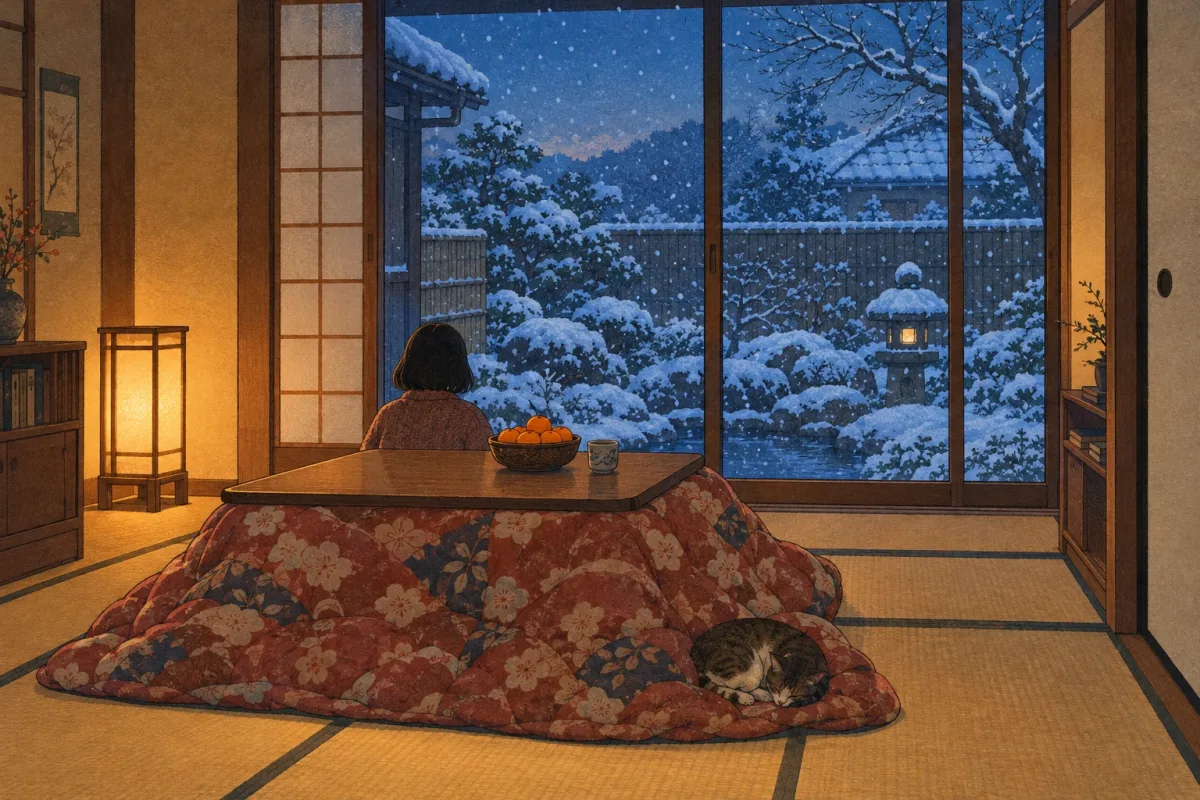
A kotatsu is a Japanese heater in which a heat source is enclosed in a yagura (a wooden frame) with a quilt draped over the top to keep you warm. The type you usually see in homes today is a low table with an electric heater fixed to its underside and a thick quilt sandwiched between the table frame and the tabletop. Sit on the floor, slip your legs under the quilt, and the warmth gradually spreads through your lower body.
What surprises people from abroad about winter in Japan may be less the kotatsu itself than how cold it is indoors. The Ministry of Land, Infrastructure, Transport and Tourism estimates that as of fiscal 2019, only about 13% of Japan's roughly 50 million homes had insulation meeting today's energy-efficiency standards, while about 29% had almost no insulation at all.
In a poorly insulated house, the temperature gap between a heated room and the corridor, changing room and bathroom is large, and it even contributes to accidents in the bath in winter. This guide looks in turn at the history of the kotatsu, why Japanese homes are cold, the dangers of a cold bathroom, the heaters you'll commonly come across and how to use them safely, and where you can try a kotatsu while travelling.
How old is the kotatsu, and what types are there?
There are two kinds of kotatsu: the horigotatsu, set over a hollow sunk into the floor, and the portable okigotatsu. The horigotatsu is the older of the two and appeared in the Muromachi period (14th to 16th centuries). At first, it seems, people set a frame over the irori (a hearth built into the floor) once its fire had burned down to embers, and rested their feet on it to warm them. The kotatsu is said to have spread from Zen Buddhism during the Muromachi period.
In the early Edo period, horigotatsu were installed even inside the Gosho (the emperor's residence), and by the Genroku era (1688–1704) they had spread widely among ordinary people, with ready-made frames on sale in Osaka. The okigotatsu seems to have grown out of putting fragile ceramic hibachi (charcoal braziers) inside wooden boxes. The main reasons the kotatsu caught on were the spread of cotton futon bedding and the growing production of charcoal and other fuels.
For a long time it ran on charcoal, but from around 1955 the electric kotatsu took over. In ordinary homes today the okigotatsu is the norm, including furniture-style kotatsu that work as an ordinary low table once the quilt is removed, and tall-legged kotatsu that you use sitting on a chair.
Even with today's advanced heating, the kotatsu is still in use, often alongside heaters that warm the whole room, in homes ranging from people living alone to families of five or six. The reasons are that it costs less in electricity than an air conditioner or underfloor heating, and that there's something comforting about warmth you feel directly.
Why are Japanese houses so cold in winter?
In section 55 of Tsurezuregusa (Essays in Idleness), written at the end of the Kamakura period, Yoshida Kenko wrote that 'a house should be built with summer in mind', going on to say that in winter you can live anywhere, but a house that is hard to live in during the hot season is unbearable. Japanese houses do indeed seem to have long been designed around summer rather than winter.
In the Meiji and Taisho eras (1868 to 1926), deaths from illness were concentrated in summer, but from the Showa era onwards the pattern shifted dramatically to winter. When surviving the summer was what mattered, building homes for summer made sense; today, insulation and heating to keep houses warm in winter are what matter.
Looking more closely, of the roughly 50 million homes in fiscal 2019, about 13% met the current energy-efficiency standards, about 22% were at the level of the 1992 standards, about 36% at the level of the 1980 standards, and about 29% fell short even of those, with no insulation or the like. Because so many older houses remain, there are still a great many poorly insulated homes.
Homes on which construction starts from April 2025 must meet the energy-efficiency standards, so a certain level of insulation is now compulsory for new builds, extensions and renovations. Well-insulated homes keep indoor temperatures steady more easily, and because the temperature throughout the house stays stable, the risk of accidents while bathing goes down too. Even so, if you live in a rented flat or an older house in Japan, you'll probably experience winters where only the heated room is warm and the corridor, toilet and changing room are chilly.
Why is a cold bathroom dangerous?
According to the 2023 Vital Statistics, 6,541 older people drowned in the bath, about three times the 2,116 people who died in road accidents. Fatal accidents are especially common among people aged 65 and over, and happen most from November to April every year.
One cause is changes in blood pressure brought on by sudden shifts in temperature. When you move from a warm room to a cold changing room and undress, your blood vessels constrict and your blood pressure shoots up; then, as your body warms in the bath, it drops. This sudden swing can reduce blood flow to the brain and cause a brief loss of consciousness. This strain on the body from temperature differences is commonly called 'heat shock'.
There are five ways to prevent accidents in the bath: warm the changing room and bathroom before you bathe; aim for water at 41°C or below and no more than 10 minutes soaking; don't stand up suddenly from the tub; avoid bathing straight after a meal or after drinking alcohol or taking medicine; and tell someone you live with before you get in. Family members should also keep an eye on older relatives while they're in the bath.
If the bathroom has no heater, you can warm it by filling the tub from the shower, or by stirring the hot water well to raise steam and leaving the lid off. Accidents in the bath can happen even to people with no existing conditions or warning signs.
What heaters will you find in a Japanese home, and how do you use them safely?
Common heating in Japanese homes includes air conditioners on heating mode, kerosene stoves and kerosene fan heaters, gas fan heaters, electric heaters, oil-filled radiators, electric carpets (heated rugs) and electric kotatsu. A summary by NITE (the National Institute of Technology and Evaluation, the government body that investigates product accidents) found that 543 accidents involving major heating appliances were reported in the five years from 2021 to 2025, and that electric heaters and electric fan heaters, together with kerosene stoves and kerosene fan heaters, accounted for about 80% of them.
Keep flammable things such as laundry, bedding, clothes and cushions away from heaters, and always switch them off (or put them out) when you go to bed or go out. With kerosene heaters, it's also important to use fresh kerosene rather than last season's, to store kerosene and petrol in separate places so you don't fill up with the wrong one, and to check that the tank cap is firmly closed after refuelling.
When you use 'open-type' gas or kerosene heaters, which release their exhaust straight into the room, ventilate once or twice an hour, for example by opening a window. Without enough ventilation, incomplete combustion can occur and lead to carbon monoxide poisoning. Carbon monoxide has no colour or smell, so it's hard to notice even at high concentrations, and it can kill.
Heaters that don't pollute indoor air with exhaust, such as air conditioners and FF heaters (which vent their exhaust outdoors), have also become common. In rented homes in Japan, many people heat the room by selecting 暖房 (danbō, heating) on the air conditioner remote, so start by checking the air conditioner in your room.
What should you watch out for with a kotatsu or hot-water bottle?
According to the Fire and Disaster Management Agency, 192 fires were caused by electric kotatsu in the five years from 2014 to 2018. Even though they're electric and use no flame, fires have started when people dried laundry inside a kotatsu or when quilts or floor chairs touched the heater.
When using a kotatsu, switch it off and unplug it when you go to bed, go out or leave it; don't use it to dry laundry; keep spray cans and lighters away from it; clean the dust off the heater; and don't stuff quilts, floor cushions or floor chairs inside it.
Another thing to watch out for is low-temperature burns. Even relatively low temperatures of about 44 to 50°C can burn you if they stay against the same patch of skin for a long time: it's said a burn can occur after 3 to 4 hours or more at 44°C, 30 minutes to an hour at 46°C, and 2 to 3 minutes at 50°C. They can happen with yutanpo (hot-water bottles), electric foot warmers, disposable heat packs, electric kotatsu and electric carpets.
Use a hot-water bottle or electric foot warmer to warm your bedding before you go to bed, and always take it out when you go to sleep. When heating a metal hot-water bottle directly on the hob, always remove the cap, and for microwavable types, follow the heating time and power setting in the instructions. Falling asleep in a kotatsu keeps the same spot warm for a long time, so when you get sleepy it's safest to move to your bed.
Where can you try a kotatsu while travelling in Japan?
In Iwate Prefecture, the Sanriku Railway runs a 'Kotatsu Train' and a 'Western-style Kotatsu Train' in winter. In winter 2026–2027 they run on the Rias Line between Kuji and Miyako stations, mainly on Saturdays and Sundays, from 19 December 2026 to late March 2027. In the tatami-floored kotatsu seats, the train slows down and briefly stops on a bridge about 30 m high overlooking the Pacific, and there's also an event in which namomi, figures from a local traditional festival, appear in the carriage.
All seats must be booked in advance: a reserved box seat on the sea side (up to 4 people) costs 14,000 yen, an unassigned box seat (up to 4 people) 10,000 yen, and a pair of side-by-side seats 6,000 yen (as of November 2026). A special bento (boxed meal) made with Sanriku seafood can be ordered when you book, up to three days before you travel. Bookings are made on the website; seats cannot be reserved by phone.
On the river cruises in Yanagawa, Fukuoka Prefecture, 'kotatsu boats' run in winter. A kotatsu warmed by a hibachi is placed in a small boat called a donkobune, and you glide along the canals keeping warm. In winter 2025–2026 they ran from 1 December to 28 February.
The Tsugaru Railway's 'Stove Train' in Aomori Prefecture is also often featured as a winter highlight, but it's warmed not by a kotatsu but by coal-burning stoves inside the carriages. After the service was suspended the previous winter, Tsugaru Railway has announced that the Stove Train will run again from 1 December 2026.
Tips
- In rented homes in Japan, the 暖房 (danbō, heating) button on the air conditioner remote is the main source of heat in winter. Check the air conditioner in your room first.
- Before bathing, warm the changing room and bathroom, and aim for water at 41°C or below and no more than 10 minutes soaking.
- When using kerosene stoves, gas fan heaters or other heaters that vent into the room, open a window to ventilate once or twice an hour.
- Don't dry laundry in a kotatsu or stuff quilts or floor cushions inside it. Switch it off when you go to bed or go out.
- A yutanpo (hot-water bottle) is for warming your bed before you sleep. Take it out of the bed when you go to sleep to avoid low-temperature burns.
Sources
- 炬燵(コタツ)とは? 意味や使い方 - コトバンク(デジタル大辞泉、精選版 日本国語大辞典、改訂新版 世界大百科事典ほか) (opens in a new tab)
- 徒然草第55段(山梨県立大学) (opens in a new tab)
- 季節と住まい/夏をむねとすべし? - 国立研究開発法人 建築研究所 (opens in a new tab)
- 今後の住宅・建築物の省エネルギー対策のあり方(第三次報告)及び建築基準制度のあり方(第四次報告)について(参考資料) - 国土交通省 (opens in a new tab)
- 省エネ基準引き上げへ。脱炭素化も。| 国土交通省 (opens in a new tab)
- 交通事故死の約3倍?!冬の入浴中の事故に要注意! | 政府広報オンライン (opens in a new tab)
- 冬季に多発する高齢者の入浴中の事故に御注意ください! - 消費者庁 (opens in a new tab)
- 適切な離隔距離、知っていますか?~暖房器具は可燃物との距離を確保して火災を防ぎましょう~ | 製品評価技術基盤機構 (opens in a new tab)
- あなたは大丈夫? 冬の製品事故 | 政府広報オンライン (opens in a new tab)
- 電気ストーブや電気こたつの火災に注意しましょう! - 福島県ホームページ (opens in a new tab)
- こたつ列車・洋風こたつ列車の運行について | 三陸鉄道 (opens in a new tab)
- こたつ舟 - 柳川市 (opens in a new tab)
- 令和8年度「ストーブ一番列車出発セレモニー」開催について | 津軽鉄道 株式会社 (opens in a new tab)