What Do All the Buttons on a Japanese Toilet Do?
Rear wash, bidet, dryer, privacy sound and the call button: how to read the symbols on a Japanese toilet panel, plus tips for using one without panic.
The short answer
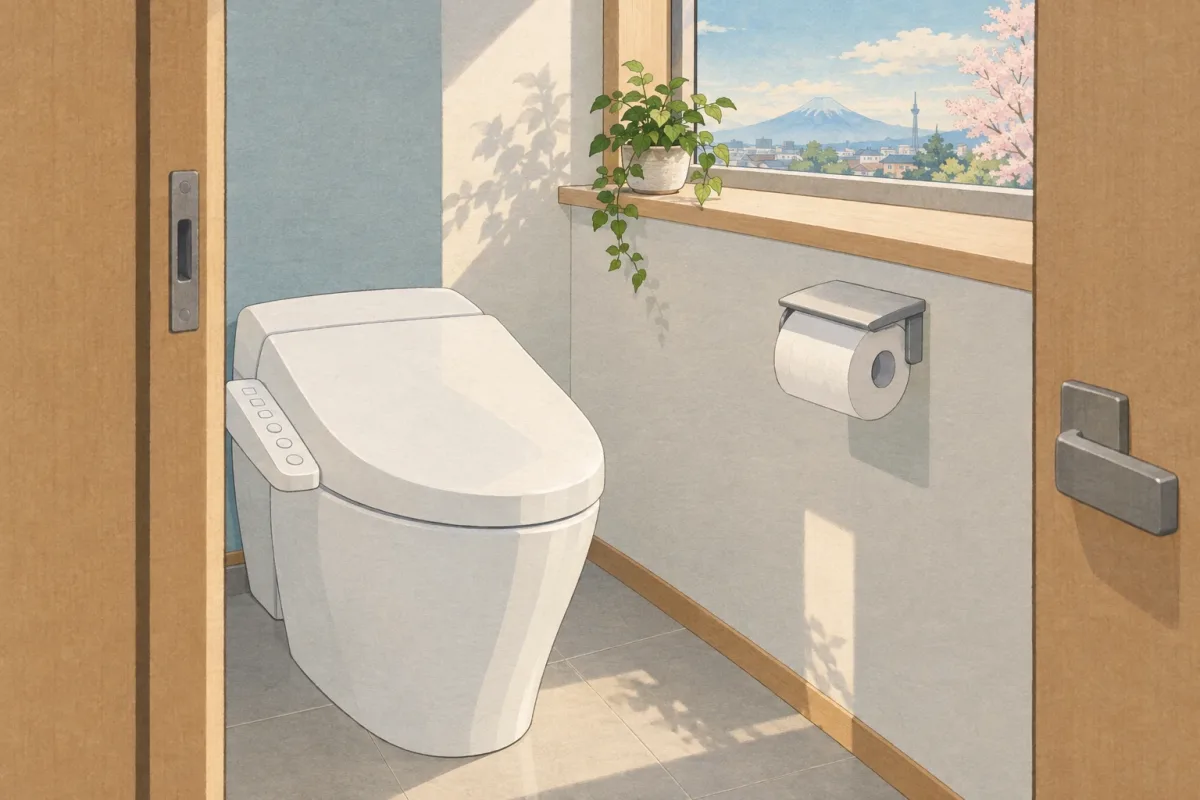
Most of the buttons control the washlet, a heated toilet seat that washes your bottom with warm water. They let you wash, stop, dry and change the water pressure. On top of that come the flush button, a "privacy sound" button that plays the sound of running water, and a call button for when you feel unwell.
Since 2017 the industry has used a standard set of pictograms, so even if you cannot read Japanese you can tell most buttons apart once you know the shapes. The single most important thing is not to press the call button on the wall thinking it is the flush.
How toilets got so many functions
Toilet seats that wash with warm water were not originally a Japanese invention. It all began in 1964, when Toyo Toki (now TOTO) started selling the American-made "Wash Air Seat" and Ina Seito (now LIXIL) began importing a Swiss-made toilet. At first they were products for hospitals and care facilities. Japanese-made versions followed, but the water temperature was unstable and some people are said to have been scalded.
Nor were they welcomed from the start. In the 1970s, some magazines and newspapers reportedly refused to run the adverts, on the grounds that a toilet was no fit subject for an advert. Even so, helped by the many people who value cleanliness and by an ageing population, they gradually caught on as products that were kind to older people.
The turning point came in 1980, when TOTO launched the "Washlet" with improved temperature control. In 1982 a TV commercial with the line "Your bottom wants to be washed too" became a talking point, and the product suddenly became widely known. In the 1990s most newly built homes chose a warm-water washing seat, and they spread to offices, hotels and stations. The Cabinet Office's Consumer Confidence Survey found that ownership among households of two or more people passed 80% in March 2016. Features such as automatic lid opening and closing, deodorising and automatic flushing were added one after another, and so the buttons multiplied.
In 2012 the first "Washlet G" became the first household machine to be recognised as a "Mechanical Engineering Heritage" item by the Japan Society of Mechanical Engineers, as a machine that created a new toilet habit and improved everyday life. According to TOTO, cumulative worldwide sales had passed 70 million units by 2025.
The 8 basic buttons on the panel
In response to the sharp rise in foreign visitors, the Japan Restroom Industry Association (the trade body for toilet makers) set out 8 "standard pictograms" for control panels in January 2017. The swirl shape means "flush": a big swirl is the full flush and a small swirl the reduced flush. Toilets of the early 1970s used as much as 16 litres of water per flush, and saving water became a major issue as cities faced water shortages; having a full and a reduced flush is one way of not wasting it. Symbols with an arrow above the toilet mean "open/close lid" and "raise/lower seat". The black square means "stop": press it first whenever you want the washing to end.
A picture of water spraying up from under a bottom shape means "rear wash", a picture of water coming up from under a seated person means "bidet" (a wash mainly for the front, for women), and three wavy lines mean the warm-air "dryer". Depending on the model, there may also be separate buttons for water pressure, water and seat temperature, and "move", which slides the nozzle back and forth. Many models clean the nozzle automatically before and after use, so there is no need to worry too much about whether it is clean.
As a curiosity, TOTO's Washlet reportedly sets the nozzle angle at 43 degrees for the rear wash and 53 degrees for the bidet, so that the water does not splash back around you. In men's toilets in public buildings, the bidet and privacy sound functions are sometimes left out.
Flushing, the privacy sound and the call button
How you flush varies from toilet to toilet. There are levers on the side of the tank, buttons on the wall, sensors you wave your hand over, remote controls beside the seat, and even toilets that flush automatically when you stand up. In Japan the rule is that toilet paper goes into the toilet, while sanitary products and the like go into the small bin beside it.
In women's toilets you will often find a device that plays the sound of running water to cover the noise of using the toilet. "Otohime" (literally "sound princess"), TOTO's product name launched in 1988, is used almost as a generic name, but another company was already selling a similar device in 1979. It was born as a water-saving machine: many people used to flush again and again to hide the sound, and the waste of water had become a problem. It is set off by waving your hand, pressing a button or simply walking in, and stops after a set time.
Then there is the one to watch out for: the call button. If you feel ill, pressing it brings someone to help, and in public toilets it sits near the flush button. The international standard ISO 19026 (based on Japan's JIS S 0026) places the flush button above the toilet paper holder and the call button at the same height but further back from the seat, with a different shape and colour so that you can tell them apart by touch.
What surprises visitors
First-time visitors are often surprised that the seat is warm, that the lid opens by itself as they approach, and that even public toilets in stations and airports have washlets. There were even reports of the singer Madonna saying on a visit to Japan that she had missed Japan's warm toilet seats. On the other hand, Japan used washiki (squat) toilets for a long time, and it was only in the late 1980s that they fell below 20% of toilets shipped. In older buildings you may still come across squat toilets or seats with no washing function, so not everything is "high-tech".
Toilets with this many functions are unique to Japan; they are sold abroad, but they can hardly be called widespread around the world yet. The habit of using a "privacy sound" out of embarrassment at others hearing you is also said to be peculiarly Japanese. For travellers, the toilet itself becomes a small encounter with a different culture.
Tips for using one without panic
Before you sit down, find "stop" and the swirl on the panel and you will not be caught off guard. If nothing happens when you press a wash button, it is because many models only work when you are properly seated. If the water seems not to stop, press "stop" before you stand up.
If you live in Japan, cleaning the nozzle and seat of your washlet at home as the instruction manual says will make it last longer. The industry association's English website also explains what the buttons mean and how to use them, with illustrations, so it is worth a look before you travel.
Tips
- Before sitting down, check where "stop" (the black square) and "flush" (the swirl) are.
- A button near the flush with a different shape or colour is the emergency call button. Do not press it thinking it will flush.
- On many models the wash buttons do not work unless you are properly seated.
- Toilet paper goes into the toilet. Sanitary products and the like go into the small bin provided.
- If you cannot find a lever, look for a button on the wall, a hand sensor, or automatic flushing.
Sources
- Pictograms of the Toilet Operation Unit - Japan Sanitary Equipment Industry Association
- トイレ操作系標準ピクトグラム - 日本レストルーム工業会
- Using the Toilet Utilities - NIPPON UTSUKUSHI TOILET (Japan Sanitary Equipment Industry Association)
- About the Spray seat - Japan Sanitary Equipment Industry Association
- About ISO 19026 - Japan Sanitary Equipment Industry Association
- 統計からみる温水洗浄便座の普及 - 日本レストルーム工業会
- トイレの歴史(年表) - 日本レストルーム工業会
- WASHLET - TOTO
- 温水洗浄便座 - Wikipedia
- ウォシュレット - Wikipedia
- トイレ用擬音装置 - Wikipedia