Japan is Nippon
What Gift Should You Bring When Visiting a Japanese Home or Host Family?
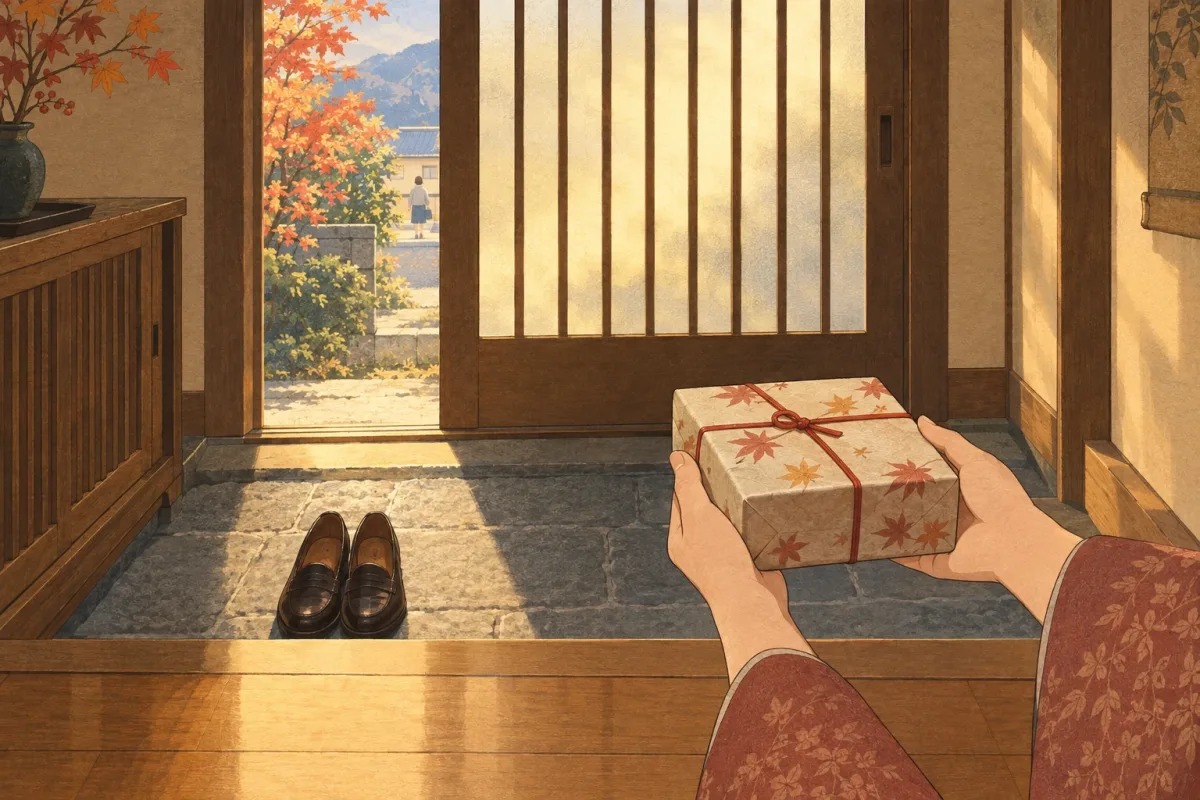
In Japan it's customary to bring a small temiyage (a visiting gift) when you go to someone's home. It needn't be expensive: something like individually wrapped sweets from your own country that keep well and the whole family can share is ideal, taken out of its paper bag and handed over with both ha
The short answer
Temiyage is the small gift you bring along in place of a greeting when you visit someone's home. The word already appears in a haikai poem from the mid-17th century (1656).
Omiyage, the word usually translated as "souvenir", also has two meanings. One is something you buy on a trip and bring home, and the other is a gift you take when visiting someone's home. In Japanese, travel souvenirs and visiting gifts are part of the same connected custom.
A gift for a visit to a friend's home isn't strictly required, but it expresses thanks for being invited. Having people over takes effort: freeing up time, cleaning, preparing tea or a meal. It helps to think of temiyage as a "thank you" for that effort, made into something you can hold.
What kind of gift should you choose?
The handbook (2026-27 edition) for participants in the JET Programme, which brings young people from abroad to work in Japanese schools and local governments, says it's a thoughtful gesture for participants coming to Japan to bring gifts for the people who will look after them, but that there's no need to go out of your way to buy something expensive.
The same handbook suggests a photo book of your home country, a calendar of its scenery, boxed or individually wrapped sweets, keyrings, and stickers for children. In Japan it's common to give a box of sweets that a whole group can share. The same thinking works perfectly for a host family.
When you don't know the other person's tastes, kiemono ("things that disappear") are a good choice, meaning food that gets eaten rather than objects that stay around: even if it's not to their liking, the rest of the family can eat it. If you're staying overnight with a family, individually wrapped sweets with plenty to go round are best, and if there are children, a family-wide treat on top of something for the children will go down well.
Something "from my country" is a conversation starter all by itself. Add a word about where the sweets are made, or when people eat them in your town, and even ordinary biscuits become a gift only you could give.
How much should you spend?
The department store Daimaru Matsuzakaya puts the usual range for a gift to a friend's home at about 1,000 to 3,000 yen. If your hosts are making you a meal or putting you up for the night, the guide is to raise the budget to about 3,000 to 5,000 yen (as of November 2026).
A gift that's too expensive backfires. Something very pricey makes the other person feel awkward and indebted, and there's no need to go out of your way to buy an expensive gift. The point of temiyage in Japan is to show your thoughtfulness, not to compete on price.
Remember that these figures are general guidelines from a department store. If your budget is tight, say on a student homestay, don't stretch yourself: a small, thoughtful gift is plenty.
What gifts should you avoid in Japan?
Odd numbers of items are preferred, and the basic rule is to avoid unlucky numbers such as 4 (shi, which sounds like "death"), 9 (ku, which sounds like "suffering") and 13. That said, among even numbers, 6 and 12 may be seen as a half-dozen and a dozen, and 8 as suehirogari (a shape that gradually widens out, which is lucky).
Other things are best avoided too: red items for a new home or a shop opening (they suggest fire, or being "in the red"), footwear for someone senior to you (it implies "stepping on" them), and Japanese tea (often used as a return gift after funerals). When meeting a partner's family about marriage, avoid knives and other blades, which suggest "cutting ties", and handkerchiefs, which can suggest "parting".
These superstitions don't matter if the other person doesn't mind, but when you're not sure, the polite thing is to leave such items off your list. Some people also feel uneasy about the hygiene of homemade sweets, so shop-bought, individually wrapped ones are the safe choice at first. It's also wise to avoid strong-smelling food, and fragile cakes that need refrigerating.
If you're bringing something from abroad, watch out for Japan's quarantine rules. Under the rules of the Animal Quarantine Service of the Ministry of Agriculture, Forestry and Fisheries, meat products such as jerky, ham, sausages and bacon can almost never be brought into Japan, even as gifts or for your own use, without an inspection certificate issued by a government agency of the exporting country. Bringing them in illegally can lead to a fine of up to 3 million yen or up to three years' imprisonment. Fruit and plants are covered by the Plant Protection Station's rules, so always check before you bring them.
How do you give a gift in Japan?
First, take your shoes off when you enter. You're expected to remove your shoes at the entrance in most Japanese homes.
The best moment to hand over your gift is not at the front door but after the greetings, once you've been shown into the room. In a Japanese-style room, give it after you sit down; in a Western-style room, before you sit. Anything that needs refrigerating or freezing, though, is kindly handed over early, before you're shown in, with a word that it needs to go in the fridge.
There's an etiquette to the handover too. You carry the gift in a paper bag so the wrapping stays clean, then take it out of the bag, turn it so the front faces the other person, and offer it with both hands. It's polite to take the paper bag home with you.
As for what to say, examples include "Okuchi ni au ka wakarimasen ga, dozo omeshiagari kudasai" ("I'm not sure it will suit your taste, but please enjoy it") and "Sasayaka desu ga, minasama de omeshiagari itadakereba ureshii desu" ("It's just something small, but I'd be glad if you could all enjoy it"). If you're not confident in Japanese, saying "Kore, watashi no kuni no okashi desu. Minasan de dozo" ("These are sweets from my country. Please share them") with a smile gets the feeling across perfectly well.
Should you say "tsumaranai mono desu ga"?
"Tsumaranai mono desu ga" is a traditional, modest phrase used when giving a gift; it literally means "this is a trifling thing, but...". Humbly calling a gift soshina ("a crude item") is built on the same idea.
The Keigo no Shishin (Guidelines on Honorific Language, 2007), compiled by the government's Council for Cultural Affairs, explains that expressions which "speak of one's own things as small or poor" don't mean the speaker really thinks so. They're a traditional verbal convention, and making your own side seem small is a way of showing consideration for the other person.
Likewise, offering a dish you're proud of with "I'm not sure it will suit your taste" is a way of not pushing your own judgement on others. At the same time, saying frankly "I think it turned out well, so please try it" can show consideration just as well.
So as a foreigner, you don't need to force yourself to say "tsumaranai mono desu ga". Simply explaining why you chose the gift, "these sweets are popular in my town" or "I chose these hoping the whole family would enjoy them", may actually please your hosts more.
What if you're the one receiving a gift? Do you give something back?
Your hosts may serve the sweets you brought right then and there. That isn't rude. A gift a guest has brought is respectfully called omotase, and it's often offered back to that guest as part of the hospitality, with the phrase "omotase de shitsurei desu ga" ("forgive us for serving what you brought").
In most cases a gift calls for a return gift: the usual amount is hangaeshi ("half return"), worth about half of what you received, and it's generally sent within a month of receiving it. This, however, applies to gifts such as those given for celebrations.
When a host family has looked after you or you've been invited to someone's home, simply sending a thank-you message after you leave gets your feelings across. Daimaru Matsuzakaya also suggests adding a message card expressing your thanks to your gift, which makes an even better impression.
Tips
- If in doubt, bring individually wrapped sweets from your own country. Things the whole family can share that keep well go down best.
- The department store guideline is about 1,000 to 3,000 yen for a visit to a friend's home, and about 3,000 to 5,000 yen if you're staying over (as of November 2026).
- It's safest to avoid sets of 4 or 9. The number 4 suggests death, and 9 suggests suffering.
- Hand over your gift after you've been shown into the room and exchanged greetings. Take it out of the paper bag, turn the front towards the other person and offer it with both hands.
- Meat products (such as jerky or sausages) can almost never be brought into Japan, even as gifts. Check the Animal Quarantine Service's rules before bringing anything from abroad.
Sources
- 手土産(テミヤゲ)とは? 意味や使い方 - コトバンク(デジタル大辞泉・精選版 日本国語大辞典) (opens in a new tab)
- 土産(ミヤゲ)とは? 意味や使い方 - コトバンク(デジタル大辞泉・精選版 日本国語大辞典) (opens in a new tab)
- 御持たせ(オモタセ)とは? 意味や使い方 - コトバンク(デジタル大辞泉) (opens in a new tab)
- 粗品(ソシナ)とは? 意味や使い方 - コトバンク(デジタル大辞泉) (opens in a new tab)
- 2026-27 General Information Handbook (English Version), 1.4.8 Other: 5) Gifts (Omiyage) - The JET Programme (opens in a new tab)
- 友達の家への手土産におすすめ!気遣いが伝わる選び方・マナーと人気ギフト | 大丸松坂屋オンラインストア (opens in a new tab)
- 親への結婚挨拶の手土産はどう選ぶ?相場や渡し方のマナー、おすすめの品を紹介 | 大丸松坂屋オンラインストア (opens in a new tab)
- 彼氏の家への手土産は何がいい?実家・一人暮らし別のおすすめや渡し方のマナーを紹介 | 大丸松坂屋オンラインストア (opens in a new tab)
- ギフトや贈り物のマナー | 郵便局のネットショップ(日本郵便) (opens in a new tab)
- 敬語の指針(平成19年2月2日 文化審議会答申) - 文化庁 (opens in a new tab)
- 肉製品などのおみやげについて:動物検疫所(農林水産省) (opens in a new tab)
- Japanese Manners Do's and Don'ts | Guide | Travel Japan - Japan National Tourism Organization (Official Site) (opens in a new tab)