Japan is Nippon
What Is a Goshuin, and How Do You Get One Politely?
A goshuin is a hand-brushed inscription and red seal you receive at a shrine or temple as proof that you came to pray. It isn't a souvenir stamp: pray first, then hand over a goshuin book at the counter and offer the set fee.
The short answer
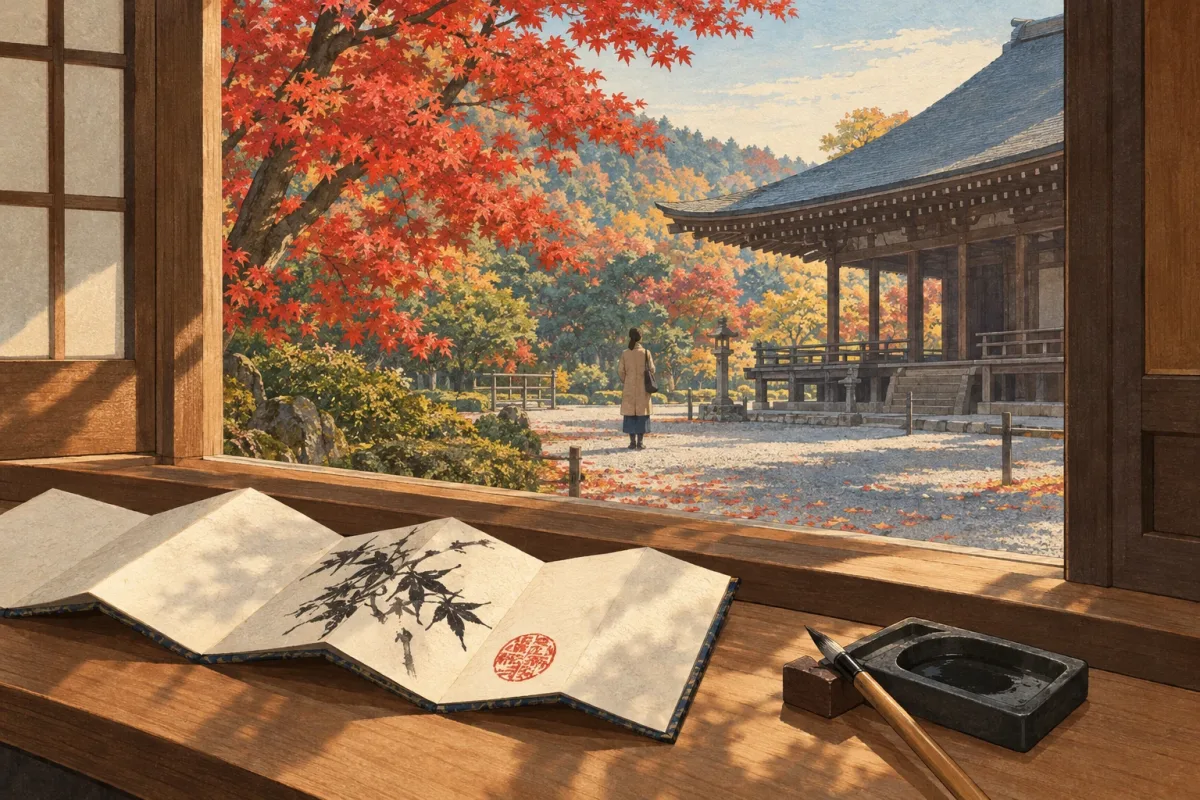
A goshuin is a written record you receive at a shrine (a place where Shinto gods are worshipped) or a temple (a place where Buddhas are worshipped) to show that you visited to pray. The name of the shrine or temple, the name of its honzon (the main Buddha the temple is centred on), the date and so on are brushed onto the paper in black ink, and a vermilion (red) seal is pressed on top. Shu means vermilion and in means seal, hence goshuin.
A goshuin is proof of a visit, and the idea is the same at shrines and at temples such as Senso-ji (in Asakusa, Tokyo).
The Shikoku 88 Temples Pilgrimage Association (the body for the 88 temples on the Shikoku henro, a pilgrimage route) explicitly warns that a goshuin is not a souvenir stamp. Think of it as something completely different from the free-to-use stamps you find at tourist spots and stations.
How did goshuin start?
Goshuin are thought to go back to the Nara and Heian periods (roughly the 8th to 12th centuries), when they were receipts given to people who offered hand-copied Buddhist sutras (shakyo) to shrines and temples. Shinto and Buddhism were intertwined at the time, so sutras were sometimes offered at shrines too.
A leading example is the Heike Nokyo, the sutras that Taira no Kiyomori, a warlord of the late Heian period, offered to Itsukushima Shrine in Hiroshima. Offering sutras is said to have spread to ordinary people, and over time people came to ask for a written proof even when they only prayed without offering a sutra.
At Naritasan Shinshoji (Chiba Prefecture), too, goshuin were originally stamped as proof of an offered sutra, and in recent years the temple grants them as proof of a visit. The place where temples give out goshuin is still called the nokyojo (literally 'sutra-offering office'), a trace of that history.
Trips around shrines and temples and goshuin collecting took off after the Meiji era as the railways developed, and the name goshuin started to appear around 1935 (Showa 10).
What is a goshuin book?
A goshuincho (goshuin book) is a book made especially for having goshuin written in. Many shrines and temples, including Todai-ji, Senso-ji, Naritasan Shinshoji and Dazaifu Tenmangu, offer their own original goshuin books.
At Todai-ji (Nara), a goshuin is basically written into a dedicated goshuin book when you visit to pray, and you can buy one in the temple grounds. As of November 2026, goshuin books cost 2,000 yen for the large size and 1,500 yen for the small size, among others. Senso-ji also offers goshuin books at the Yogodo hall, where its goshuin office is.
Naritasan Shinshoji lists the price of its goshuin book as 'hatsuhoryo 2,000 yen' (as of November 2026). Hatsuhoryo comes from the old practice of offering the year's first ripened ears of rice to the gods, and the word now means money offered to the gods. The thinking is that the money you pay when you receive something at a temple or shrine isn't a purchase price but an offering.
On the Shikoku pilgrimage, people use a dedicated book called a nokyocho. There is also a custom called kasane-in ('layered seals'), where each time you make the pilgrimage you receive the seal again in the same nokyocho, two or three times over.
How do you get a goshuin, step by step?
The basic rule is to pray first. On the Shikoku pilgrimage you receive the goshuin at the nokyojo after offering sutras at the main hall and elsewhere, and at Dazaifu Tenmangu (Fukuoka Prefecture), goshuin for the small shrines in its grounds are likewise received 'after praying'. A goshuin is proof of a visit, so praying comes first and the goshuin comes after.
At a shrine, the usual etiquette is to bow lightly before the torii gate and enter the grounds, purify your hands and mouth at the chozuya (the purification basin), drop in a coin offering and pray with 'two bows, two claps, one bow' (two deep bows, two claps, then one more deep bow). There are no strict rules of etiquette, though, and shrines and regions have their own ways.
Once you have prayed, go to wherever goshuin are handled. At shrines this is often called the juyosho (the counter where amulets and talismans are given out) or the shamusho (shrine office); at temples it is often the nokyojo or shuinjo (goshuin office). For example, Meiji Jingu (Tokyo) handles them at Nagadono, the juyosho in front of the Kaguraden hall; Senso-ji at the Yogodo hall on the west side of the main hall; and Ise Jingu (Mie Prefecture) at the Kaguraden halls of the Inner Shrine and Outer Shrine, among other places.
Hand over your goshuin book at the counter and offer the set fee. As of November 2026, it's 300 yen per goshuin at Todai-ji and 500 yen at Naritasan Shinshoji. If it is being handwritten on the spot it takes a little while, so wait quietly.
What should you avoid when getting a goshuin?
Most important of all, don't treat goshuin as stamps to collect. Bear in mind that they are not souvenir stamps. Some places can't write in anything other than the designated items, so expect that you may be turned away if you hand over a notebook or diary rather than a goshuin book.
Reselling is strictly forbidden. Yushima Tenmangu (Tokyo) gives one goshuin per person because it is proof of a visit (several are allowed if they are different kinds), and prohibits resale.
Watch the opening hours too. Meiji Jingu accepts requests from 9:00 until the gates close (16:10 in November), Senso-ji from 8:00 to 16:30, Zojo-ji (Tokyo) from 9:00 to 17:00, and the temples on the Shikoku pilgrimage generally from 8:00 to 17:00 (all as of November 2026). If you rush in at the last minute in the late afternoon, you may miss out.
On the Shikoku pilgrimage, allow plenty of time in spring and autumn, when the nokyojo get crowded. Even when it's busy, good manners mean not hurrying the person writing for you.
What are kakioki and limited-edition goshuin?
Instead of having it written directly into your goshuin book, you can also receive a goshuin written on a sheet of paper in advance; this is called kakioki. At Yushima Tenmangu, monthly limited-edition goshuin are given out only as paper kakioki and cannot be written directly into a goshuin book. Its direct writing into goshuin books also ends at 17:00 (as of November 2026).
Naritasan Shinshoji uses printed goshuin during busy periods such as New Year because of the crowds, and at other times writes them by hand at the Great Main Hall and elsewhere. It helps to know that at popular shrines and temples, how you receive a goshuin can change from day to day.
Many places also issue limited-edition goshuin for seasonal events, and Naritasan Shinshoji and Yushima Tenmangu announce them in the news sections of their official websites. If there's a particular goshuin you're after, check the official website before you go. Bringing a clear plastic folder is handy so you can carry kakioki sheets home without folding them.
Can foreigners get a goshuin?
None of the official guidance from the shrines and temples we looked at made nationality or religious belief a condition for receiving a goshuin. What matters is visiting with respect for the shrine or temple.
The Tokyo Shinto Shrine Association likens a goshuin book to an irreplaceable companion that keeps the emotion of each visit alive for ever. The goshuin you collect along your journey can bring back even that day's weather and scenery, and should become the most personal record of your trip to Japan.
Senso-ji's official website also has an English version. Even if you're not confident with the language, holding out your goshuin book with both hands and giving a slight bow is more than enough to get your feelings across.
Tips
- A goshuin is proof that you came to pray. Finish praying at the main sanctuary or main hall first, then head to the juyosho or nokyojo.
- For your first book, try buying a goshuin book at a shrine or temple you visit on your trip. A design unique to that shrine or temple makes a lovely memento of the journey.
- Many places charge a few hundred yen for a goshuin (300 yen at Todai-ji and 500 yen at Naritasan Shinshoji, as of November 2026), so have some coins ready to keep things smooth at the counter.
- Many places stop accepting requests in the late afternoon, and some shrines change their hours with the seasons. Check the times on the official website before you go.
- When you hand over your goshuin book, taking off its cover or opening it at the next blank page saves the writer some trouble and is appreciated.
Sources
- 授与品(4) 御朱印(ごしゅいん)の起源を教えてください – 東京都神社庁 (opens in a new tab)
- 奉納金に初穂料(はつほりょう)と書くのはなぜですか – 東京都神社庁 (opens in a new tab)
- 参拝の作法 - 東京都神社庁 (opens in a new tab)
- お遍路の心得 – (一社)四国八十八ヶ所霊場会 (opens in a new tab)
- 札所参拝手順 – (一社)四国八十八ヶ所霊場会 (opens in a new tab)
- 御朱印 - 浅草寺 (opens in a new tab)
- 御朱印 | 大本山成田山新勝寺 (opens in a new tab)
- 御朱印について - 東大寺 (opens in a new tab)
- お守り・授与品 - 湯島天満宮(湯島天神) (opens in a new tab)
- ご参拝の方へ|明治神宮 (opens in a new tab)
- よくあるご質問|伊勢神宮 (opens in a new tab)
- よくある質問|太宰府天満宮 (opens in a new tab)
- よくあるご質問|大本山 増上寺 (opens in a new tab)