Japan is Nippon
How Cold Is Japan in Winter, and What Should You Wear?
Winter in Japan (December to February) varies hugely by region: Tokyo and Osaka average around 5-6°C in January with mostly clear, dry days, while Sapporo averages just over -3°C under snow and Niigata and Kanazawa on the Sea of Japan side get day after day of snow or rain. Wherever you go, pack a w
The short answer
The Japan Meteorological Agency (JMA, the national body in charge of weather forecasts and observations) defines winter as December to February. But Japan stretches a long way from north to south, so the same January can look completely different depending on where you are. Going by JMA's climate normals (the average over the 30 years from 1991 to 2020), the average January temperature is 17.3°C in Naha (Okinawa) but -3.2°C in Sapporo (Hokkaido).
The other big factor is the difference between the two sides of the mountains that run down the middle of the Japanese archipelago. Cities on the Pacific side, such as Tokyo, get plenty of clear days in winter and very dry air. Cities on the Sea of Japan side, such as Niigata and Kanazawa, get day after day of snow or rain. Tokyo normally gets 192.6 hours of sunshine in January; Kanazawa gets only 62.3.
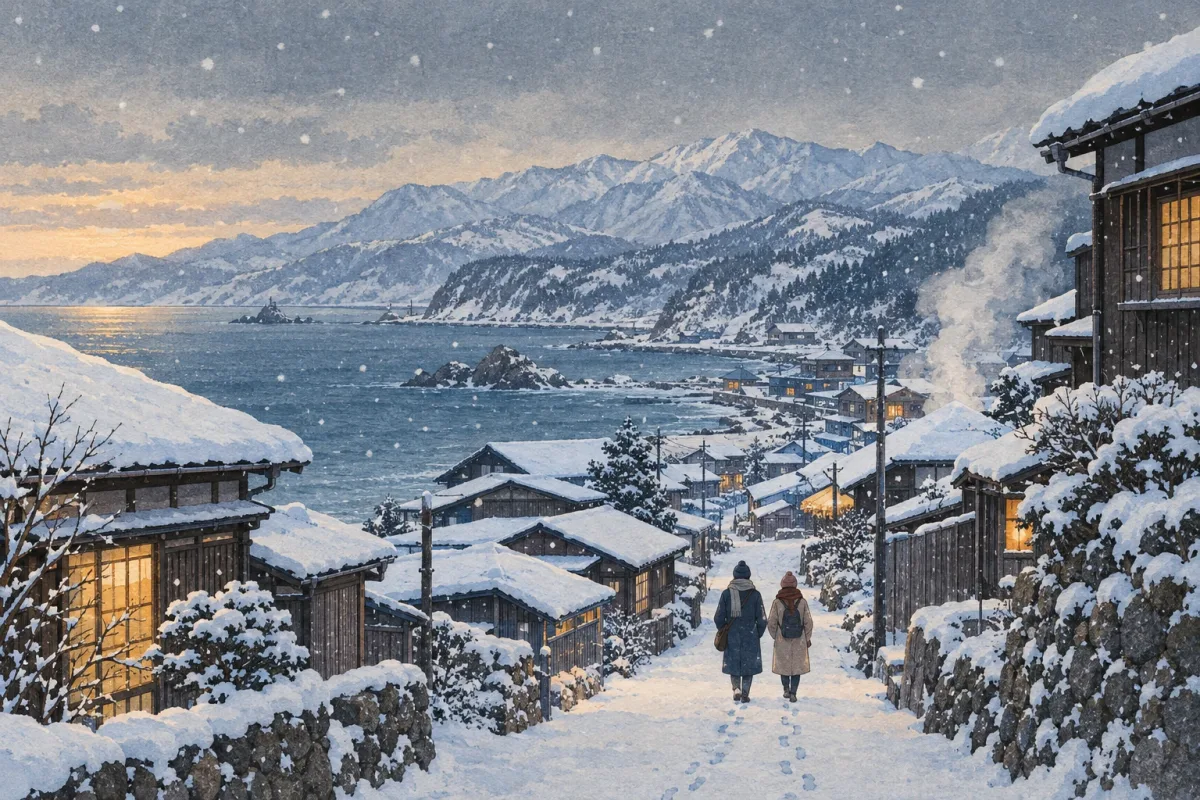
Snow rarely settles in big cities such as Tokyo and Osaka, but the surrounding mountains and the northern regions are covered in snow every year. Wherever you travel, a warm winter coat is essential.
How cold are Tokyo, Osaka and Sapporo in winter?
In a normal year, January in Tokyo has an average temperature of 5.4°C, an average daytime high of 9.8°C and an average morning low of 1.2°C. December averages 7.7°C and February 6.1°C, so January is the coldest month of the year. Osaka is much the same as Tokyo, averaging 6.2°C in January (high 9.7°C, low 3.0°C).
Sapporo, in Hokkaido, is another world. Its January average is -3.2°C, and even the average high is -0.4°C, so it stays below freezing during the day too. The average low is -6.4°C. In a normal year 137cm of snow falls in January in total, and the depth of lying snow reaches an average of 95cm in February.
On the Sea of Japan side of Honshu (Japan's main island), Niigata city averages 2.5°C in January (high 5.3°C, low 0.1°C) and Kanazawa 4.0°C. That's only a little colder than Tokyo, but there is far more precipitation. Kanazawa normally gets 301.1mm in December, more than five times Tokyo's December figure (57.9mm).
Fukuoka in Kyushu averages 6.9°C in January, Sendai in the Tohoku region 2.0°C and Naha in Okinawa 17.3°C. If one trip takes you from Tokyo to Hokkaido or Okinawa, pack on the assumption that the temperature difference could be close to 20°C.
Why does the Sea of Japan side get heavy snow while the Pacific side stays sunny?
A phrase you hear constantly in winter weather forecasts is seikō-tōtei ('high in the west, low in the east'). It describes a pattern with higher pressure to the west of Japan and lower pressure to the east, the typical winter setup. When there is a cold high-pressure system over Siberia on the continent and a deep low over the sea east of Japan, cold north-westerly seasonal winds blow from the continent towards Japan.
The cold, dry north-westerly winds coming off the continent pick up heat and water vapour as they cross the relatively warm Sea of Japan, turning into moist air. This air builds snow clouds over the sea, and when it reaches land and hits the mountains it is pushed upwards and drops even more snow. Snowflakes fall slowly, so the stronger the wind, the further inland towards the mountains they are carried, which is why the mountains get more snow than the plains.
Having dropped its snow on the Sea of Japan side, the air is dry by the time it crosses the mountains and comes down on the Pacific side. The dry, cold wind that blows over the mountains into the Kanto region in winter is called karakkaze (literally 'dry wind'). That's why Tokyo winters are mostly sunny, and why Tokyo's normal January humidity is 51%, well below Niigata's 72%.
A band of snow clouds around 1,000km long, called the JPCZ (Japan sea Polar air mass Convergence Zone), sometimes forms over the Sea of Japan in winter. When the well-developed snow clouds that come with the JPCZ keep streaming into the same area, record-breaking snowfall can pile up in a short time. Frequent winter thunder is another feature of the Sea of Japan side: in a normal year Niigata city has 6.1 days of thunder in December, far more than Tokyo (0.2 days).
Where can you see snow in Japan?
Hokkaido gets the most snow, and ski resorts such as Niseko and Rusutsu are famous. On Honshu, Hakuba in Nagano Prefecture is the best-known ski area, and from the Kansai region there is also Biwako Valley near Lake Biwa.
The most famous snow event is the Sapporo Snow Festival, held every year in early February. It features hundreds of sculptures made of snow and ice and draws more than 2 million visitors. At Zao Onsen in Yamagata Prefecture, trees thickly coated in snow and ice, known as juhyō (rime-covered trees) or 'snow monsters', are a winter highlight.
Daily life in the snowy regions is worth seeing in itself. The deepest snow of the year in Niigata Prefecture is under 100cm on the coast, 100-150cm on the plains and 200-250cm in the mountains.
Winter pleasures also include hot springs such as Ginzan Onsen (Yamagata Prefecture), Kusatsu Onsen (Gunma Prefecture) and Kurokawa Onsen (Kumamoto Prefecture), along with nabe (hot pot), ramen and atsukan (warmed sake). Soaking in a hot spring while looking out over a snowy landscape is an experience only winter in Japan can give you.
What should you wear in Japan in winter?
A warm winter coat is a must wherever you go. Even in Tokyo and Osaka, the average January morning low is around 1-3°C. The sun can feel warm on a clear day, but once it sets the temperature drops fast.
The best approach is layering: several thinner pieces rather than one thick one. With an undershirt, then a shirt or jumper, then a coat on top, you can adjust simply by taking one layer off when you get warm. On a trip where you are constantly moving between indoors and outdoors, on trains, in shops and visiting temples, being able to take things off and put them back on easily really matters.
If you're heading to Hokkaido, Tohoku or the snowy Sea of Japan side, waterproof, non-slip shoes, gloves, a hat and a scarf to cover your neck will put your mind at ease. Sapporo's average January high is -0.4°C, and in a normal year snow falls on almost every day of January (29.1 days).
Winter air on the Pacific side is very dry. JMA sometimes issues a 'dry air advisory' warning people to watch out for hazards caused by dry air. Bringing lip balm and moisturiser will help keep your skin and lips from getting chapped.
Are the days really short in Japan in winter?
Yes. Around the winter solstice in 2026 (21 December), the sun rises in Tokyo at 6:46 and sets at 16:31. Around the summer solstice (21 June), Tokyo's sunrise is at 4:25 and sunset at 19:00, so winter daylight is about four and a half hours shorter than in summer.
Sapporo, further north, has even less: on 21 December 2026 the sun rises at 7:02 and sets at 16:03. Expect it to start getting dark soon after 16:00.
Visit sights where you want to enjoy the view, or places where you'll be walking on snowy paths, in the bright hours from morning to early afternoon. Save the hours after dark for night views, hot springs and warm meals, and you'll make the most of a winter trip.
What should you watch out for when travelling in winter?
Heavy snow has a big effect on transport. When heavy snow could leave vehicles stranded or cause major traffic jams, JMA urges people to avoid non-essential trips and not to travel into the affected area from elsewhere. When travelling in snowy regions, build some slack into your plans.
In winter, JMA issues warnings for heavy snow and snowstorms, and advisories for heavy snow, wind and snow, avalanches, snow accretion, low temperatures and more. JMA's disaster prevention information on weather, earthquakes, tsunamis and so on is available in 16 languages, including English. Getting into the habit of checking the forecast and any warnings before you set off will give you peace of mind.
You can check train services on the rail operators' official websites. JR East, for example, publishes information in English on trains that are, or are expected to be, delayed by 30 minutes or more.
One more thing that's easy to overlook is the New Year holidays. Many restaurants and tourist facilities close over the year-end and New Year period from late December to early January, so if you're travelling then, check opening days in advance. On the other hand, hatsumōde, the first visit of the year to a shrine or temple, is an experience you can only have at this time of year.
Tips
- Even in Tokyo and Osaka, January mornings are around 1-3°C. Combine a warm coat with layers that are easy to take off and put on (based on JMA climate normals).
- If you're going to Hokkaido or the Sea of Japan side, waterproof, non-slip shoes plus gloves and a hat will put your mind at ease.
- Around the winter solstice the sun sets in Tokyo at about 16:30. Start sightseeing in the morning and get round while it's still light.
- If snow is forecast, keep checking JMA's warnings (available in English) and the rail operators' service information, and leave slack on travel days.
- Many shops and facilities close from late December to early January, so check the opening days of the places you want to visit on their official websites (as of November 2026).
Sources
- 気象庁|過去の気象データ検索 平年値(年・月ごとの値) 東京 (opens in a new tab)
- 気象庁|過去の気象データ検索 平年値(年・月ごとの値) 大阪 (opens in a new tab)
- 気象庁|過去の気象データ検索 平年値(年・月ごとの値) 札幌 (opens in a new tab)
- 気象庁|過去の気象データ検索 平年値(年・月ごとの値) 新潟 (opens in a new tab)
- 気象庁|過去の気象データ検索 平年値(年・月ごとの値) 金沢 (opens in a new tab)
- 気象庁|過去の気象データ検索 平年値(年・月ごとの値) 仙台 (opens in a new tab)
- 気象庁|過去の気象データ検索 平年値(年・月ごとの値) 福岡 (opens in a new tab)
- 気象庁|過去の気象データ検索 平年値(年・月ごとの値) 那覇 (opens in a new tab)
- 時に関する用語 | 気象庁 (opens in a new tab)
- 気圧配置 気団・前線・気圧配置・天気図・気圧系の発達、移動に関する用語 | 気象庁 (opens in a new tab)
- 風 | 気象庁 (opens in a new tab)
- 新潟県の気象の特徴 | 新潟地方気象台 (opens in a new tab)
- 大雪に関する情報について | 気象庁 (opens in a new tab)
- 気象警報・注意報 | 気象庁 (opens in a new tab)
- Multilingual Information on Disaster Risk Reduction | Japan Meteorological Agency (opens in a new tab)
- 日の出入り@東京(東京都) 令和8年(2026)12月 - 国立天文台暦計算室 (opens in a new tab)
- 日の出入り@東京(東京都) 令和8年(2026)06月 - 国立天文台暦計算室 (opens in a new tab)
- 日の出入り@札幌(北海道) 令和8年(2026)12月 - 国立天文台暦計算室 (opens in a new tab)
- Winter in Japan | Guide | Travel Japan (Japan National Tourism Organization) (opens in a new tab)
- Weather & Geography | Travel Japan (Japan National Tourism Organization) (opens in a new tab)
- Train Status Information | JR-EAST (opens in a new tab)