Why Are There Vending Machines Everywhere in Japan, Even on Mountains?
Safety, the 100-yen coin, hot-and-cold machines and a "just lend the space and power" model. Mount Fuji's summit machine goes up by bulldozer each summer.
The short answer
Japan had about 2.59 million jihanki (vending machines) at the end of 2025. Add "automatic service machines" such as coin change machines and coin lockers and the total is about 3.88 million.
They multiplied because several things came together: low crime, huge numbers of 100-yen coins in circulation, technology that lets one machine sell both cold and hot drinks, and a business model in which you only have to "lend the space and the electricity" to get one. The machine on the summit of Mount Fuji, carried up by bulldozer only for the summer climbing season, is a rather special case.
Japan's vending machines in numbers
According to the industry body, the Japan Vending System Manufacturers Association, there were 2,585,200 vending machines at the end of December 2025. Drink machines made up the vast majority at 2,178,800, and machines selling soft drinks in cans and PET bottles alone numbered 1,975,200. Other machines sell food such as cup noodles and ice cream, cigarettes, tickets and meal tickets, and daily goods.
In fact the number keeps falling. Counting automatic service machines too, there were said to be about 5.6 million at the peak in 2000, so the roughly 3.88 million at the end of 2025 is more than 30% lower. In 2025 as well, vending machines alone fell 1.1% on the previous year, and the total including automatic service machines fell 0.7%. Competition from konbini (convenience stores) and drugstores and rising delivery costs are said to be driving a shake-out among the operators who manage the machines.
Even so, while the association says the country with the most machines in absolute terms is the United States (6.58 million at the end of 2012), it estimates that Japan probably has the highest density in the world relative to its population and land area.
Why they spread so far
The association gives four main reasons vending machines spread in Japan: (1) low crime, (2) the huge number of 100-yen coins in circulation, (3) the introduction of ticket machines, and (4) the development of canned coffee and hot-and-cold vending machines.
The history goes back further than you might think. Japan's first vending machine was devised in 1888, in the Meiji era, by Tawaraya Koshichi, who was granted a patent for it in 1890. They really took off from the 1960s, helped by the issue of new 100-yen and 50-yen coins in 1967 and by Japanese National Railways (now JR) introducing ticket machines for short-distance tickets in cities.
Then in 1973 the drinks maker Pokka teamed up with a machine maker to develop the world's first machine that could sell both cold and hot drinks, and placed the first one at the Yoro service area on an expressway (in Gifu Prefecture). Vending machines that could sell hot drinks even in winter are said to have contributed greatly to the growth of Japan's soft drink market.
The explanation that "they can be placed outdoors because it is safe" is disputed, however. Some point out that the reason machines in Europe and the US are mostly indoors is that they were never designed to stand up to wind and rain in the first place, so safety alone does not explain it.
A model where you "just lend the space and power"
Another big reason is how little the host has to do. Coca-Cola Bottlers Japan, one of the major operators, explains that the drinks company keeps ownership of the machine, and the host only provides the space and the electricity, with no upfront or installation costs. The host is paid a sales commission (rebate) based on how much sells, and the drinks company takes care of restocking, collecting empty containers, cleaning and repairs. Stock levels are apparently monitored by a remote system.
In other words, anyone with a bit of spare space and a power supply, whether a shop or a car park, can easily decide to give it a try. That does not mean a machine can go anywhere; the decision is made after checking installation standards, safety, the look of the surroundings and the law. Drinks companies also compete with each other for good spots, and the result is the familiar scene of vending machines lined up all over town.
By the way, a typical drink machine holds around 500 cans. A machine that sells only soft drinks in cans or PET bottles needs no special permit to install. Cup-type machines (which pour drinks into a cup), on the other hand, need a permit under the Food Sanitation Act, and one of the conditions is that they are installed indoors. That is why you never see cup-type machines outdoors.
How the Mount Fuji summit machine gets there
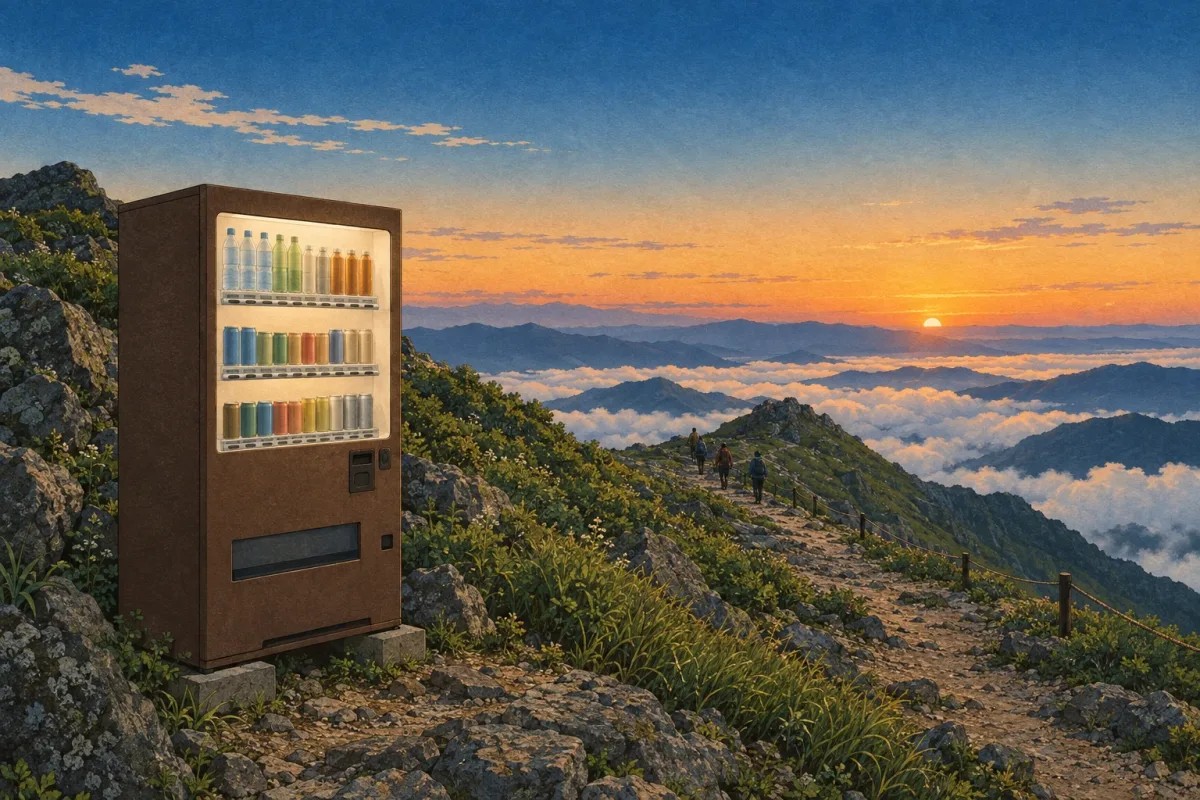
The classic example of "even on mountains" is the summit of Mount Fuji. According to Coca-Cola Bottlers Japan, every July, in time for the climbing season, a machine is carried to the summit by a commercial bulldozer. The trip takes about 2 hours each way over a violently bumpy route, with a member of the sales staff riding along, and the machine is removed around mid to late August.
Because Mount Fuji is a World Cultural Heritage site, this machine is painted brown to blend in with its surroundings. Water is the best seller, but since the summit temperature is between 0 and just under 10 degrees even in midsummer, it also stocks plenty of hot drinks such as canned coffee.
Care for the landscape is not limited to Mount Fuji. The industry body has set a calm beige "recommended landscape colour" for areas where machines need to blend in with their surroundings. At the Iwami Ginzan Silver Mine World Heritage site (Shimane Prefecture), machines with a wood-grain finish are also used.
The other side of vending machines that surprises visitors
Japanese vending machines are more than just drink dispensers. Since 2005, drink machines have carried a sticker showing the address where they stand. This was requested of the industry by the national organisation of fire chiefs, so that people making an emergency call can say where they are.
There are also "disaster-ready" machines that, under agreements between local authorities and operators, can give out the drinks inside for free in a disaster. Ito En describes a model that, even in a power cut, can generate electricity by pressing keys or turning a handle and hand out drinks free of charge.
There are systems for age-restricted products too. Since 2008, cigarettes from vending machines can only be bought with taspo, an IC card for adults. Outdoor alcohol machines are being replaced with models that can check your age with a driving licence or similar ID.
There are standard temperatures as well: according to the association, cold cans are sold at about 5°C and hot cans at about 55°C. It is thanks to hot-and-cold machines that you can buy a hot can on a station platform in the depths of winter.
Some people may feel that "lit up 24 hours a day, they waste electricity". According to the association, recent outdoor machines use light sensors and timers to switch their lights off during the day and on only at night. Since 1995, energy-saving machines ("eco vendors") have also been introduced that chill their drinks on summer mornings and stop cooling in the afternoon, when electricity demand peaks. Lighting is also increasingly being switched to LEDs.
Tips
- Most machines now take e-money such as transport IC cards. With e-money, choose your drink first and then tap your card (with cash, put the money in first).
- The recycling box beside a vending machine is only for empty cans and PET bottles. Please do not put other rubbish in it.
- If you cannot tell where you are during an emergency call, read out the address on the sticker of a nearby drink machine to make it easier to explain.
- The Mount Fuji summit machine is only there for a limited time, usually from its installation in July until it is removed around mid to late August. Do not rely on it too much; carry your own water up as well.
- Cigarette and alcohol machines have age checks using an adult IC card or ID. Some machines stop selling at night (from 11pm to 5am).