Why Do Japanese People Take a Bath Every Night?
A Japanese bath isn't a place to get clean but a place to warm up and reset after the day. That is also why it happens at night.
The short answer
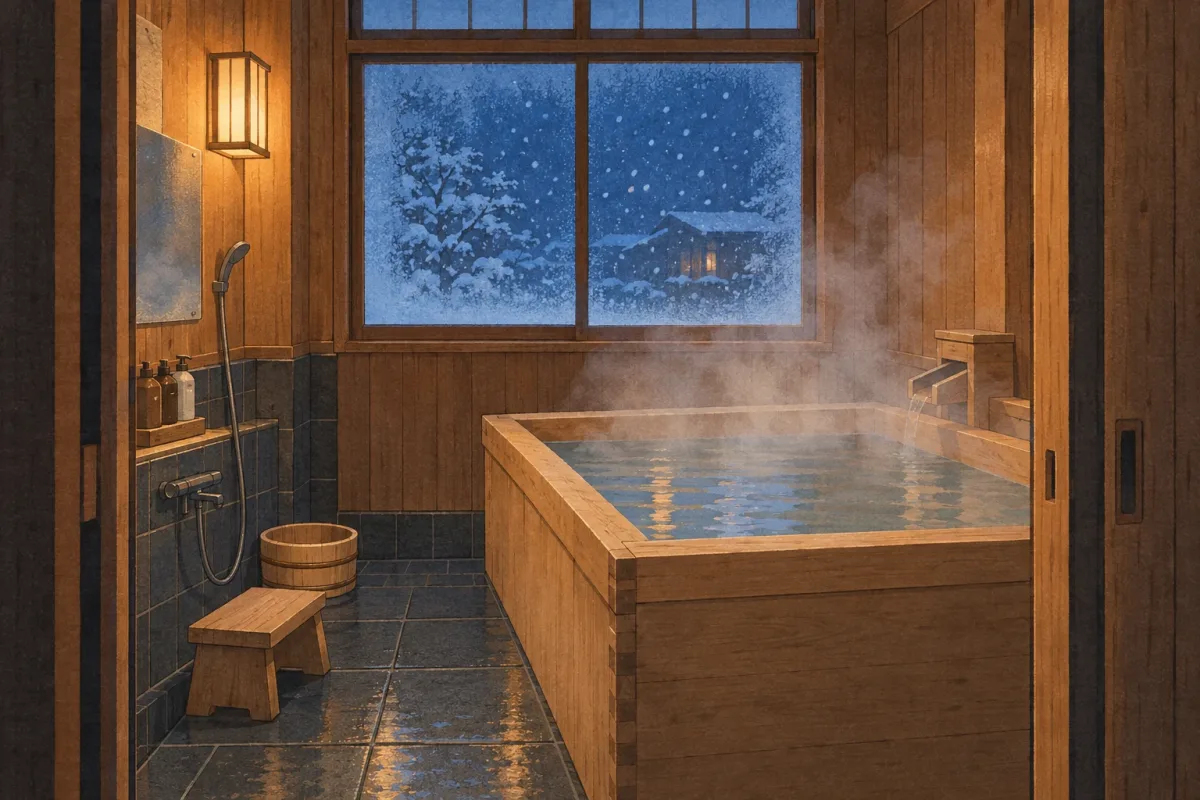
A Japanese bath is not just for washing off the dirt. You wash your body before getting into the water, and you get into the yubune (the tub filled with hot water) to warm up and relax. The typical pattern is to bathe at night to shake off the day's tiredness and sleep soundly.
That said, not everyone soaks in the tub every night. Surveys show that only about half of people soak in the tub every day in winter, many make do with just a shower in the hot months, and the number of shower-only people is rising across all age groups.
From temple "seyoku" to Edo's public bathhouses
According to the Tokyo Sento Association, Buddhism played a big part in how Japan's bathing culture began. Buddhism, which arrived in the 6th century, taught that cleansing the body brings spiritual merit, and temples widely practised seyoku, offering baths even to the poor. Todai-ji temple in Nara still has its Oyuya (great bathhouse). By the end of the Heian period, bathhouses called yuya, the forerunners of the public bathhouse, had appeared in Kyoto.
In the Kamakura and Muromachi periods, seyoku spread to the warrior class and the aristocracy. It is on record that in 1192 Minamoto no Yoritomo held 100 days of seyoku as a memorial for the retired Emperor Go-Shirakawa. Later came "furo-burumai", where households with a bath invited guests to bathe and then enjoy tea or sake afterwards. From early on, the bath was also a place for hospitality and for people to gather.
Records say Edo's first sento (public bathhouse) was built in 1591. By the early 17th century they were so widespread that it was said "every neighbourhood has a bath", and they became a place for ordinary people to relax, where everyone met naked regardless of social rank. Sento in those days heated their water from the morning and closed around 6pm. In the large room upstairs, customers fresh from the bath drank tea or played go and shogi (Japanese chess), so the sento was also the neighbourhood's social hub. Early sento were more like steam baths, but around the same time the suefuro appeared, a bath with plenty of hot water that you soak in up to your neck, and it gradually spread into homes too.
For a long time Edo's sento were mixed-sex, and the shogunate issued ban after ban. Enforcement tightened during the Tenpo Reforms (1841 to 1843), and some sento added partitions to the tub or set separate days for men and women. Mixed bathing reportedly only really disappeared around the middle of the Meiji era.
In the Meiji era, sento were remodelled to be brighter and more spacious, and in the early Showa era taps (called karan) were installed. Around 430 sento are still operating in Tokyo (as of November 2024).
"Every day" is a surprisingly recent habit
The habit of bathing every day actually spread nationwide not all that long ago. It was only after the period of rapid economic growth from the 1950s to the 1970s, when gas water heaters and running water reached ordinary homes, that having your own bath became the norm. Before that, it was not unusual for families to go to the sento, or to bathe in a home-made bath built from an oil drum.
Home bathrooms changed a great deal too. In 1958 a product went on sale that combined a fibre-reinforced plastic (FRP) tub with a boiler that reheated the water by circulating it, and it spread through public housing estates and ordinary homes. From the mid-1960s the "unit bath", assembled on site from factory-made parts, also became popular. Outside hotels, Japanese homes still mostly keep the toilet and the bathroom separate.
So why at night rather than in the morning? The reasons usually given are that people want to wash off the day's sweat and grime before getting into their futon or bed, and that they want to warm up and relax before sleeping. Bathing researchers recommend soaking in 40°C water for 10 minutes and getting out about 90 minutes before bed as a healthy way to bathe.
How Japanese people bathe today
In a 2023 survey across all 47 prefectures by the water-heater maker Rinnai, 53% of people said they soak in the tub every day in winter, while 17% said they shower every day without ever using the tub. The most popular water temperature was 40°C, at 31%, and the most common soaking time was 10 to 14 minutes. By prefecture, Toyama liked the hottest water, at an average of 41.3°C, and Yamanashi soaked the longest, at an average of 17.8 minutes.
A 2025 to 2026 survey of 2,600 people in the Tokyo area by Tokyo Gas's Urban Life Research Institute found that people in every age group said they liked bathing. Overall, though, the most common pattern was "showers in the hot months, the tub the rest of the year", and "shower people", once mostly in their twenties, are increasing among the over-thirties too. On winter weekdays, bath time averaged about 26 minutes, of which about 11 minutes were spent soaking. By age and sex, teenage boys soaked the longest, at about 15 minutes, and teenage girls spent the longest in the bathroom overall, at about 32 minutes, with more than 30% of them using a smartphone in the tub. More than 70% of teenagers also knew the internet slang "furo cancel kaiwai" (roughly "the bath-cancelling crowd"), meaning people who find bathing a hassle and skip it.
When it comes to complaints about the bathroom, "cold" and "mould" top the list, and many people find cleaning the bathroom a chore. More people than in the 2014 and 2019 surveys said they would be willing to pay for machines that clean the bathroom automatically or for outside cleaning services. People may love their baths as much as ever, but perhaps the honest truth today is that they want as little effort as possible.
What surprises people from abroad
The first thing that throws people is probably that you do not wash yourself in the tub. In Japan, good manners mean washing in the washing area before getting in, or at the very least pouring hot water over yourself to rinse off. There is even a saying: "Americans take a bath to get clean, but the Japanese get clean before taking a bath."
Another thing worth knowing about is the danger of bathing in winter. According to Japan's Consumer Affairs Agency, deaths of older people drowning in their bathtubs at home now outnumber road traffic deaths in recent years, and they are concentrated in the cold months from November to April. The temperature gap between a warm living room and a cold changing room and bathroom puts a strain on the body, and the Consumer Affairs Agency recommends measures such as heating the changing room, keeping the water at 41°C or below, and soaking for no more than 10 minutes.
Tips for enjoying a Japanese bath
Whether you bathe at home, at a ryokan (traditional inn) or at a sento, the basics are the same. First wash your body and hair in the washing area and rinse off all the suds, then get into the tub. The tub is a place to soak quietly, and your towel stays out of the water.
A neighbourhood sento is an easy way to experience everyday Japanese bathing culture. On an evening when you want to soak away the tiredness of travelling, why not look for a sento nearby?
Tips
- Before getting into the tub, wash yourself in the washing area and rinse off the suds thoroughly. Using soap in the tub is bad manners.
- If you are not used to hot water, don't push yourself; start with short soaks. A good guide is around 40°C for about 10 minutes.
- In winter, warm up the changing room and bathroom before you bathe, and don't stand up suddenly from the tub. Also avoid bathing straight after a meal or after drinking alcohol.
- If you live with other people, it is reassuring to let them know before you take a bath.
- A neighbourhood sento is an affordable place where locals unwind. It is an easy way to try Japanese bathing culture while travelling, too.