Japan is Nippon
Why Do Japanese Trains Have Women-Only Cars?
Those "Women Only" signs on the platform mark cars set aside to protect women from groping on packed trains. Who can ride, when, and how binding is it?
The short answer
Women-only cars are carriages that railway companies set aside to protect women from chikan (groping and other unwanted sexual touching on crowded trains, which is a crime in Japan). The Japan Private Railway Association, the industry body for Japan's private railway companies, describes them in exactly those terms: cars introduced to protect women from groping.
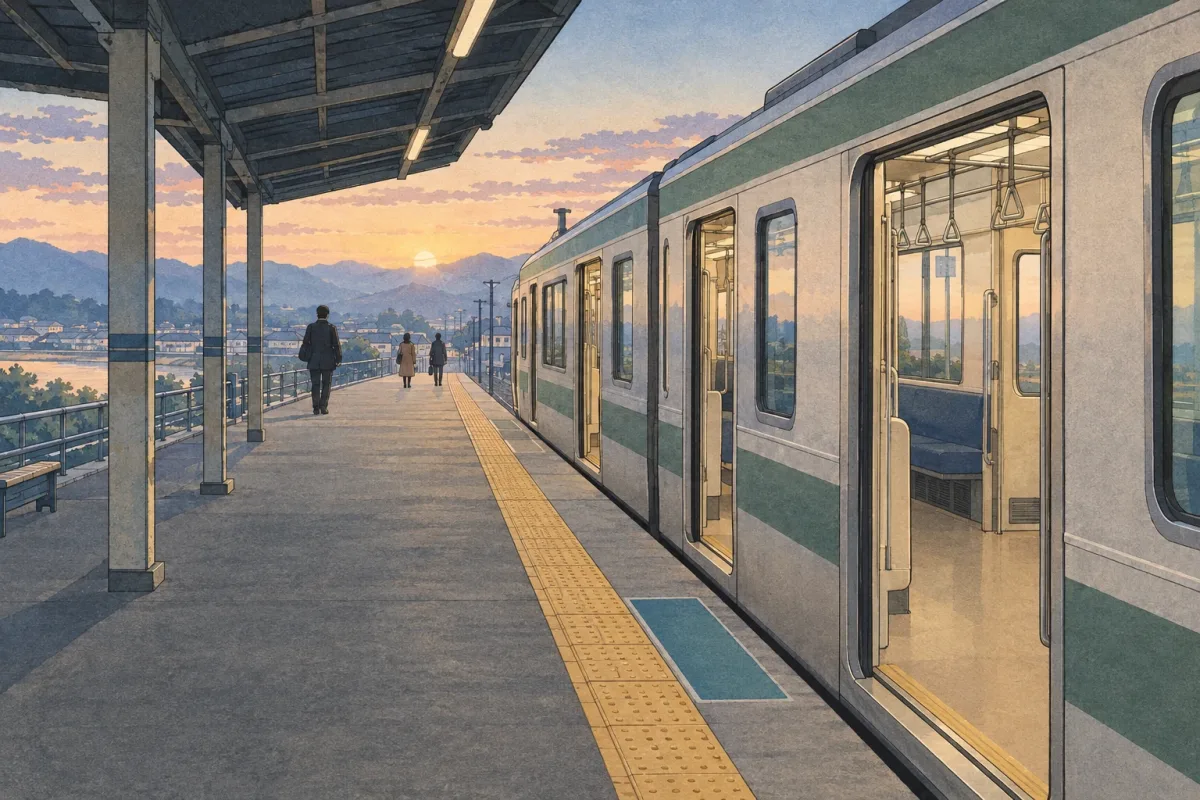
In most cases one particular car of the train becomes women-only during the commuter rush hours. Besides women, primary-school-age children and younger, people with disabilities and the people helping them can ride in it too.
According to the Ministry of Land, Infrastructure, Transport and Tourism, as of fiscal 2023 they were in use on 91 lines run by 32 railway operators. On commuter lines in the big cities you will now find them on almost every route.
The groping problem behind them
Tokyo's commuter trains get so full in the morning rush that passengers are pressed right up against each other, and that has long made them a breeding ground for groping. According to the Tokyo Metropolitan Police Department, about 950 cases were cleared in the capital in 2025 as obscene acts under the city's nuisance prevention ordinance. More than half took place on trains, and most happened between 7 and 9 in the morning, when people are travelling to work and school.
Government research backs this up. In a 1999 Cabinet Office survey, about half of the 1,773 women who responded said they had been groped on public transport or in the street.
In response, railway companies have run extra trains to ease crowding and campaigned for better manners, and on top of that they have spread women-only cars as a physical way of offering a place where groping is less likely to happen.
When did they start?
Surprisingly, women-only trains already existed in the Meiji era. In 1912, after harassment of female students became a problem, "ladies-only trains" are said to have run on Tokyo's Chuo Line during the morning and evening rush. After the war, in 1947, "women and children only cars" appeared as well, but they were eventually scrapped.
Women-only cars in their current form were first tried by Keio Corporation, a private railway in Tokyo, in December 2000, and properly introduced from March 2001. JR East followed in July 2001.
The big turning point was a push from the government. In a survey the Ministry of Land, Infrastructure, Transport and Tourism carried out in the Tokyo area in January 2002, just under 80 per cent of women and just under 70 per cent of men supported women-only cars. From October 2002 the ministry ran a two-month trial in the Kansai region with the help of Hankyu Railway and Keihan Electric Railway, and both companies introduced them for good that December. Kintetsu, Nankai, Hanshin and Nishitetsu followed in 2003, and in May 2005 Tobu, Seibu, Keisei, Odakyu, Tokyu, Keikyu, Tokyo Metro and Sotetsu in the Tokyo area all introduced them at once.
Who can ride, and when?
Each railway company words it a little differently, but the basics are the same. Keio and the Tsukuba Express say that women, children of primary-school age and younger, and people with disabilities and their helpers can ride. On JR West, boys up to the sixth year of primary school and people with disabilities (including their helpers) can ride.
The hours vary a great deal by company and line. On Keio, for example, the rule covers limited express, express and similar trains arriving at Shinjuku between 7:30 and 9:30 on weekday mornings, and some limited express and express trains leaving Shinjuku from 18:00 on weekday evenings. On JR West's Osaka Loop Line and some other lines, on the other hand, a women-only car runs from the first train to the last, weekends and holidays included.
You can spot the car from the boarding position markings on the platform and the stickers on the train. The hours are shown on those signs, in station notices and in the timetable. Outside those hours anyone can use it as an ordinary car.
Is it the law?
Women-only cars are not set out in any law. The Japan Private Railway Association calls them a "service car" that legal rules do not reach. Railway companies run them by asking for passengers' "understanding and cooperation", and a man who gets on is not penalised.
Even so, most male passengers avoid the women-only car during its hours. In the ministry's survey a majority of men supported the idea too, and in practice cooperating is seen as simple good manners.
Some people do object, asking whether it discriminates against men or why there are no men-only cars. The Tokyo Metropolitan Bureau of Transportation explains that it has had no strong requests for men-only cars and that no other operator has introduced them, so it has no plans for them at present. Women-only cars are only one of several measures against groping: the police are also developing a crime-prevention app and telling people what to do if they are groped or see it happen.
Tips
- Look for "Women Only" (女性専用車) signs on the platform floor, on pillars and on the train doors, and check the hours they apply.
- If you are a male traveller, it is good manners to stay out of the women-only car during the hours shown. If you get on by mistake, just move to the next car at the next station and that is fine.
- Boys of primary-school age and younger, and people with disabilities and their helpers, can ride even if they are male, so families travelling with children can use the car without worry.
- If you are groped or see someone being groped on a train, tell station staff or a police officer. In an emergency you can call 110. In Tokyo, the Metropolitan Police Department's crime-prevention app, Digi Police, has a feature for alerting people around you to a groper.
- The area by the doors of a crowded car is said to be where groping happens most often. If you are a woman travelling in Japan, using the women-only car during its hours is one option worth considering.
Sources
- 女性専用車両 | 鉄道用語事典 | 日本民営鉄道協会 (opens in a new tab)
- 女性専用車両 路線拡大モデル調査 報告書(平成15年3月) | 国土交通省 (opens in a new tab)
- 痴漢等の性犯罪被害防止対策 | 警視庁 (opens in a new tab)
- 女性専用車のご案内 | 京王電鉄 (opens in a new tab)
- 女性専用車両・女性専用席 | JRおでかけネット(JR西日本) (opens in a new tab)
- 女性専用車両はどういう人が利用できるのですか | つくばエクスプレス (opens in a new tab)
- 女性専用車両の導入経緯について知りたい | 阪急電鉄FAQ (opens in a new tab)
- 女性専用車両はあるのに、男性専用車両がないのはなぜ? | 朝日小学生新聞 (opens in a new tab)
- 痴漢遭遇・目撃時の対応方法 | 痴漢撲滅プロジェクト(東京都) (opens in a new tab)
- 日本の女性専用車両 - Wikipedia (opens in a new tab)