Japan is Nippon
Chagu Chagu Umakko
Horses wearing as many as 700 bells each walk 14 km from the rice fields to an old castle town: Iwate's early-summer procession honouring working horses.
Iwate
- IwateAbout 14 km from Onikoshi Sozen Shrine in Takizawa to Morioka Hachimangu in Morioka
Recent years
| Year | Dates | Visitors | Notes |
|---|---|---|---|
| 2026 | 13 June | — | 65 horses took part. With security costs soaring, the three host municipalities covered the costs, and the procession went ahead at its usual scale. That year there was no rest and meet-the-horses area on the Nakatsu River riverbank. |
| 2025 | 14 June | — | 68 horses took part, carrying children through the rice fields and the city streets. |
| 2024 | 8 June | 175,000 | 60 horses took part, under clear skies. |
| 2023 | 10 June | — | 62 horses took part. After cancellations (2020 and 2021) and a scaled-down event (2022) due to COVID-19, it returned to normal without restrictions for the first time in four years, and visitors could once again meet the horses at the rest areas. |
When and where is it held?
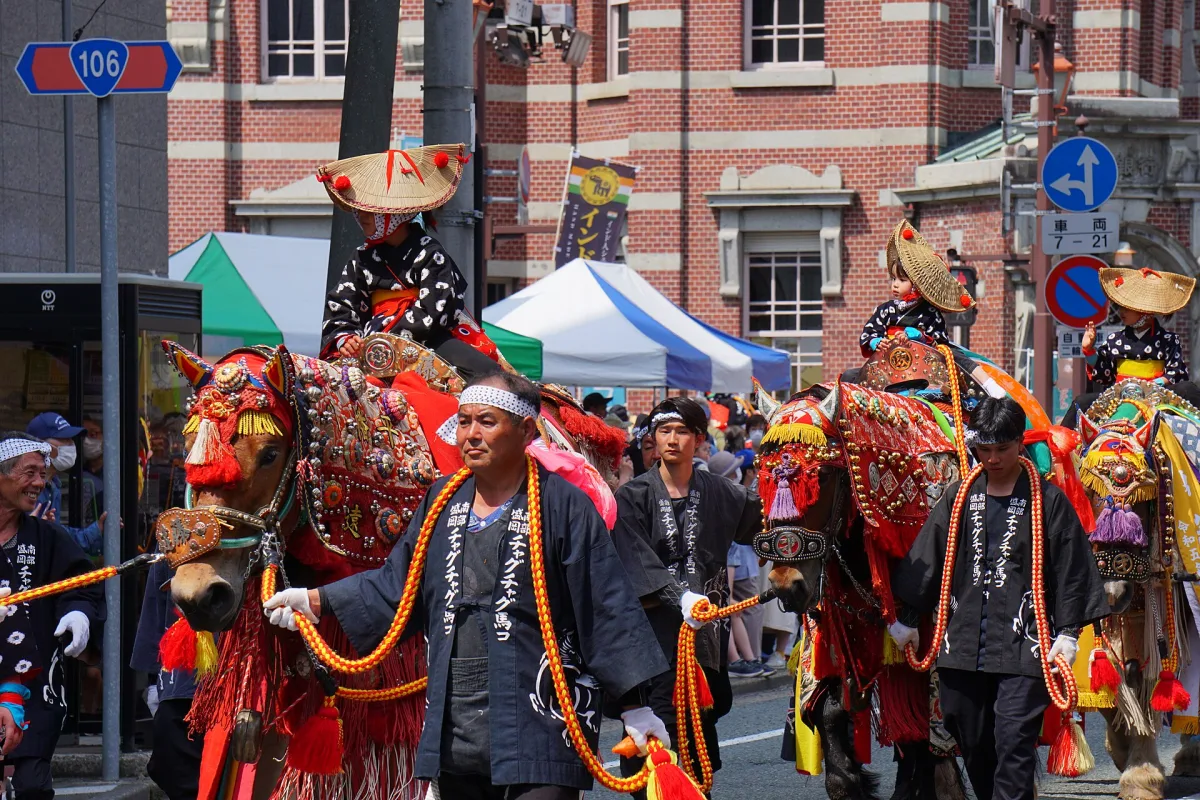
Chagu Chagu Umakko is a traditional event held in Takizawa and Morioka, Iwate Prefecture, on the second Saturday of June every year. "Umakko" is an affectionate Tohoku (northeastern Japan) word for a horse. Farm horses dressed in colourful shozoku (decorative costumes for horses) set off from Onikoshi Sozen Shrine in Takizawa and parade about 14 km to Morioka Hachimangu shrine in Morioka, a journey of about five hours.
The number of horses varies from year to year; the preservation society's guide puts it at about 60. In 2026 the event was held on 13 June with 65 horses. The rule is that each horse has two handlers leading it and one child riding on its back. It is organised by the Chagu Chagu Umakko Preservation Society, whose office is in Morioka City's tourism section.
The name "chagu chagu" comes from the sound of the bells, large and small, on the costumes, which jingle with every step. In 1996 this sound was chosen by what was then the Environment Agency as one of the "100 Soundscapes of Japan to Preserve".
It began as a visit to a shrine to give tired horses a rest
Iwate has long been known for raising horses, and it even developed a distinctive farmhouse, the Nanbu magariya, in which people and horses lived under one roof. In the busy season before rice planting, Tango no Sekku, the 5th day of the 5th month of the old lunar calendar, was a day off from farm work. On that day farmers rested horses worn out by work in the paddies and took them to pray at shrines such as Sozen shrines, dedicated to the guardian deity of horses, so that they would stay healthy. This custom, which became known as "O-Sozen mairi", is said to be the origin of Chagu Chagu Umakko.
By the middle of the Edo period, it had become fashionable to dress up the horses for the shrine visit. According to Takizawa City, around the Kansei era (the end of the 18th century), some horses took part wearing "konida shozoku", the costume worn by packhorses carrying baggage in daimyo (feudal lord) processions, handed down by the Nanbu family, lords of the Morioka domain. This is said to be the prototype of today's costumes.
In 1930, when Prince Chichibu, known for his love of horses, visited Iwate, the horses that had prayed at Onikoshi Sozen Shrine formed a line and paraded to Morioka Hachimangu, where they were shown off at the horse-riding ground in the shrine grounds, and it caused a sensation. From the following year, parading to the Hachimangu after the shrine visit became the custom, which is the form it takes today. In 1958 the date moved to 15 June in the modern calendar to avoid the busiest farming season, and from 2001 it moved to the second Saturday of June so that more horses could take part and more people could watch. In 1978 it was selected by the Agency for Cultural Affairs as an "intangible folk cultural property for which records should be made".
Hand-woven costumes and 700 bells
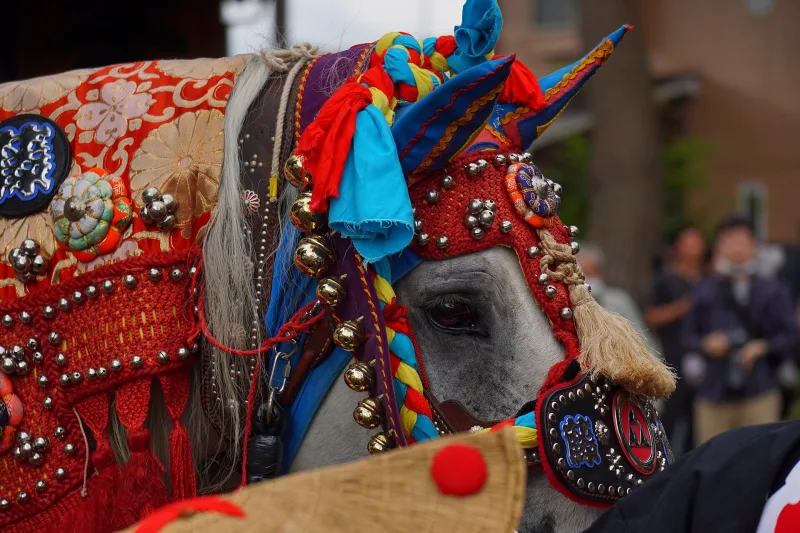
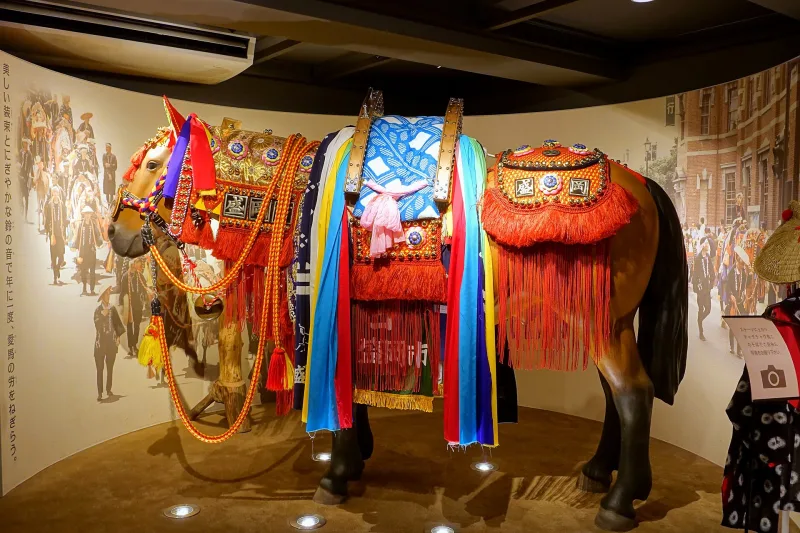
The costumes are hand-woven from high-quality hemp and coloured with shikon (deep purple) dye or other plant dyes, with every stage done by hand. Each family has its own colour scheme and way of making them, passed down from generation to generation. Today, workshops on how to make them are held in winter, when farm work is quieter. Each horse is said to wear about 700 bells.
Each part of the costume has a job. The "mimibukuro" that cover the ears keep insects away and act as earplugs so the horse is not startled by loud noises. The chrysanthemum-shaped "manju" are said to protect against arrows, a sign that the costume itself was once regarded as armour. The "hanakakushi" hanging in front of the face bear the family's yago (house name) or similar.
Some of the horses taking part still work at logging sites today. It is a glamorous procession, but the real stars are always the horses that work alongside people.
Where to watch: from rice fields to castle town
The procession leaves Onikoshi Sozen Shrine at around 9:30 am (the planned time for 2026) and passes Takizawa City Hall and Aoyama-cho in Morioka before entering the city centre. In Takizawa you can watch the horses against a backdrop of paddy fields and Mount Iwate; in Morioka, good spots include the Yugaose and Asahi bridges over the Kitakami River, the Zaimokucho shopping street with its old townscape, the area in front of Morioka Station and Kaiun Bridge, and Odori in the city centre. The procession reaches the finish at Morioka Hachimangu at around 2 pm. Check the exact expected passing times on the "parade route map" that the preservation society publishes on its website every year.
At Onikoshi Sozen Shrine, Big Roof Takizawa and Morioka Fureai Oibaba Plaza, the horses are tied up to rest, and you can take photos and meet them up close. The oibaba is a Meiji-era brick building for training horses indoors. Big Roof Takizawa also hosts the "Chagu Chagu Umakko Fureai Matsuri", with performances of local folk arts and more.
Crowds are large: a record 184,000 people came in 2022, and 175,000 in 2024. There is no car park near Onikoshi Sozen Shrine, so you walk about 1.4 km from car parks such as the one at Takizawa City Hall. On the day, a paid shuttle bus runs between Morioka Station and Big Roof Takizawa, but it does not stop at the shrine. Roads along the route are closed to traffic as the procession passes.
Rules for watching without startling the horses
Horses are very sensitive animals. To prevent accidents, flash photography, shouting, loud noises such as car horns, and drones are all prohibited along the route. If you drive nearby, you are asked to take care that your headlights do not switch on automatically and startle the horses. Show your support by waving, not by cheering.
Unlike people, horses cannot stop at traffic lights or change their walking pace by choice. Watch quietly as they keep walking all the way to the finish.
Tips
- The mood differs greatly between Takizawa, with its rice fields and Mount Iwate, and the old castle town of Morioka. To see both, the easiest plan is Takizawa in the morning, then waiting around Morioka Station in the afternoon.
- Each year the preservation society publishes the expected passing times on its website as a "parade route map". Always check it before you set out.
- There is no car park at Onikoshi Sozen Shrine. Most people take the paid shuttle bus from Morioka Station to Big Roof Takizawa and walk from there (the shuttle bus does not stop at the shrine).
- Turn your camera flash off. Shouting and loud noises are also prohibited.
- To get close to the horses for photos, head to the meet-the-horses areas at Big Roof Takizawa or Morioka Fureai Oibaba Plaza, where they rest.
Sources
- チャグチャグ馬コ保存会公式ホームページ (opens in a new tab)
- チャグチャグ馬コ保存会「歴史」 (opens in a new tab)
- チャグチャグ馬コ保存会「行進行事」 (opens in a new tab)
- チャグチャグ馬コ保存会「装束」 (opens in a new tab)
- チャグチャグ馬コ保存会「令和8年6月13日(土)チャグチャグ馬コ開催!」 (opens in a new tab)
- 滝沢市「チャグチャグ馬コ(うまっこ)」 (opens in a new tab)
- 滝沢市「チャグチャグ馬コとは?」 (opens in a new tab)
- 盛岡市「チャグチャグ馬コ」 (opens in a new tab)
- 盛岡観光コンベンション協会「2024年 チャグチャグ馬コ情報」 (opens in a new tab)
- 盛岡観光コンベンション協会「2026チャグチャグ馬コてくてくツアー」 (opens in a new tab)
- 岩手県「【滝沢市・盛岡市】チャグチャグ馬コ」 (opens in a new tab)
- IBC岩手放送「初夏を彩る風物詩『チャグチャグ馬コ』 65頭が約14キロを練り歩く」(2026年) (opens in a new tab)
- IBC岩手放送「チャグチャグ馬コ6月13日に開催決定 警備費高騰で3市町合わせて1400万円負担」(2026年) (opens in a new tab)
- 朝日新聞「水田に鈴の音響かせチャグチャグ馬コ 65頭が着飾って行進」(2026年) (opens in a new tab)
- IBC岩手放送「鈴の音と鮮やか装束馬が行列『チャグチャグ馬コ』」(2025年) (opens in a new tab)
- 共同通信(47NEWS)「響く鈴音、伝統の田園風景 岩手でチャグチャグ馬コ」(2025年) (opens in a new tab)
- IBC岩手放送「初夏の風物詩、チャグチャグ馬コ 6月14日開催が決まる」(2025年、2024年の人出) (opens in a new tab)
- 朝日新聞「60頭の装束馬が行進 チャグチャグ馬コ開かれる」(2024年) (opens in a new tab)
- IBC岩手放送「チャグチャグ馬コ4年ぶり通常開催」(2023年) (opens in a new tab)
- 朝日新聞「チャグチャグ馬コ、4年ぶり通常開催 マスク制限なし、馬と触れ合い」(2023年) (opens in a new tab)
- Wikipedia「チャグチャグ馬コ」(補助) (opens in a new tab)