Japan is Nippon
YOSAKOI Soran Festival
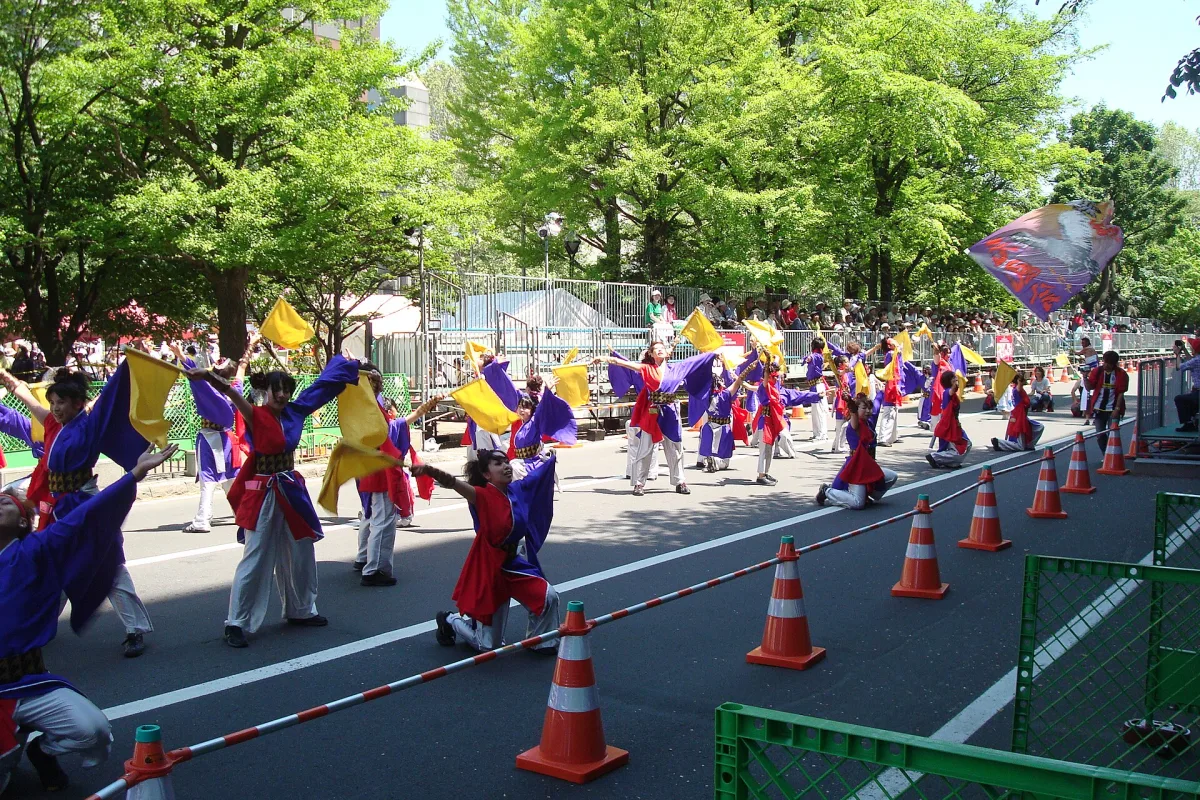
Just two rules: hold naruko clappers and use Soran Bushi. Some 270 teams and 27,000 dancers take over Sapporo in a festival only 30-odd years old.
Hokkaido
- HokkaidoSapporo; centred on Odori Park (West 8-chome stage, Odori north-south parade), with about 17 venues across the city including Susukino
Recent years
| Year | Dates | Visitors | Notes |
|---|---|---|---|
| 2026 | 10–14 June | about 2,285,000 | The 35th. 275 teams and about 27,000 people took part across 17 venues. Spectator numbers were the highest in the official records. |
| 2025 | 4–8 June | about 2,110,000 | The 34th. 270 teams and about 27,000 people took part across 17 venues. |
| 2024 | 5–9 June | about 2,109,000 | The 33rd. 256 teams and about 25,000 people took part across 15 venues. |
| 2023 | 7–11 June | about 2,067,000 | The 32nd. 238 teams and about 24,000 people took part across 13 venues. The festival returned to its pre-COVID format. |
| 2022 | 8–12 June | about 1,405,000 | The 31st. Held for the first time in three years after cancellations in 2020 and 2021, with venues cut to 10 in Sapporo and 2 elsewhere in Hokkaido, and 195 teams taking part. |
When and where is it held?
The YOSAKOI Soran Festival is a dance festival held every year in early June in Sapporo, Hokkaido. In recent years it has run for five days from Wednesday to Sunday; in 2026 (the 35th) it took place from 10 to 14 June. It is organised by the YOSAKOI Soran Festival Organising Committee, a general incorporated association.
The main venue is Odori Park, which runs east to west through central Sapporo, with other venues all over the city, including Susukino, the square in front of the Hokkaido Government's red-brick building, shopping streets and the car parks of large supermarkets. The number of venues varies from year to year; in 2025 and 2026 there were 17. True to the festival's motto, "The city is the stage", the whole city becomes a stage.
According to official figures, 275 teams and about 27,000 people took part in 2026, and spectators numbered about 2,285,000, the most since records began in 1992. The dates of the next festival (2027) had not yet been announced as of October 2026.
Only two rules: naruko and Soran Bushi
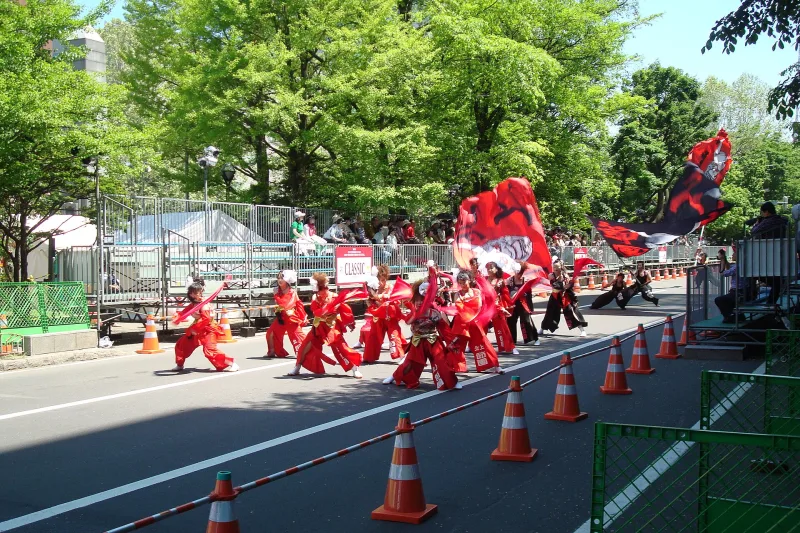
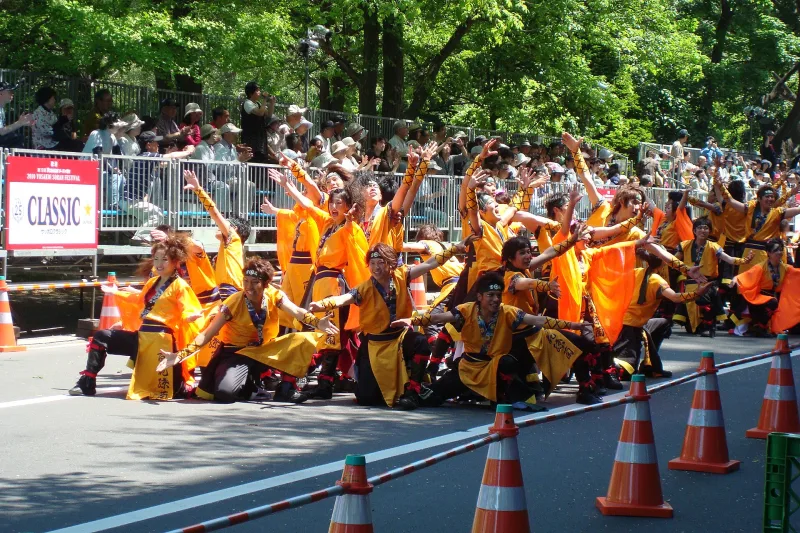
The dances at this festival have only two rules: dancers must hold naruko (wooden clappers) in their hands, and the music must include a phrase from Soran Bushi. Everything else, from choreography and musical arrangement to costumes and make-up, is up to each team.
Naruko are tools you rattle to make a noise. They were originally hung in fields so the sound would scare off birds, and after the Yosakoi Festival in Kochi brought them into its dances, they became an essential part of yosakoi-style festivals. Soran Bushi is a work song that Hokkaido fishermen sang as they hauled in their nets during herring fishing, a folk song known for its call of "Yaren, Soran".
Teams have up to 150 members and range from teams made up mainly of children and men's teams with powerful dances to teams from outside Hokkaido and from abroad, with participants from places including Taiwan, Brazil, Russia and the United States. Each team's showmanship is part of the fun too, such as the decorations on the jikatasha, the vehicle that leads the team in the parade, and the performances on the microphone.
Brought back from Kochi by a university student
The festival's roots lie in the Yosakoi Festival in Kochi city, Kochi Prefecture. A Hokkaido University student who saw that festival in Kochi was so moved that in 1991 they formed an organising committee with fellow students. The next year, in June 1992, the first festival was held, run by university students in Hokkaido.
The first festival had 10 teams with about 1,000 dancers, about 200,000 spectators and three venues. From there it grew quickly, reaching 408 teams in 2001. Even today, the main stage at Odori Park West 8-chome is planned and run by a student organising committee of university student volunteers.
Because of COVID-19 the festival was cancelled in 2020 and 2021, and in 2022 it was held for the first time in three years with venues cut to 10 in Sapporo (plus 2 elsewhere in Hokkaido). Since 2023 it has returned to its pre-COVID format.
Two ways to watch: parade and stage
The dances come in two forms: the parade style, in which teams dance as they move forward behind their jikatasha, and the stage style, in which they dance in a fixed spot. You can see both in Odori Park.
At the Odori north-south parade venue, teams dance their way from West 7-chome to West 5-chome along the roads on the south and north sides of Odori Park. It is a thrilling venue where judging also takes place, but watching the parade requires a ticket for the paid sajikiseki (stand seating built along the road).
The Odori Park West 8-chome venue is a special stage surrounded by the park's greenery and the only venue where every participating team appears during the five days. On the night of the last day, the Final Stage, which decides that year's grand prize, is held here. The special seats facing the stage are paid, but on some days the arena seats right in front of the stage are open free of charge during regular performance times (in 2026, on Wednesday, Thursday, Saturday and Sunday).
Viewing manners and ways to enjoy it
In the stand seats, special seats and arena seats, you cannot take photos or videos with your camera fixed to the floor or your lap using a monopod, tripod or similar. The filming rules for each Odori venue are posted on the official website every year, so check them before you go.
At Odori Park West 5 and 6-chome, a food event called Kita no Food Park, bringing together tastes from Hokkaido and beyond, runs during the festival, so you can eat between dances. On Friday night there is Soran Night, when the previous year's prize-winning teams dance on an illuminated stage, and performances begin on the streets of the Susukino nightlife district too.
Tips
- Start at the stage at Odori Park West 8-chome. Every team dances here, so you can compare lots of them.
- For the Final Stage on the last day, when the grand prize is decided, and Soran Night on Friday, even the arena seats at the West 8-chome venue need paid tickets. If you want to see them, check tickets early.
- You can only watch the Odori parade with a ticket for the stand seats. To watch for free, aim for the times when the arena seats are open free of charge, or the other venues around the city.
- Performance times and venues can be checked in advance in the team performance schedule on the official website. Following a team you like is another way to enjoy the festival.
Sources
- YOSAKOIソーラン祭り公式サイト「YOSAKOIソーラン祭りとは?」 (opens in a new tab)
- YOSAKOIソーラン祭り公式サイト「基礎知識」 (opens in a new tab)
- YOSAKOIソーラン祭り公式サイト「歴史と開催結果」(開催規模の推移) (opens in a new tab)
- YOSAKOIソーラン祭り公式サイト「観覧について」 (opens in a new tab)
- YOSAKOIソーラン祭り公式サイト「開催スケジュール」(2026年) (opens in a new tab)
- YOSAKOIソーラン祭り公式サイト「第35回 6月14日開催レポート」 (opens in a new tab)
- Wikipedia「YOSAKOIソーラン祭り」(補助:歴史、2022〜2025年の会期) (opens in a new tab)