Japan is Nippon
Furukawa Festival
Giant drums boom through the night as men clash with smaller drums; next day, ornate floats pass white-walled storehouses. Hida-Furukawa, wild then calm.
Gifu
- GifuKeta Wakamiya Shrine and central Furukawa, Hida City (including Matsuri Hiroba)
Recent years
| Year | Dates | Visitors | Notes |
|---|---|---|---|
| 2026 | 19–20 April | about 55,000 (organisers' figure) | The shigakusai on the 19th featured the mikoshi and float processions and the Okoshi Daiko; the 20th brought the line-up of all nine floats, karakuri puppet offerings and the night festival. |
| 2025 | 19–20 April | 60,000 (Hida City Tourism Association) | The first weekend festival in 11 years, since 2014. Participants from outside the city also helped pull the floats. Rain was forecast from the afternoon of the 20th, so the night festival and other events were cancelled. |
| 2024 | 19–20 April | over 50,000 (Hida City Tourism Association) | The first normal festival in five years, after pandemic cancellations and scaled-down years. The fierce jostling of the Okoshi Daiko was allowed again. |
| 2023 | 19–20 April | about 30,000 | The Okoshi Daiko procession returned for the first time in four years, on a smaller scale and with an agreement to hold back from fierce jostling. Local high school students and others helped make up for the shortage of float pullers. |
When and where is it held?
The Furukawa Festival (Furukawa Matsuri) is the annual festival of Keta Wakamiya Shrine in Furukawa-cho, Hida City, Gifu Prefecture, an area known as Hida-Furukawa. It takes place every year on 19 and 20 April; the dates are fixed, so they stay the same whatever the day of the week.
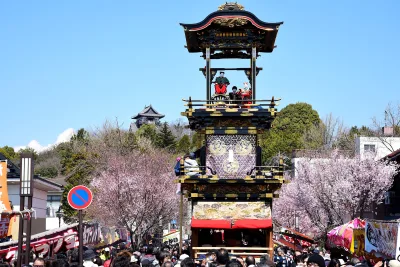
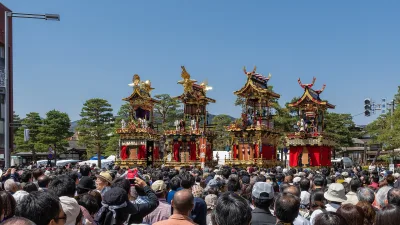
At its heart is the procession of the mikoshi (the portable shrine that carries the deity), joined by two big events: the wild, energetic Okoshi Daiko ("wake-up drum") and the calm, stately procession of yatai (festival floats). As "the Okoshi Daiko and Yatai Events of the Furukawa Festival", they were designated an Important Intangible Folk Cultural Property in 1980, and in 2016 the festival was added to UNESCO's Intangible Cultural Heritage list as one of 33 "Yama, Hoko, Yatai" float festivals from across Japan.
It takes place in central Furukawa, with its white-walled storehouses and the Seto River canal, within walking distance of JR Hida-Furukawa Station. About 50,000 people come over the two days.
The wild side: Okoshi Daiko
The Okoshi Daiko on the night of 19 April is the festival's big draw. It is said to have started as an alarm-call drum to tell townspeople the festival was beginning, and over time it became an event in its own right. It first appears in written records in 1831.
After a Shinto ritual in Matsuri Hiroba (the festival square), hundreds of men sing a celebration song together, and then the drumming begins. Men wrapped in sarashi (bleached cotton bands) carry a wooden tower holding a big drum about 80 centimetres across around the town. On top, the uwauchi drummer sits astride the drum while the yokouchi drummers stand at the side, both bringing long sticks crashing down. Being a drummer is an honour that comes only once in a lifetime: the young men chosen cut willow from the mountains themselves and spend over a month polishing it into drumsticks.
Chasing the tower are the tsuke-daiko from each neighbourhood: small drums tied to poles about 3.5 metres long. Getting closest to the tower is a matter of neighbourhood pride, so a fierce battle for the front position goes on until around midnight. Look out too for "tonbo", where a pole is stood upright and someone performs acrobatics on top of it. A line of lanterns leads the procession, a beautiful sight in contrast to the roughness of the drumming.
The calm side: floats and the night festival
In Furukawa the festival floats are called yatai. The earliest record of them dates from 1776, and a record from 1782 describes nine yatai being pulled through the town. Floats introduced from Edo (old Tokyo) were refined by the Hida no Takumi, Hida's famously skilled carpenters and craftsmen, who also brought in karakuri (mechanical) puppets, metal fittings and textiles from Kyoto, creating a distinctive, opulent local style.
On the 19th each float tours its own neighbourhood, and on the 20th comes the hikisoroe, when the floats line up together at a set location. At street corners around the town, karakuri puppet performances are offered on the Seiryutai and Kirintai floats, and children's kabuki on the Byakkotai ("Hashi Benkei", the tale of Ushiwakamaru and Benkei). The puppets are string-operated, with tricks such as a doll that climbs a ladder and a turtle that turns into a crane.
From the evening of the 20th comes the yomatsuri (night festival) that closes the event. The floats, lit with lanterns, tour the town, and the festival ends in a quieter mood than in the daytime.
The mikoshi procession and local customs
On the 19th, the shigakusai (opening festival), a Shinto ritual is held at the shrine and then the mikoshi comes down into the town. The procession includes kagura (sacred dance), gagaku (court music), shishimai (lion dance) and tokeiraku, played on gongs and drums. When the mikoshi reaches the otabisho (the place where the deity stays during the festival) in the evening, it is guarded all night. On the 20th, the hongakusai (main festival), the mikoshi tours the town and returns to the shrine.
Salt is scattered down the middle of the road where the mikoshi passes, with lines of salt branching off to the doorway of each house. This custom purifies the road and welcomes the deity into each home. On festival days families also hold "yobihiki", inviting relatives and friends over for a feast, with dishes such as tempura manju (deep-fried buns filled with sweet bean paste).
The temperament of Furukawa's men is known as "Furukawa yancha" (Furukawa mischief). The Okoshi Daiko was once so rough that the tsuke-daiko were banned several times in the Meiji era, but today it keeps the restraint fitting for a religious ritual.
Tips for watching
The Okoshi Daiko sets off from Matsuri Hiroba, which gets very crowded, so arrive early. After it starts, you can watch the tsuke-daiko clash at the big, busy junctions. The best spot is said to be the junction in Ichinomachi where the Kaba Sake Brewery and Watanabe Sake Brewery stand. The route changes every year, so check the route maps posted around town or the pamphlets, and get ahead of the procession to wait for it.
Even in April, Hida nights get cold, so dress warmly. Watch your footing in the crowds, too. As a rule only ujiko (local residents belonging to the shrine) can take part in the Okoshi Daiko, but in some years visitors can join locals walking in the lantern procession.
If it rains, the float line-up is cancelled, but the Okoshi Daiko goes ahead regardless. On rainy days the karakuri puppets and children's kabuki can be seen at the float storehouses. Outside the festival, you can see three of the real festival floats at the Hida Furukawa Matsuri Kaikan (festival museum).
Tips
- The Okoshi Daiko on the night of the 19th gets extremely crowded, so leave plenty of time to reach Matsuri Hiroba (the festival square), where the drumming starts.
- The best way to see the tsuke-daiko clashes is to check the route map and wait at a big junction.
- April nights in Hida are cold, so bring warm clothing.
- To take your time over the floats, go to the line-up of floats on the afternoon of the 20th. It is far calmer than the Okoshi Daiko.
- If it rains, the float line-up is cancelled, though you may be able to see the karakuri puppets and children's kabuki at the float storehouses.
Sources
- 飛騨古川まつり会館「古川祭について」 (opens in a new tab)
- 飛騨古川まつり会館「よくある質問」 (opens in a new tab)
- 飛騨市公式観光サイト「飛騨の旅」:古川祭 (opens in a new tab)
- 岐阜県飛騨市(PR TIMES)「伝統『古川祭』11年ぶりに土日の開催」(2025年3月31日) (opens in a new tab)
- 朝日新聞「もみ合い熱気 古川祭、飛驒路に春の訪れ 岐阜・飛驒市」(2026年4月21日) (opens in a new tab)
- 朝日新聞「ド迫力、古川祭 起し太鼓に華やか屋台、祭りの維持に助っ人も」(2025年4月22日) (opens in a new tab)
- 朝日新聞「勇壮さと華やかさ 飛驒の旧城下町がわいた古川祭、5年ぶり通常開催」(2024年4月21日) (opens in a new tab)
- 朝日新聞「岐阜県の古川祭、5年ぶりの通常開催 旧城下町、勇壮に『起し太鼓』」(2024年4月20日) (opens in a new tab)
- 朝日新聞「飛騨・古川祭に3万人 担い手不足に高校生の助っ人も」(2023年4月21日) (opens in a new tab)
- 朝日新聞「動と静の古川祭 3年ぶりの起し太鼓に拍手 岐阜・飛驒」(2022年4月21日) (opens in a new tab)
- Wikipedia「古川祭」 (opens in a new tab)