Japan is Nippon
Takayama Spring Festival (Sanno Matsuri)
Twelve floats clad in gold and fine carving line Hida-Takayama's old streets for two days. How to see the quick-change puppets and the lantern-lit night festival.
Gifu
- GifuThe southern part of Takayama's old castle town (Kamimachi), around Hie Shrine and the Jinya-mae crossroads
Recent years
| Year | Dates | Visitors | Notes |
|---|---|---|---|
| 2026 | 14 and 15 April | — | On the 15th the float line-up and the gojunko procession were cancelled, and the floats were shown in their storehouses. The puppet performances were also held at the storehouses rather than in front of the Jinya. |
| 2025 | 14 and 15 April | — | Rain cancelled the night festival on the 14th and the float line-up and gojunko procession on the 15th. The puppet performances were watched at the float storehouses. |
| 2022 | 14 and 15 April | — | After the COVID-19 disruption, it was decided to hold the festival in its traditional form for the first time in three years. On the first day rain cancelled the float line-up and gojunko procession, and the floats were shown in their storehouses. |
| 2021 | 14 and 15 April | about 9,000 (14th, as reported by the Asahi Shimbun) | Greatly scaled down as an infection control measure. The float line-up, puppet performances and night festival were cancelled, and the floats were shown in their storehouses. The year before, in 2020, only the Shinto rites were held. |
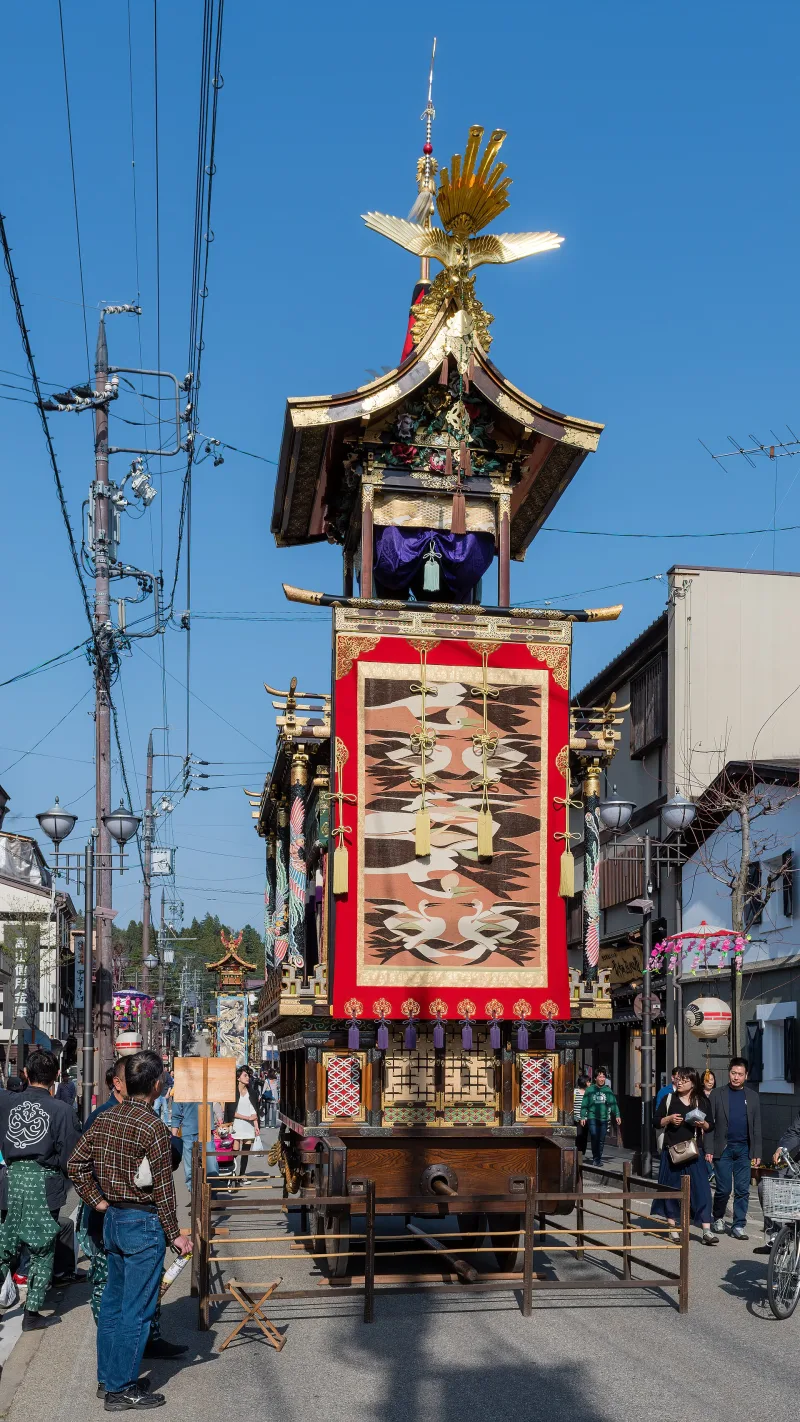
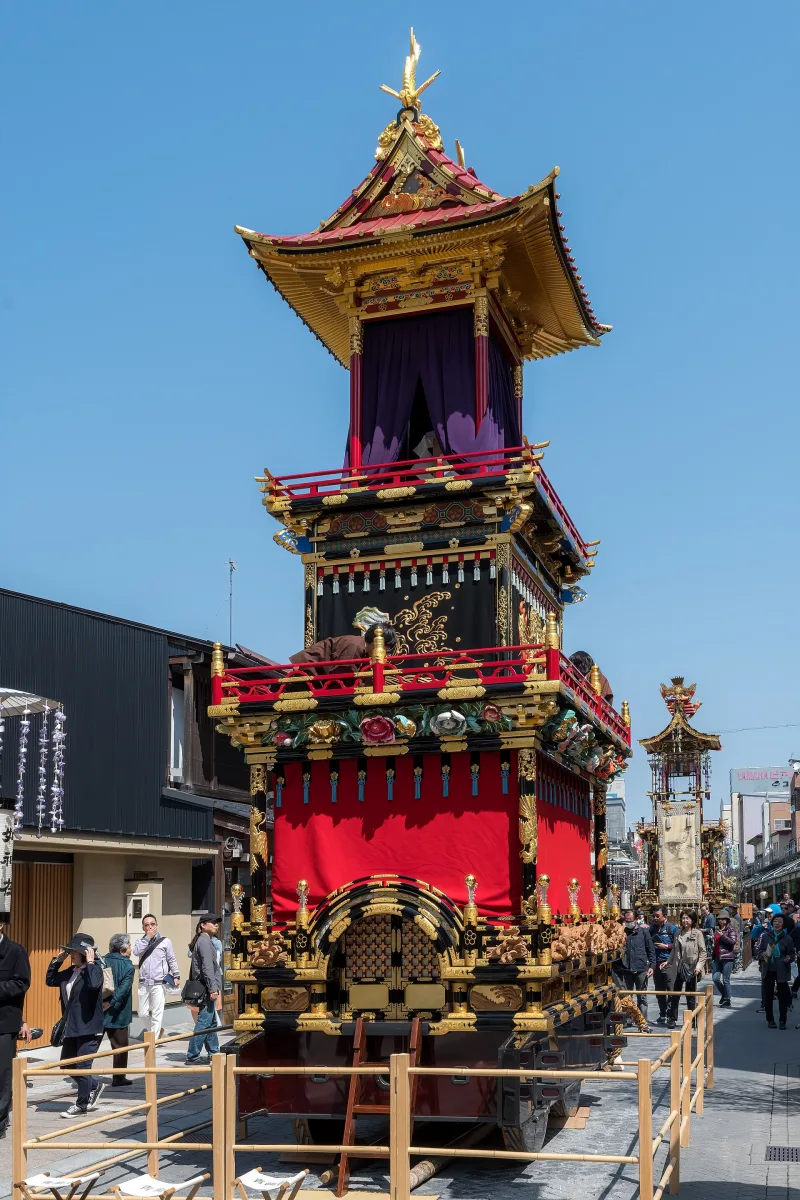
What is it, and when and where?
The Takayama Spring Festival is held every year on 14 and 15 April in Takayama, Gifu Prefecture. It is the annual festival of Hie Shrine, the ujigami (local guardian deity) of the southern half of the old Takayama castle town, and its official name is the Sanno Matsuri. Together with the Hachiman Matsuri, held at Sakurayama Hachimangu Shrine on 9 and 10 October in autumn, it makes up what is known as the Takayama Festival.
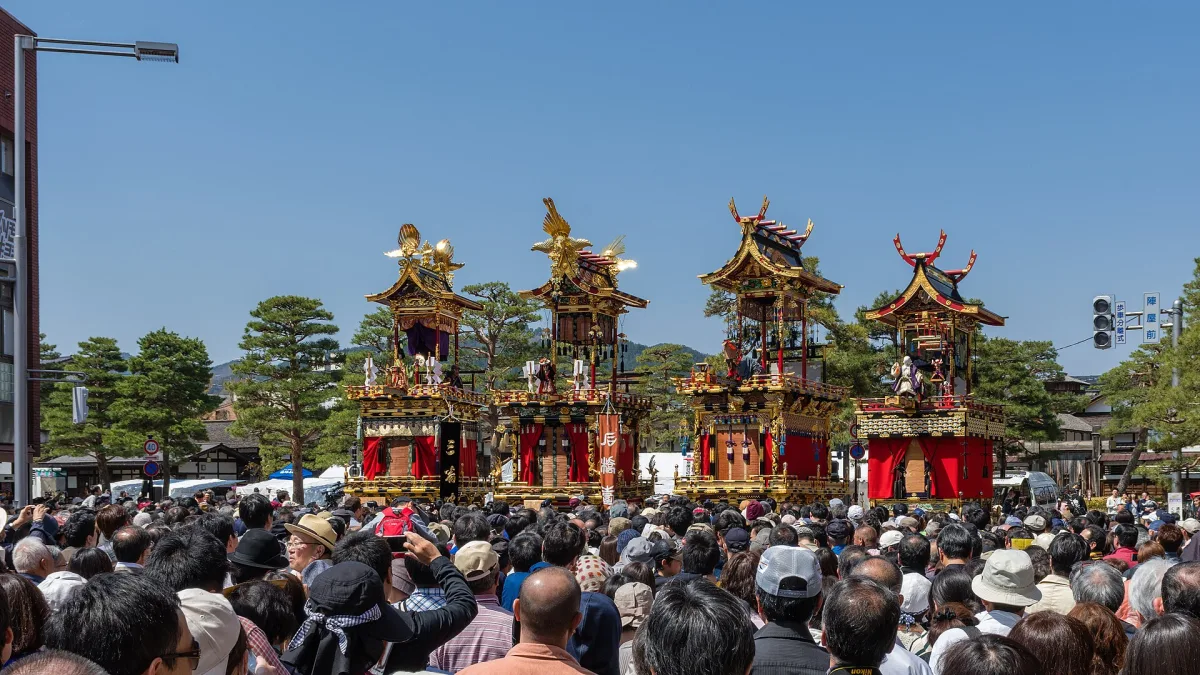
The biggest attraction is the lavish floats called yatai (dashi, decorated festival floats that are pulled through the streets). Twelve appear at the spring festival, and the stage is Kamimachi, the area south of Yasukawa-dori street in the town centre. The dates are fixed regardless of the day of the week, and if rain cancels an event it is not postponed to another day.
Floats and craftsmanship since the Edo period
A letter written in 1692 says that the Sanno Matsuri had been held once every three years for about the past 40 years, so the festival is thought to have already been taking place by around 1652. The floats are said to have joined the festival from around 1718.
The float carvings developed after 1837, when works by Tatekawa Washiro, a master carver from Suwa in Shinshu (today's Nagano), were fitted to the float Godaisan, and Takayama's own master craftsmen began trying to outdo one another. A celebrated example is 'Karako Gun'yu' (Chinese children at play) on the Kirin-tai float, carved by Taniguchi Yoroku at the age of 24 from a single board of zelkova wood, using the wood's growth rings to shape the roundness of the children's knees and cheeks.
The 23 floats of the spring and autumn festivals together were designated Important Tangible Folk Cultural Properties of Japan in 1960, and 'the float events of the Takayama Festival' an Important Intangible Folk Cultural Property in 1979. In 2016 it was inscribed, together with festivals from across Japan, on UNESCO's Intangible Cultural Heritage list as part of 'Yama, Hoko, Yatai, float festivals in Japan'.
The main events over the two days
At the yatai hikisoroe (float line-up), the 12 floats are lined up in the streets where you can see them up close. Four of them, Kagura-tai, Sanbaso, Shakkyo-tai and Ryujin-tai, line up at the crossroads in front of Takayama Jinya (the Edo-period government office).
In the karakuri hono (puppet offering), three floats, Sanbaso, Shakkyo-tai and Ryujin-tai, present performances by karakuri (mechanical puppets) to the gods at the Jinya-mae crossroads. They are held twice a day on both days. On Sanbaso, a boy puppet buries his face in a mask box and, when he looks up, has changed in an instant into an old man's mask; on Shakkyo-tai, a dancing beauty turns into a wild lion and then back into a beauty. The Shakkyo-tai puppetry was banned in 1892 as bad for public morals, but it was revived in 1984. On Ryujin-tai, a dragon god emerges from a small jar held by a Chinese boy.
The gojunko is a procession of several hundred people winding through the town around the mikoshi (portable shrine), with lion dancers, gagaku (ancient court music), the 'tokeiraku' players beating gongs and drums, and guards in kamishimo (Edo-period samurai formal dress). Because of its sound, the tokeiraku is known locally as 'kankakokan'.
The lantern-lit night festival
On the night of the 14th there is the yomatsuri (night festival). The floats, each lit with about 100 lanterns, move slowly through the town, and finally return to their own storehouses while the 'Takai Yama' song of parting is sung.
The floats travel in a long line, so the crowds can spread out to watch. The start and end points get crowded, so it's best to watch from somewhere along the route. Within the festival area each house hangs a lantern under its eaves. The designs differ for each float group, with more than 20 kinds, so looking out for them as you wander is part of the fun.
Coping with crowds and weather
Takayama gets enormous crowds at festival time, and there are no spectator seats. The Jinya-mae crossroads, where the puppet performances take place, is especially crowded, and you may find you can't move. People who are unsure of their stamina, or who use a wheelchair or pushchair, are advised to watch the YouTube live stream or the screen at the Nakabashi Tourist Information Office.
The floats are precious cultural properties, so if it rains or looks like rain the float line-up is cancelled and the floats are shown in each neighbourhood's storehouse. The puppet performances may also be cut back or held inside the storehouses. Changes are decided on the day and announced on the official tourism website and social media and at the information headquarters set up on the day.
On sunny days it can get quite warm in the daytime, but Takayama is surrounded by mountains, so the temperature drops from about 5pm and it feels chilly by the time of the night festival. Bring an extra layer. During the night festival, never touch the floats and don't step into the road. Please also avoid crossing the gojunko procession or following along behind it. Filming with drones is banned.
Tips
- Book accommodation early. Places to stay in the town centre are fully booked more than six months ahead, so also consider the outskirts and nearby towns.
- Even on rainy days the doors of the float storehouses are often opened so you can see the floats. Even if a cancellation is announced, take a walk around town.
- The puppet performances are extremely crowded, so if you really want to see one, claim a spot early or watch the live stream.
- Roads are closed on the festival days, and the streets get so crowded you can't get through on a bicycle or kick scooter. Explore on foot.
- Restaurants get busy too. It's a good idea to eat outside the usual mealtimes.
Sources
- 飛騨高山旅ガイド(高山市公式観光サイト)「春の高山祭をもっと知る 歴史と見どころ」 (opens in a new tab)
- 飛騨高山旅ガイド(高山市公式観光サイト)「2026年 春の高山祭」 (opens in a new tab)
- 飛騨高山旅ガイド「2025年 春の高山祭」2025年4月15日時点(Internet Archive) (opens in a new tab)
- 岐阜新聞「春の高山祭3年ぶり開幕 豪華屋台、厳かに」(2022年4月14日) (opens in a new tab)
- 朝日新聞「絢爛豪華な屋台は蔵の中 2年ぶり開催『静かな』高山祭」(2021年4月14日) (opens in a new tab)
- 朝日新聞「春の高山祭、屋台『曳き揃え』中止に 新型コロナの影響」(2020年3月) (opens in a new tab)
- Wikipedia「高山祭」(補助資料) (opens in a new tab)