Japan is Nippon
Nagahama Hikiyama Festival
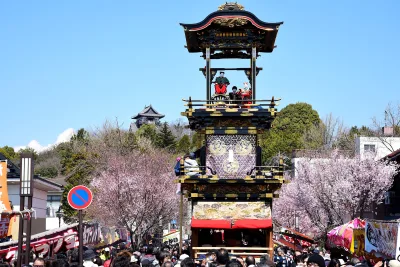
On tiny stages atop lavish floats, boys aged about 5 to 12 perform real kabuki. A spring festival in Nagahama, Shiga, by Lake Biwa, going for nearly 400 years.
Shiga
- ShigaNagahama Hachimangu and the old town of Nagahama (the float neighbourhoods, the shrine approach and the otabisho)
Recent years
| Year | Dates | Visitors | Notes |
|---|---|---|---|
| 2026 | 9–17 April | — | Performing floats: Tokiwazan, Kujakuzan, Okinazan and Banzairo. On the 15th, under cloudy skies and with covers over the floats, the offerings began with the first float, Tokiwazan. The museum streamed it live on YouTube. |
| 2025 | 9–17 April | — | Performing floats: Shojomaru, Hoozan, Kotobukizan and Takasagozan (in lot order). |
| 2024 | 9–17 April | — | Performing floats: Kankozan, Seigaizan, Gekkyuden and Kasugayama (in lot order). |
| 2023 | 9–17 April | — | To mark 450 years since Hideyoshi founded the town of Nagahama, all 13 floats gathered at the otabisho on the 15th. |
When and where is it held?
The Nagahama Hikiyama Festival is the spring festival of Nagahama Hachimangu, a shrine in Nagahama, Shiga Prefecture, held every year from 9 to 17 April in the old town of Nagahama. Because the dates are fixed, they are the same every year whatever day of the week they fall on.
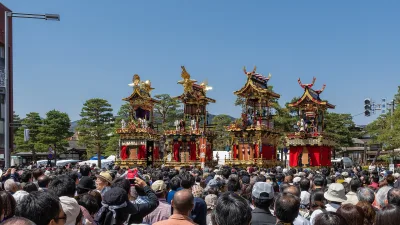
The biggest day is 15 April, known locally as the honbi ("the main day"). From the morning, children's kabuki is performed as an offering at Nagahama Hachimangu; then the hikiyama (floats) make their way to the otabisho (the place where the deity stays temporarily during the festival), and performances continue along the shrine approach and at the otabisho.
Nagahama is sometimes counted, alongside Kyoto's Gion Matsuri and the Takayama Festival in Gifu Prefecture, as one of Japan's three great float festivals. It was designated a national Important Intangible Folk Cultural Property in 1979, and in 2016 it was inscribed on UNESCO's Intangible Cultural Heritage list as one of Japan's 33 "Yama, Hoko, Yatai, float festivals".
Children's kabuki performed on the floats
A hikiyama is a festival float that is pulled around town. Nagahama's floats are decorated with metal fittings, carvings and paintings that bring together the finest Edo-period (1603–1868) craftsmanship, earning them the nickname "moving art museums". There are 13 floats in all, and 12 of them have a stage at the front about the size of four and a half tatami mats; each year four of them take their turn as the debanyama (performing floats).
On these stages, children's kabuki is performed. The actors are boys aged about 5 to 12 from the neighbourhoods that own the floats (known as yamagumi), and in Nagahama kabuki is called kyogen or simply gei ("the art"). Just as in ordinary kabuki, there are tachiyaku (heroic male roles) and onnagata (actors who play women).
The plays are new every year, adapted for children and for the small stage, and given titles unique to Nagahama. Each performance lasts about 40 minutes. For about three weeks, from the spring holidays in late March until the festival, the children practise under a choreographer, learning to read their lines and rehearsing on their feet, and finally rehearse with the joruri narrator (tayu) and shamisen (three-stringed lute) before the real performances.
The main events over nine days
On 9 April comes the senkoban ("incense-stick watch"), when festival officials go round each yamagumi's rehearsal space timing the performance. The name comes from the old practice of measuring the time by how long an incense stick took to burn. From the 9th to the 12th the rehearsals of each performing float are open to the public, and the wakashu, the young men who look after the children, make the hadaka mairi ("naked pilgrimage") to Nagahama Hachimangu and Hokoku Shrine.
On the 13th, from early in the morning, members of all 13 floats go to Nagahama Hachimangu to receive the gohei (sacred paper wands), and in the afternoon the kujitori-shiki, a lottery ceremony, decides the order of performances. In the evening, on floats pulled out into the streets of each neighbourhood, the child actors, now in full costume and make-up, perform their kabuki for real for the first time. On the 14th, after morning performances in the neighbourhoods, the floats gather at Nagahama Hachimangu, and in the evening comes the yuwatari, when the child actors parade through town in costume, escorted by the wakashu.
On the 15th, after the tachiwatari, a warrior procession said to be connected with Toyotomi Hideyoshi, kabuki is offered on the four floats in the order decided by lottery. On the first float (ichibanyama), the auspicious Sanbaso dance is performed first. When the sun sets and the floats' lanterns are lit, they head back from the otabisho to their neighbourhoods. On the 16th there are several more performances in the neighbourhoods for the closing day, and on the 17th the gohei are returned to the shrine and the festival ends.
A history that began in Hideyoshi's castle town
Nagahama is a castle town built around 1574, along with Nagahama Castle, by Hashiba (later Toyotomi) Hideyoshi, who went on to unify Japan. According to tradition, when a son was born to Hideyoshi, he gave gold dust to the townspeople in celebration, and each neighbourhood used it to build a float and pull it around in the Hachimangu festival; this is said to be how it began.
A script from 1742 and records of plays from 1769 onwards show that children's kabuki was already being performed on the floats by the middle of the Edo period. The people of Nagahama were quick to take up kabuki, the fashion of the day, and turned their town into a moving theatre.
The float processions stopped in 1937, during the war, but the processions and children's kabuki were revived in 1950, and around this time it came to be called the Nagahama Hikiyama Festival. More recently, it was cancelled in 2020 because of COVID-19, and in 2021 it was held on a reduced scale, without the float procession to Nagahama Hachimangu and with live video streaming. Some of the floats are decorated with tapestries woven in Brussels, Belgium, in the 16th century.
Viewing tips
If you want to take your time watching the children's kabuki, look out for the jicho kyogen, the performances in each float's own neighbourhood on the evening of the 13th, the morning of the 14th and on the 16th. On the 15th the performances go on from morning until night as the venue moves from Nagahama Hachimangu to the approach and then to the otabisho. Detailed performance times and places are usually published around mid-March.
On the 15th, if the weather is bad, covers may be put over the floats. On the honbi in 2026 the sky was cloudy and the plays were performed with the covers still on, but the child actors' spirited performances drew warm applause from the audience. At the yuwatari on the evening of the 14th, the child actors strike mie (the dramatic frozen pose with which a kabuki actor seals a moment) along the way, to applause from the roadside.
Even if you visit Nagahama outside the festival, you can see real festival floats at the Nagahama Hikiyama Museum, within walking distance of JR Nagahama Station: about 7 minutes on foot. On the 14th and 15th there are traffic restrictions around the museum, so the train is more convenient than driving.
Tips
- The highlight is the honbi on 15 April. From the offerings at Nagahama Hachimangu to the performances at the otabisho, you can see all four floats and their kabuki.
- Besides the 15th, there are performances on the streets of each neighbourhood on the evening of the 13th, the morning of the 14th and on the 16th. These are chances to watch from close to the floats.
- Rehearsals are open to the public from 9 to 12 April. Seeing how much the children improve before the real thing is one of the special pleasures of this festival.
- In the yuwatari on the evening of the 14th, the child actors walk in costume from Nagahama Hachimangu to near the Hikiyama Museum, striking mie poses along the way.
- If you visit outside April, you can see real festival floats at the Nagahama Hikiyama Museum. The museum has also streamed the festival day on YouTube in the past.
Sources
- 長浜市曳山博物館「長浜曳山祭について」 (opens in a new tab)
- 長浜市曳山博物館「子ども歌舞伎について」 (opens in a new tab)
- 長浜市曳山博物館「長浜曳山まつりの行事」 (opens in a new tab)
- 長浜市曳山博物館「過去の祭りの記録」(年表) (opens in a new tab)
- 長浜・米原・奥びわ湖観光サイト「長浜曳山まつり 子ども歌舞伎(4月13日~16日)」 (opens in a new tab)
- 長浜市曳山博物館「令和8年度 奉納狂言のくじ順が決定しました。」 (opens in a new tab)
- 長浜市曳山博物館「令和7年度 奉納狂言のくじ順が決定しました。」 (opens in a new tab)
- 長浜市曳山博物館「令和6年度 奉納狂言のくじ順が決定しました」 (opens in a new tab)
- 長浜市曳山博物館「2026長浜曳山まつりの様子をYouTubeで生配信します。」 (opens in a new tab)
- 長浜市曳山博物館「交通規制のお知らせ【令和8年4月14日・15日】」 (opens in a new tab)
- 毎日新聞「長浜曳山まつり 『本日』迎え、子ども役者が歌舞伎熱演 滋賀」(2026年4月15日) (opens in a new tab)
- Wikipedia「長浜曳山祭」 (opens in a new tab)
- 長浜経済新聞「2年ぶり『長浜曳山まつり』 規模縮小や動画配信で密避け開催」(2021年4月) (opens in a new tab)
- 中日新聞「長浜曳山祭の子ども歌舞伎、今年は絵で楽しんで コロナで中止」(2020年6月) (opens in a new tab)