Japan is Nippon
Hakata Dontaku
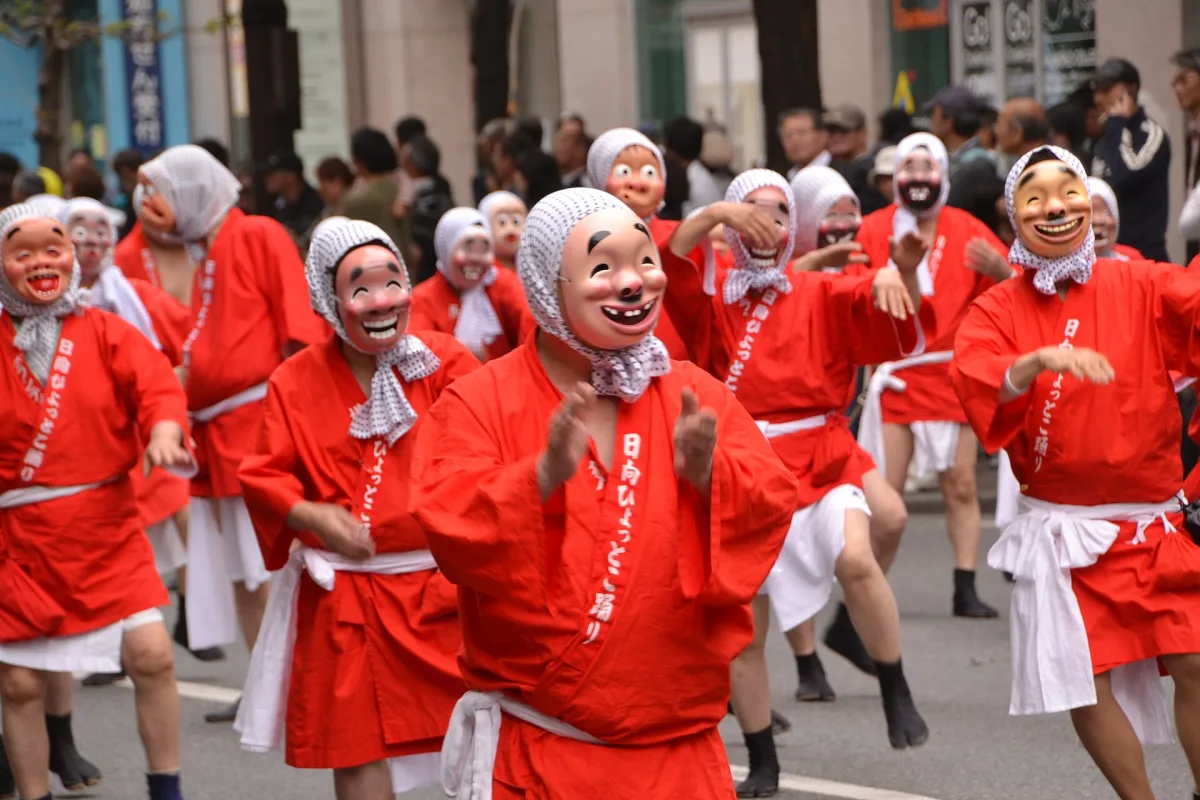
Costumed crowds parade through Fukuoka clacking rice paddles. Rooted in New Year rites over 800 years old, this May festival draws over 2 million people.
Fukuoka
- FukuokaCentral Fukuoka (Dontaku Hiroba on Meiji-dori, in front of Hakata Station, and stages across the city)
Recent years
| Year | Dates | Visitors | Notes |
|---|---|---|---|
| 2026 | 3–4 May | about 2,150,000 (organisers' figure) | The 65th festival. Rain on the first day cancelled some events. India took part from overseas for the first time, among 14 overseas groups. The paid tourist grandstand at Suijo Park was dropped and new town-walk viewing seats were introduced. |
| 2025 | 3–4 May | about 2,350,000 (organisers' figure) | The 64th festival. Blessed with good weather, it drew the biggest crowds since the pandemic. |
| 2024 | 3–4 May | about 2,300,000 (organisers' figure) | The 63rd festival. About 200,000 more people than the year before, back to pre-pandemic levels. |
| 2023 | 3–4 May | 2,100,000 (organisers' figure) | The 62nd festival and the first normal one in four years. A big recovery from the scaled-down 2022 festival (800,000), back to roughly the usual numbers. |
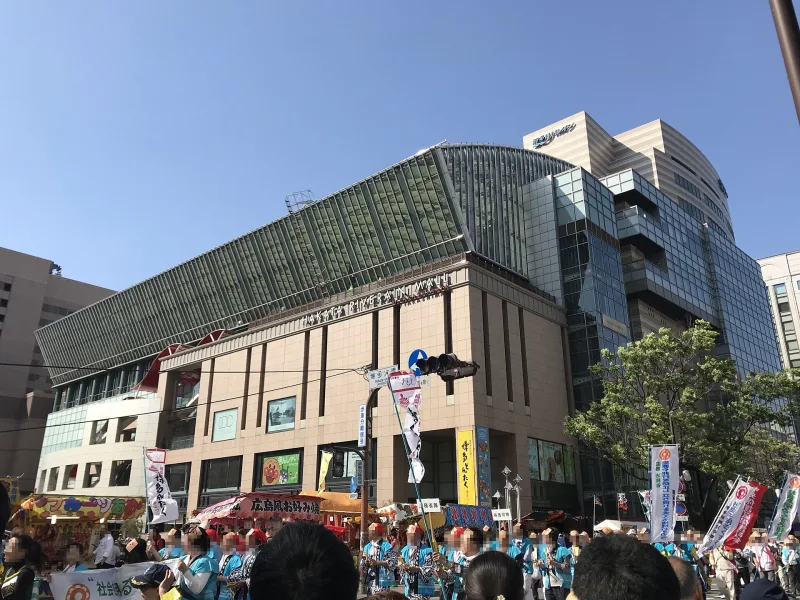
When and where is it held?
Hakata Dontaku Minato Matsuri (officially the "Fukuoka Citizens' Festival Hakata Dontaku Minato Matsuri") takes place in Fukuoka City, Fukuoka Prefecture, every year on 3 and 4 May. It falls in the middle of Golden Week, Japan's long holiday stretch from late April to early May, and according to the organisers, the Fukuoka Citizens' Festival Promotion Association, it draws over 2 million people over the two days every year. There is also an eve-of-festival event on 2 May.
The stars are the participating groups, called "Dontaku-tai". Companies, schools, community groups, tourism promotion teams from other towns and even groups from overseas perform dances and music in costumes of their own choosing. At the 65th festival in 2026, more than 1,300 people in 14 groups came from overseas.
The whole of central Fukuoka becomes the venue. The main stage, Dontaku Hiroba, is Meiji-dori, closed to traffic, where the parade runs for about 1.3 kilometres. Stages called "enbudai" are also set up in front of Hakata Station and around the city, and the whole town is given over to Dontaku.
Its roots: Hakata Matsubayashi
Dontaku grew out of Hakata Matsubayashi, an Important Intangible Folk Cultural Property. The Chikuzen no Kuni Zoku Fudoki, a regional gazetteer compiled by the Edo-period scholar Kaibara Ekiken, records that it began in 1179, and it is thought to be a New Year celebration from the imperial court in Kyoto that spread to the regions. There are also records that around 400 years ago the townspeople of Hakata put together matsubayashi processions and went to the local lord's castle to offer New Year greetings.
Today's Matsubayashi is made up of four groups: three gods of good fortune, Fukujin (Fukurokuju), Ebisu and Daikoku, plus the chigo, girls who perform dances. On 3 and 4 May, the masked gods ride on horseback in a procession around the city, bringing blessings wherever they go. The Matsubayashi also leads the parade at Dontaku Hiroba.
In the early Meiji era, Matsubayashi was banned under the new government's policies, but it later resumed and came to be called "Dontaku". It stopped again during the Pacific War, but in 1946, with the city still scarred by air raids, local volunteers revived it with paper costumes and borrowed shamisen (three-stringed lutes) and drums, and it restarted in full from 1947. Since 1962 it has been the "Fukuoka Citizens' Festival", open to anyone in the city.
What "Dontaku" means, and the mystery of the rice paddles
The word "Dontaku" is said to be a corruption of the Dutch "zondag" (Sunday, or a day off). The Japanese word "handon", meaning a half-day off, is thought to share the same origin. Across Japan the word was once used to mean a holiday, but in Hakata it survived as the name of a cheerful festival.
Many Dontaku groups carry and clack shamoji, the flat paddles used to serve rice. The official website tells a story that long ago, when Dontaku musicians passed a merchant's house, the woman of the house, busy making dinner, got so caught up in the fun that she joined in by tapping the shamoji she was holding.
The song best known for being played at Dontaku is "Bonchi Kawaiya", which is also introduced on the official website.
Highlights of the two days
On 3 May, an opening ceremony declares Dontaku under way, and then the parade begins at Dontaku Hiroba on Meiji-dori. Led by the Matsubayashi, local Dontaku groups, marching bands, taiko drum teams and more appear one after another. On Hakata Ekimae-dori, too, the street becomes a stage for Dontaku groups to perform.
On 4 May the stages and parades continue around town, along with a marching festival of marching bands. In the evening comes the grand finale, the So-odori, which spectators can jump into. Finally, at venues all over town, the festival closes with "Hakata te-ippon", Hakata's own style of ceremonial hand-clapping.
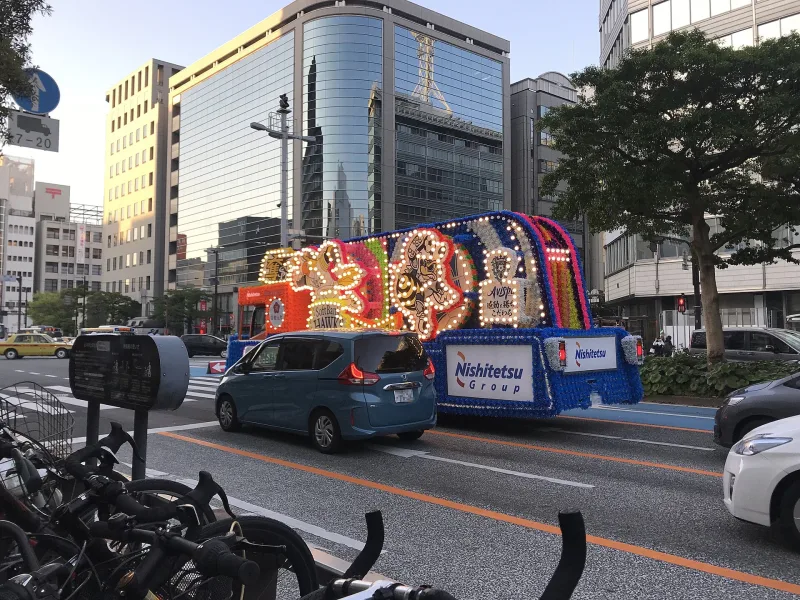
During the festival, "hana-jidosha" (flower cars) decorated with LED lights drive around Fukuoka. They carry on the tradition of the "hana-densha" (flower trams) of the streetcars that once ran through the city.
Tips for watching
You can watch the parade freely from the roadside. The programme on the official website shows which groups appear on which stage and when. From 2026 the paid tourist grandstand that used to be set up in Suijo Park was dropped and replaced with "Dontaku town-walk viewing seats".
Crowds and events depend on the weather. In 2026 rain on the first day cancelled some events, but the second day was sunny and busy. Events may change in wet weather, so check the official website and social media for the latest information before you go. In 2026 there was also an official live stream of the parade.
To join the So-odori, head on the evening of 4 May to one of its venues: Gofukumachi, Nakasu-Kawabata, Suijo Park or the main festival stage.
Tips
- The parades and stages are free to watch. If there is a particular Dontaku group you want to see, check times and places in the programme on the official website.
- Anyone in the crowd can jump in and join the "So-odori" mass dance on the evening of 4 May. It is the best way to experience Dontaku for yourself.
- The Hakata Matsubayashi procession tours the city during the day on 3 and 4 May. The sight of Fukujin, Ebisu and Daikoku riding on horseback is the very root of Dontaku.
- At night, illuminated "hana-jidosha" (flower cars) drive around the city. Their schedule is published on the official website and elsewhere.
- If you cannot make it on the day, there may be an official live stream of the parade (there was one in 2026).
Sources
- 福岡市民の祭り 博多どんたく港まつり 公式サイト (opens in a new tab)
- 博多どんたく港まつり公式サイト「博多どんたくとは」 (opens in a new tab)
- 博多どんたく港まつり公式サイト「博多松囃子」 (opens in a new tab)
- 博多どんたく港まつり公式サイト「総おどり」 (opens in a new tab)
- 博多どんたく港まつり公式サイト「観光桟敷席」 (opens in a new tab)
- 毎日新聞「どんたくフィナーレ 五月晴れの『総踊り』 雨影響も 人出215万人」(2026年5月5日) (opens in a new tab)
- 西日本新聞「博多どんたく、総おどりでフィナーレ 2日間で215万人」(2026年5月4日) (opens in a new tab)
- 読売新聞「『どんたく』の人出235万人でコロナ禍後で最多」(2025年5月5日) (opens in a new tab)
- TNCニュース「『博多どんたく港まつり』2日間で235万人の人出 コロナ禍以降で最多」(2025年5月5日) (opens in a new tab)
- 読売新聞「博多どんたく港まつり閉幕、2日間で230万人」(2024年5月5日) (opens in a new tab)
- 西日本新聞「博多どんたく、総おどりでフィナーレ 福岡市中心部に2日間で230万人『コロナ前水準に』」(2024年5月4日) (opens in a new tab)
- RKB毎日放送「博多どんたくフィナーレ 人出は210万人に」(2023年5月4日) (opens in a new tab)
- Wikipedia「博多どんたく」 (opens in a new tab)