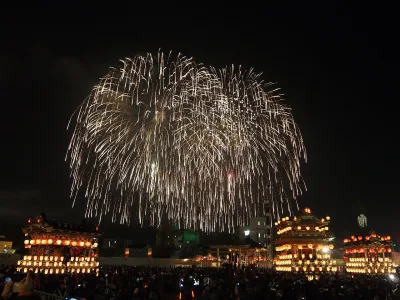
Kasuga Wakamiya On-matsuri
At midnight a deity moves along a pitch-dark approach; by day about 1,000 people in Heian-to-Edo dress parade through Nara. A December festival since 1136.
Nara
- NaraKasuga Taisha and Wakamiya Shrine in Nara, and the otabisho on the approach; the Owatari-shiki parade runs from the Nara Prefectural Office through the city along Sanjo-dori and other streets
Recent years
| Year | Dates | Visitors | Notes |
|---|---|---|---|
| 2026 | 15–18 December (Owatari-shiki on the 17th) | — | The 891st festival. The main events are fixed every year for 15–18 December. |
| 2025 | 15–18 December (Owatari-shiki on the 17th) | — | The 890th festival. Rain had been forecast, but the Owatari-shiki was only partly shortened and about 1,000 people took part. Rain began partway through the Otabisho-sai, and a temporary roof was put up over the turf stage so the performances could continue. |
| 2024 | 15–18 December (Owatari-shiki on the 17th) | — | The 889th festival. About 1,000 people took part in the Owatari-shiki under clear skies. |
| 2023 | 15–18 December (Owatari-shiki on the 17th) | — | The 888th festival. After four scaled-down years in a row because of COVID-19 and rain, the Owatari-shiki was held at its usual size (about 1,000 people) for the first time in five years. |
| 2022 | 15–18 December (Owatari-shiki on the 17th) | — | The 887th festival. A return to full scale for the first time in three years had been planned, but because of rain the Owatari-shiki was cut to about 20 people over about 300 metres of the approach (in 2020 and 2021 it was scaled down as a COVID-19 measure). |
What is it, and when is it held?
The Kasuga Wakamiya On-matsuri is the festival of Wakamiya Shrine, a sessha (a subsidiary shrine attached to a main shrine) of Kasuga Taisha in Nara. "On-matsuri" is an honorific way of saying "the festival", in other words a special festival. Preparatory rituals begin in July, but the main events are held every year from 15 to 18 December, and 17 December is the festival's big day. In 2026 it again runs from 15 to 18 December, with the big day, the 17th, falling on a Thursday.
On the 17th the festival fills the whole day. At midnight the Wakamiya deity is moved from its main sanctuary to a temporary hall called the otabisho. By day a procession that includes groups of performers goes to pay its respects to the deity there, ancient performing arts are offered from the afternoon into the night, and the deity is returned to its sanctuary before the day is out. The procession and the performing arts are designated a national Important Intangible Folk Cultural Property.
A festival born in a time of famine and disease
According to the organisers, in the 1130s, during the Heian period (794–1185), long rains and floods brought famine after famine, and disease spread. Seeking the protection of the Wakamiya deity, the retired emperor and the regent Fujiwara no Tadamichi, among others, built a shrine on its present site in 1135, and in 1136 the deity's spirit was welcomed to Kasugano and a grand festival was held; this is said to be how it began. Tradition says the long rains and floods then ended, and ever since, the festival has been held by the whole of Yamato Province (today's Nara Prefecture) to pray for good harvests and for people's peace of mind.
The date changed over the centuries, and from the Meiji era (1868–1912) it was fixed on 17 December in the modern calendar. The organisers say it "has continued without a single break", and 2025 was its 890th edition. For a long time the festival was run by monks of Kofukuji, a temple with close ties to Kasuga Taisha; since the Meiji era it has been organised by Kasuga Taisha.
The midnight Senko-no-Gi
At midnight on the 17th comes the Senko-no-Gi, the ritual that moves the Wakamiya deity from its main sanctuary to the otabisho. Every light along the approach is put out, and not only photography but even switching on a torch is forbidden. The way is purified with two large pine torches and incense, and the Shinto priests surround the deity with layer upon layer of sakaki branches (a sacred evergreen), moving through the darkness to the strains of gagaku (ancient court music) while continually calling out "Woh, woh".
Members of the public can watch from the side of the approach, but according to news reports the organisers ask people to remember that "this is not sightseeing or a show; you are taking part in a ritual". Receiving the deity quietly and without lights is the rule for this ceremony. The Kanko-no-Gi, in which the deity returns to its sanctuary, takes place at around 11pm on the 17th, likewise in darkness.
The daytime Owatari-shiki and performances into the night
At noon on the 17th, the Owatari-shiki, a historical costume parade, sets off from in front of the Nara Prefectural Office. It has about 1,000 participants and about 50 horses. It passes in front of Kintetsu Nara Station and JR Nara Station, then heads east up Sanjo-dori to the approach to Kasuga Taisha. Twelve groups follow one another in costumes spanning the Heian to the Edo periods, including the Hi-no-Tsukai (the official envoy) on horseback, shaded by a parasol decorated with cranes; shrine maidens; troupes of sarugaku (an old name for Noh) and dengaku performers; child archers for yabusame (horseback archery); and a daimyo's procession from the Edo period.
In front of the Yogo-no-Matsu (the "pine where the deity appears"), just inside the first torii of Kasuga Taisha, comes the Matsu-no-Shita-shiki, in which each troupe in the procession performs an excerpt of its art. This pine is said to be the origin of the pine tree painted on the back wall of every Noh stage.
From about 2.30pm the Otabisho-sai begins on the turf stage at the otabisho, and until about 10.30pm a succession of performances are offered: kagura danced by shrine maidens, Azuma Asobi danced by children, dengaku, Seino (danced with the face hidden behind a white cloth), Kagura-shiki (a shortened form of the Noh piece Okina), Yamato-mai (the dance of Yamato) and bugaku, dances that came from mainland China and the Korean Peninsula. It is like watching the history of Japanese performing arts in a single day. On the 18th there is also sumo wrestling offered to the deity, and Noh and kyogen (comic theatre) in the Goen-no (the after-festival Noh).
Viewing tips and things to note
The Owatari-shiki can be watched for free from the streets of the city. For those who want to sit and watch in comfort, the Nara City Tourism Association sets up paid special stand seats at three places: the starting point (Noborioji Garden), in front of the Yogo-no-Matsu and in front of the otabisho. In recent years booking has opened in mid-October.
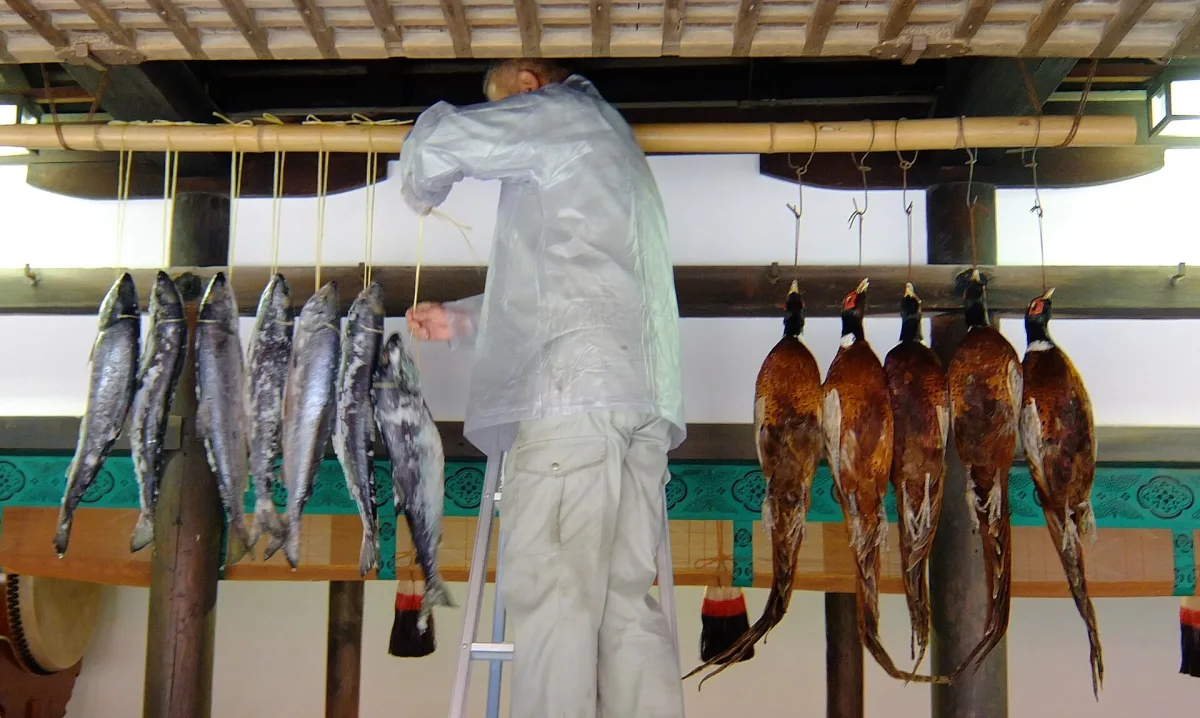
On the 17th there are traffic restrictions along the parade route. On rainy days the Owatari-shiki may be drastically scaled down; in 2022, rain cut the parade to about 20 people covering only about 300 metres of the approach. On the 15th, at the Oshukusho (the festival's lodging house) in a shopping street in central Nara, the costumes and props used in the parade are laid out alongside salmon and pheasants hung as offerings, and the festival's signature dish, noppe-jiru (a thick vegetable soup), is served.
Tips
- During the midnight Senko-no-Gi and Kanko-no-Gi rituals, photography is banned, and so is any light from torches or smartphones. December nights are cold, so bring warm clothing.
- For the Owatari-shiki parade, good places to watch are near the first torii (shrine gate) of Kasuga Taisha, where the Matsu-no-Shita-shiki takes place, or along Sanjo-dori. If you would like a seat, look into the special stand seats offered by the Nara City Tourism Association.
- The performances of the Otabisho-sai go on into the night. After dark, the Azuma Asobi and bugaku dances are performed by the light of kagaribi (bonfires in iron baskets).
- On days when rain is forecast the parade may be scaled down. Check the day's information from the organisers or the news before you set out.
- At the Oshukusho on the 15th you can get a glimpse of festival preparations you rarely see anywhere else, such as noppe-jiru soup and the salmon and pheasants hung as offerings.
Sources
- 春日若宮おん祭保存会 公式サイト
- 春日若宮おん祭 公式サイト「おん祭について」
- 春日若宮おん祭 公式サイト「行事案内」
- 春日若宮おん祭 公式サイト「御渡り式」
- 春日若宮おん祭 公式サイト「御旅所祭」
- 奈良市観光協会(共同通信PRワイヤー)「第890回春日若宮おん祭『特別桟敷席』10月20日(月)に予約開始」
- Wikipedia「春日若宮おん祭」
- 奈良新聞「おん祭へ準備始動 奈良市の若宮神社で『流鏑馬定』」(2026年)
- 産経ニュース「師走の古都華やかに 春日若宮おん祭『お渡り式』の一行が練り歩く」(2025年)
- 朝日新聞「快晴だが雨の予報、千人の歴史絵巻どうなる? 『おん祭』は決断した」(2025年)
- 毎日新聞「奈良最大の『春日若宮おん祭』 1000人が時代行列、古都を彩る」(2024年)
- 産経ニュース「春日若宮おん祭 『お渡り式』5年ぶり通常規模で」(2023年)
- NHK奈良「雨で規模縮小 奈良で『春日若宮おん祭』の『お渡り式』」(2022年、アーカイブ)
- 産経ニュース「春日若宮おん祭『お渡り式』 今年も大幅に規模縮小」(2021年)
- 産経ニュース「春日若宮おん祭の時代行列、コロナで縮小に」(2020年)