Okonomiyaki
In Osaka the batter and fillings are mixed and then cooked; in Hiroshima they are layered. Same name, two very different dishes: let's compare them.
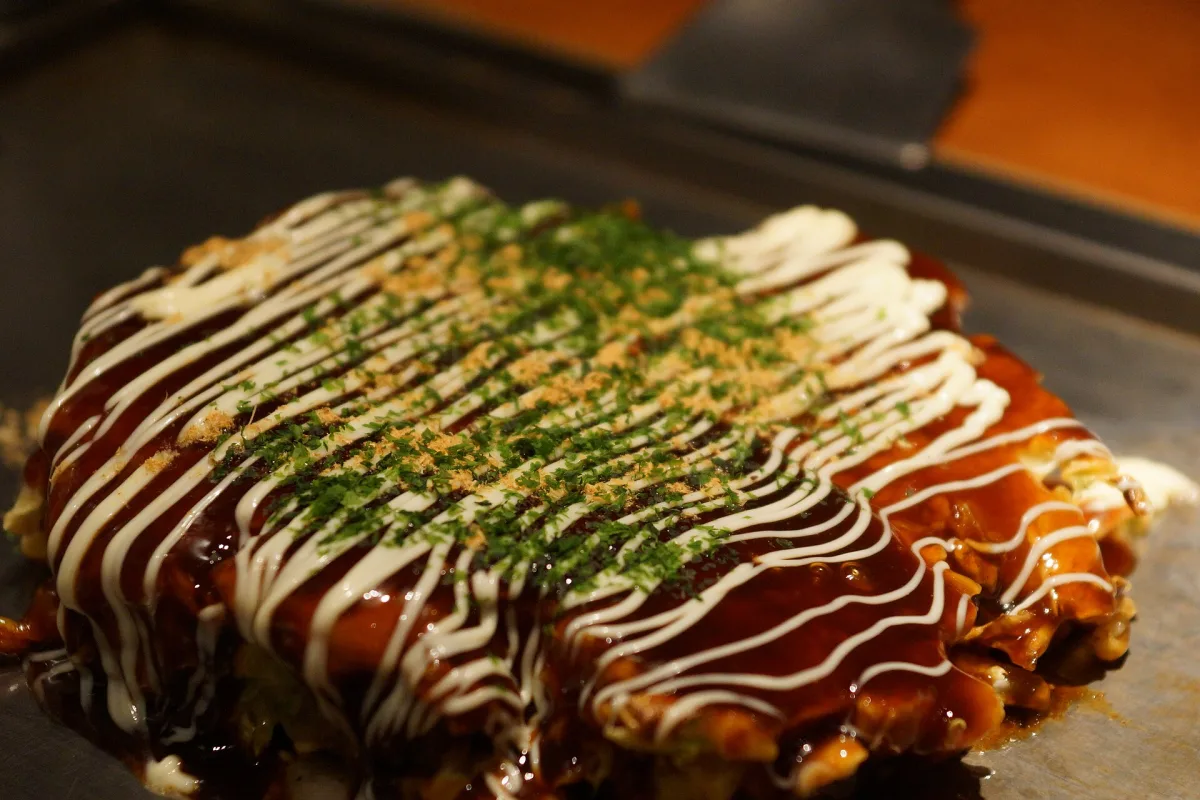

Eaten all over Japan
Best known in Osaka and Hiroshima.
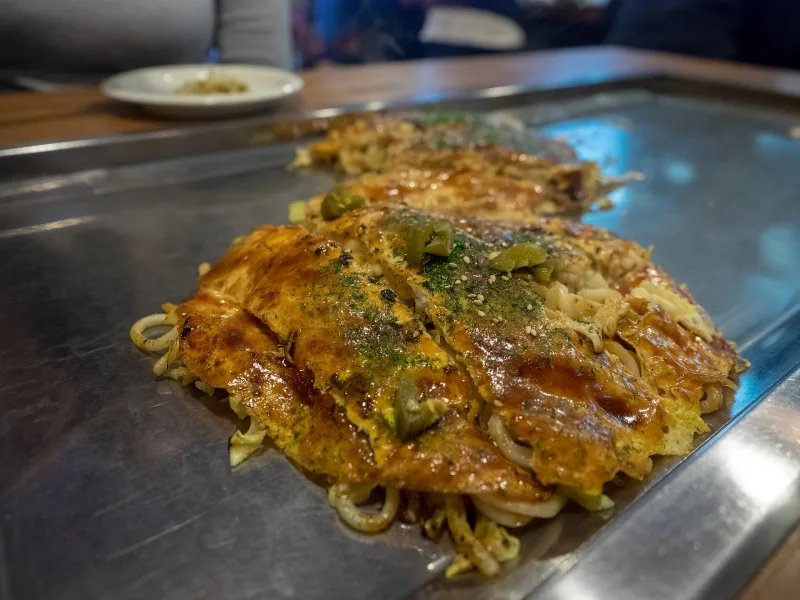
.jpg)
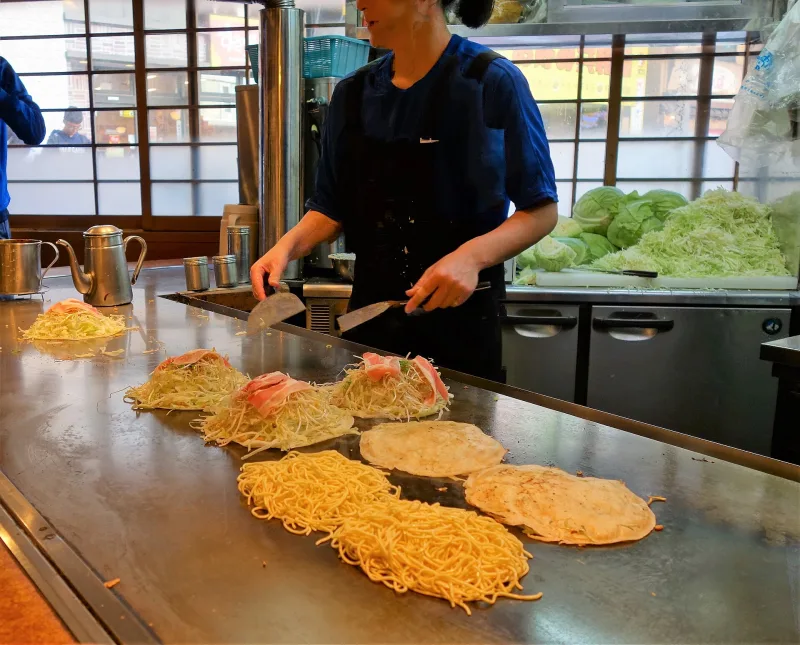

What is okonomiyaki?
Okonomiyaki is a batter of wheat flour mixed with dashi (a stock made from things like katsuobushi, dried bonito flakes), combined with cabbage, pork and other ingredients and cooked flat on a teppan (a thick iron hotplate). Once it's done, it gets a coat of sweetish okonomiyaki sauce, a sprinkling of aonori (powdered dried seaweed) and kezuribushi (thinly shaved katsuobushi), and mayonnaise if you like.
In Osaka it is seen, alongside takoyaki, as a flagship of "konamon" culture (dishes made with wheat flour). But the "okonomiyaki" of Kansai, the region centred on Osaka, and the okonomiyaki of Hiroshima are made very differently. Broadly speaking, Kansai mixes the batter and fillings before cooking ("mazeyaki", mixed-cooking), while Hiroshima builds the ingredients up in layers ("kasaneyaki", layered-cooking).
Osaka and Kansai style: mixed, light and fluffy
For Osaka okonomiyaki, shredded cabbage, egg, tenkasu (the crunchy bits of batter left over from frying tempura), spring onions and so on are mixed into a dashi-based batter, spread into a round on the hotplate and cooked on both sides. The classic touch is to lay thin slices of pork belly on top partway through so they cook along with it. Adding grated yamaimo (Chinese yam, also called nagaimo) to the batter for a light, airy texture is also said to be an Osaka hallmark.
"Modan-yaki", made with yakisoba (fried noodles) added, is popular too. And in Osaka people sometimes eat okonomiyaki as a side dish with a bowl of white rice, something the Osaka Convention and Tourism Bureau points out tends to surprise people from elsewhere. Depending on the restaurant, you either cook it yourself on the hotplate at your table or the staff cook it and bring it to you.
Hiroshima style: layered, with noodles
Hiroshima okonomiyaki starts with batter spread thinly on the hotplate like a crêpe. A mountain of cabbage is piled on top, followed by pork and other fillings. The whole thing is flipped and left to steam-cook, then layered with separately fried yakisoba noodles and a thin omelette to finish. The sauce is usually a rich, sweet one.
According to Hiroshima Prefecture, the standard order is "nikutama soba" (with pork, egg and Chinese-style noodles), and there's also "nikutama udon", with udon instead. You can ask for a "double" with two portions of noodles or a "triple" with three. Because the noodles make a single okonomiyaki a full meal, people in Hiroshima reportedly don't eat it with rice.
Within Hiroshima Prefecture there are local variations too. "Fuchu-yaki" from Fuchu city uses minced meat; "Kure-yaki" from Kure city uses thin udon and is folded in half into a semicircle; and "Shobara-yaki" from Shobara city has rice instead of noodles and is eaten with ponzu (a citrus and soy sauce). "Onomichi-yaki" from Onomichi city contains chicken gizzards and ika-ten (a fried squid snack).
From tea sweet to post-war staple: a history of okonomiyaki
According to an explanation by the Ministry of Agriculture, Forestry and Fisheries, okonomiyaki is said to trace back to "funoyaki", a tea sweet that the tea master Sen no Rikyu served at tea ceremonies in the Azuchi-Momoyama period (the late 16th century). It was a thin pancake of flour mixed with water, spread with miso and rolled up. This is presented as a tradition, though, not something confirmed by clear records.
By the end of the Edo period, cooking flour batter on an iron plate had caught on among ordinary people, and in the late Meiji era "yoshoku-yaki" ("Western-style griddle cake"), made with flour, cabbage and sauce, appeared. At the time it was a light snack, more like cheap sweets for children, but shop after shop added more pork and vegetables until it became the okonomiyaki we know today. Osaka, too, started out with the layered style, with fillings placed on top of the batter, and only later did the mixed style take over. Okonomiyaki is said to have become known nationwide as an Osaka speciality from around the mid-1960s to the early 1970s, when restaurant chains marketed it as "Osaka's famous dish".
Hiroshima okonomiyaki is said to have begun with "issen yoshoku" ("one-sen Western food"), a children's snack before the war. After the war it changed shape into food to fill hungry stomachs, and the number of shops is thought to have grown because the area had many ironworking factories, so hotplates were easy to get hold of. From the late 1950s to the early 1960s, more and more shops opened in converted parts of people's homes, and noodles and pork were added. From the late 1970s, around the time the Hiroshima Toyo Carp (the local professional baseball team) won the championship, it was featured in guidebooks and elsewhere, and its name spread across the country.
Where and how to eat it
For the real thing, head to Osaka Prefecture and Hiroshima Prefecture. Osaka Prefecture has a great many okonomiyaki restaurants, and people eat it regularly as home cooking too. Hiroshima Prefecture has the most okonomiyaki restaurants per 100,000 people in Japan (Ministry of Internal Affairs and Communications, 2014 Economic Census for Business Frame), and Hiroshima city even has buildings packed with okonomiyaki restaurants, which are popular with visitors. These days you can also eat it at restaurants all over Japan and at festival food stalls.
One way to eat it is to leave it on the hotplate, cut it into bite-sized pieces with a small metal spatula and eat straight from the spatula. But when Hiroshima Prefecture staff looked into it, they found that spatula users and chopstick users were roughly half and half, whether or not people were from Hiroshima, so chopsticks are perfectly fine. In Hiroshima it's also a favourite way to round off a night of drinking.
For those with dietary restrictions: standard okonomiyaki contains wheat flour, egg and pork, the batter uses dashi, and it is topped with kezuribushi (fish). Hiroshima style also contains Chinese-style noodles. If you are vegetarian or want to avoid pork, check with the restaurant before ordering.
Tips
- If you're visiting both Osaka and Hiroshima, try both and compare. They share a name, but the mixed Kansai style and the layered Hiroshima style have completely different textures.
- If you can't decide in Hiroshima, the classic order is "nikutama soba". You can swap the noodles for udon, or ask for a "double" to get more noodles.
- At places with a hotplate built into the table, check at the start whether you cook it yourself or the staff cook it for you.
- If eating with the little spatula is tricky, it's fine to ask for chopsticks. Plenty of locals use chopsticks too.
- If you want to avoid pork or fish-based stock, check the ingredients before you order.