Japan is Nippon
What Do Japanese People Eat for Breakfast, and Where Can Travellers Get It?
A traditional Japanese breakfast is rice and miso soup with small side dishes such as grilled fish, pickles, eggs and seaweed. As a traveller, your handiest options are convenience stores (many open 24 hours), hotel and ryokan breakfasts, breakfast set meals at gyudon chains that open early, the caf
The short answer
A traditional Japanese breakfast is washoku (Japanese-style food) built around rice and miso soup, with several small side dishes laid out alongside. Typically that means rice and miso soup combined with fish, pickles, tofu, vegetables, seaweed and an egg dish, served not on one big plate but as lots of small dishes.
That doesn't mean every Japanese person eats that kind of breakfast every morning, though. In a survey the Ministry of Agriculture, Forestry and Fisheries ran in autumn 2025, 77.0% of people said they eat breakfast 'almost every day', and among 20- to 39-year-olds the figure was only 61.6%. One in five people in that younger group said they 'hardly ever' eat breakfast.
Travellers have more breakfast options than you might expect. There are convenience stores, hotel buffets, Japanese-style breakfasts at ryokan, cafe morning sets, bakeries by stations and chain restaurants serving dishes such as gyudon (beef on rice). This guide covers what each is like, plus tips for when you want to eat early, don't like raw egg or are vegetarian.
What is a traditional Japanese breakfast?
The basic shape of a Japanese meal is ichijū sansai ('one soup, three dishes'). One soup plus three side dishes is considered an ideal nutritional balance. A Japanese-style breakfast is easiest to think of as a simple version of it: rice and miso soup with grilled fish, an egg dish, pickles and so on.
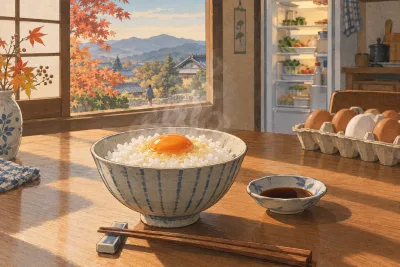
Something you'll often see at a Japanese breakfast is nattō. Nattō is whole soybeans that have been fermented, and the classic way to eat it at breakfast is on rice with mustard, soy sauce or tare (a seasoning sauce). Some people add raw egg or chopped spring onion. It's widely loved in Japan, but it has a smell like a mature cheese and divides opinion among visitors from abroad.
This food culture is admired around the world, too. 'Washoku, traditional dietary cultures of the Japanese' was added to UNESCO's Intangible Cultural Heritage list on 4 December 2013. The listing describes washoku as a social practice that respects nature and values local natural ingredients such as rice, fish, vegetables and edible wild plants.
How many Japanese people actually eat breakfast?
The Ministry of Agriculture, Forestry and Fisheries' survey on attitudes to shokuiku (food education), published in March 2026, was sent to 5,000 people aged 20 and over across Japan between 30 October and 28 November 2025, and 2,391 of them answered. In this survey, 77.0% said they eat breakfast 'almost every day', 5.7% '4-5 days a week', 4.6% '2-3 days a week' and 11.0% 'hardly ever'.
The younger people are, the more likely they are to skip breakfast. Looking at 20- to 39-year-olds in the same survey, 61.6% eat breakfast 'almost every day' and 20.1% 'hardly ever'. The government has set a target of getting the share of young people who skip breakfast (those who eat it only 2-3 days a week plus those who hardly ever do) down to 15% or less, but in this survey the combined figure was 28.2%.
When people who rarely eat breakfast were asked what they would need in order to eat it, the top answer was 'having an appetite in the morning' (44.5%), followed by 'having time to make breakfast myself' (43.7%) and 'being able to get up early' (40.4%). And of those who live with family, 39.8% eat breakfast with their family 'almost every day', fewer than the 60.9% who do so for dinner. Whether people eat breakfast clearly depends on how their mornings go, from appetite to time.
Can you buy breakfast at convenience stores and bakeries?
For travellers, the most dependable option is the convenience store (konbini). There's a konbini on almost every street corner, many are open 24 hours, and for breakfast you can pick up onigiri, sandwiches, fruit, smoothies, coffee, energy bars and more. They're a lifesaver on days when your hotel doesn't include breakfast or you're setting off early.
Onigiri are a classic Japanese snack: rice with a filling inside, wrapped in nori seaweed. If you're vegetarian, look in the konbini's chilled section for onigiri filled with umeboshi (sour pickled plum) or kombu (kelp). Edamame, salads and inari-zushi (rice stuffed into pouches of sweet simmered fried tofu) are also options for people who don't eat meat or fish.
Bakeries are another breakfast option. Bakeries are often near stations or in shopping streets, and sell savoury breads, sweet breads, sandwiches and drinks. Cafes also sometimes serve morning-only breakfast sets combining toast, eggs, salad and a drink.
What are hotel and ryokan breakfasts like?
Hotel breakfast buffets often offer both Japanese and Western food, which makes them perfect for trying a little of a Japanese breakfast. The etiquette is to take only what you can finish, and going back for seconds is fine.
Ryokan (traditional Japanese inns) often serve a full Japanese breakfast, which is usually eaten in your room or in a quiet dining room. There may be dishes you don't recognise, but you can simply pick what you can eat to suit your appetite. We cover how to spend a stay at a ryokan in more detail in another guide.
If unfamiliar food first thing in the morning makes you nervous, you can sort it out when you book. Some ryokan offer room-only plans (sudomari, no meals) or dinner-only plans. It's a good idea to check the breakfast menu, portion size and meal times with the inn before you book.
Where can you eat breakfast early and cheaply in Japan?
Chains serving Western food, gyudon and Japanese set meals include Yoshinoya, Matsuya, Sukiya, Gusto and Denny's, and at some of them you can order on multilingual touch screens. The gyudon chains serve breakfast menus only in the morning.
The gyudon chain Yoshinoya treats 4:00 to 11:00 as its breakfast hours (as of 2025; hours may vary by branch). Yoshinoya's asa teishoku (breakfast set meals) are themed on ichijū sansai, the basic Japanese meal, combining rice, miso soup and three side dishes. The nattō set is 430 yen including tax and the grilled fish set is 530 yen including tax (as of November 2026).
Sukiya's breakfast menu includes mazenokke (toppings to pile on your rice), tamakake (which comes with a raw egg), a fried-egg set, and grilled fish sets with grilled salmon or salted mackerel. If you don't eat raw egg, the fried-egg or grilled fish sets are the safe choice. We look at Japan's raw egg culture in another guide.
Outside the places that serve breakfast, quite a few restaurants don't open until late morning. If you want to eat very early, check the night before which konbini and breakfast places are near your hotel, and you won't be stuck in the morning.
What is 'morning service' at a Nagoya cafe?
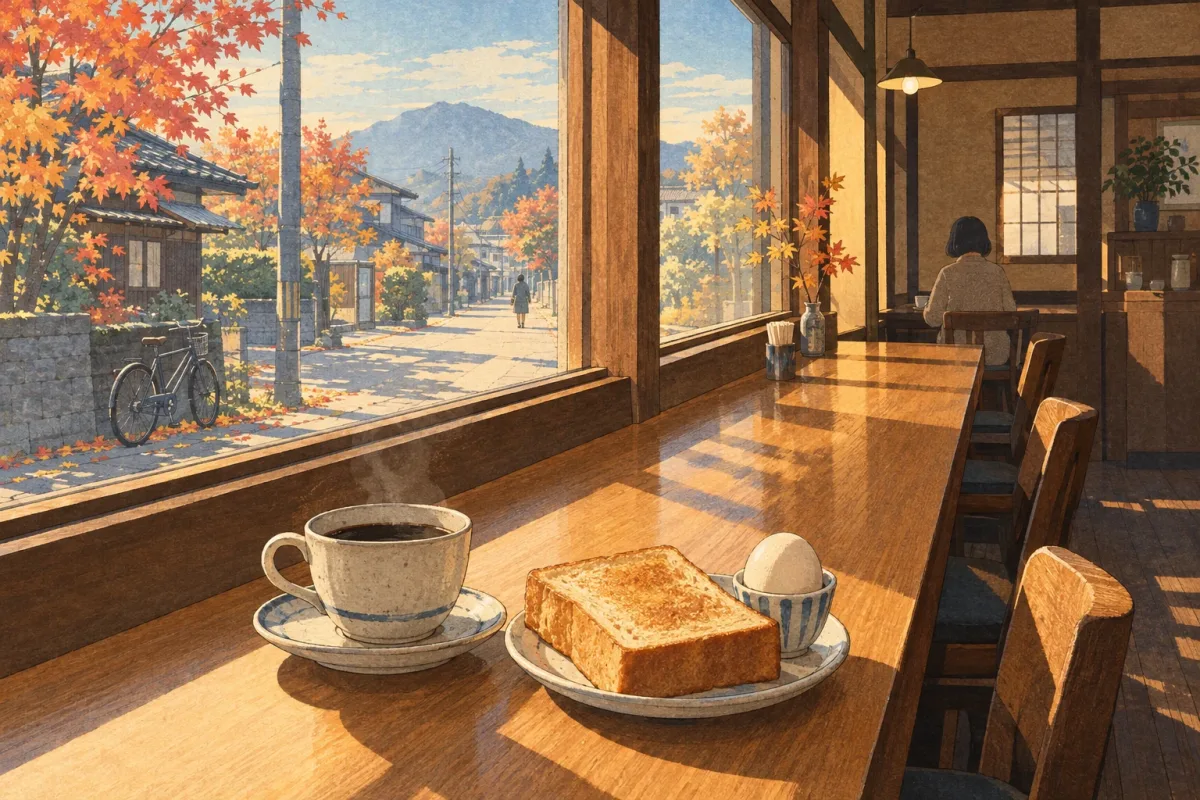
Aichi Prefecture has a culture called morning service (mōningu): order a drink at a kissaten (an old-style coffee shop) in the morning, and bread and eggs come free. In Ichinomiya (a city north of Nagoya), a morning set of bread, an egg dish and so on comes free for the price of a cup of coffee (about 300-500 yen). Some cafes serve a set for an extra charge.
Ichinomiya is known as the birthplace of mōningu. From 1955 to the early 1960s, Ichinomiya prospered on its wool textile industry, and merchants held business meetings in coffee shops to get away from the noise of the machines. The story goes that one coffee shop owner started serving regulars a boiled egg and peanuts with their morning coffee. A feature on Aichi Now, Aichi Prefecture's official tourism website, cautions, however, that this is only conjecture, since no records survive.
About 500 coffee shops in Ichinomiya serve mōningu. The local Ichinomiya Morning Council recommends three rules: serve it at a shop in Ichinomiya, include an egg dish in keeping with the original, and use Ichinomiya produce wherever possible. Morning hours run, for example, from 7:00 to 11:30 or 8:00 to 11:30, so it's mainly a morning-only service.
Nagoya's mōningu is usually a set built around toast. Some cafes include ogura toast (toast topped with sweet red bean paste), a Nagoya speciality, and some let you choose onigiri or cold chagayu (rice porridge cooked in tea) instead of toast. Popular cafes can have queues even on weekdays, so give yourself plenty of time.
Tips
- To eat early, your surest bets are konbini, many of which are open 24 hours, or a gyudon chain's breakfast set. Yoshinoya treats 4:00 to 11:00 as its breakfast hours (this varies by branch).
- Coffee shop mōningu is mainly a morning-only service. In Aichi, lots of cafes give you toast and a boiled egg for just the price of a drink.
- If you're staying at a ryokan, check the breakfast time and menu before you book. If a Japanese breakfast worries you, you can choose a room-only plan and eat out.
- If raw egg isn't for you, avoid menus that come with one, such as Sukiya's tamakake, and go for a fried-egg or grilled fish set.
- Vegetarians should be aware that nattō sauce and many soups and sauces may use fish stock (dashi made with katsuobushi, dried bonito flakes, and the like). At a konbini, umeboshi or kombu onigiri, edamame and salads are good options.
Sources
- Starting Your Day in Japan: Breakfast Options to Fit Your Travel Plans | JAPAN Monthly Web Magazine (Japan National Tourism Organization) (opens in a new tab)
- Learn about Japan's Unique Superfood, Natto | Travel Japan (Japan National Tourism Organization) (opens in a new tab)
- Practical Facts for Vegetarians in Japan | Travel Japan (Japan National Tourism Organization) (opens in a new tab)
- 「和食」がユネスコ無形文化遺産に登録されています:農林水産省 (opens in a new tab)
- Washoku, traditional dietary cultures of the Japanese, notably for the celebration of New Year | UNESCO Intangible Cultural Heritage (opens in a new tab)
- 食育に関する意識調査報告書(令和8年3月) 調査の概要:農林水産省 (opens in a new tab)
- 食育に関する意識調査報告書(令和8年3月) 2.現在の食生活について:農林水産省 (opens in a new tab)
- 食育に関する意識調査報告書(令和8年3月) 調査結果の概要:農林水産省 (opens in a new tab)
- 一宮モーニング | スポット検索 | 【公式】愛知県の観光サイトAichi Now (opens in a new tab)
- 喫茶愛あふれる一宮モーニングの世界 | 特集 | 【公式】愛知県の観光サイトAichi Now (opens in a new tab)
- A Search for Vintage: Nagoya's Retro Cafes and Mouth-watering Morning Combos | Visit Nagoya (opens in a new tab)
- 朝食メニュー | 吉野家公式ホームページ (opens in a new tab)
- 吉野家で朝食を食べた方に翌朝11時まで利用できる100円引きレシートクーポンを配付(株式会社吉野家 ニュースリリース、2025年9月5日) (opens in a new tab)
- 朝食ラインナップ | すき家のメニュー | すき家 (opens in a new tab)