Japan is Nippon
Why Is Beaujolais Nouveau Such a Big Deal in Japan?
Beaujolais Nouveau, the new wine made from that year's Gamay grapes in France's Beaujolais region and released on the third Thursday of November, became an autumn ritual in Japan because the day arrives there eight hours before it does in France, because it suits a food culture that loves the first
The short answer
Beaujolais Nouveau is a shinshu (a new wine, freshly made that year) made from grapes harvested that same year in the Beaujolais region of eastern France. Beaujolais is about 30 minutes by car from Lyon, a city famous for its food. According to Inter Beaujolais (the French government-recognised body that represents the Beaujolais wine trade), Beaujolais Nouveau may go on sale from the third Thursday of November each year; in 2026 that was 19 November. In Japan this day is called kaikinbi, literally 'the day the ban is lifted'.
Several things came together to make Beaujolais Nouveau such a talking point in Japan. Japan's date changes eight hours before France's, so it gets the release before the wine's home country; the wine fitted a food culture that delights in the very start of each season; and then there was the wine boom of the late 1980s. The 'fourth wine boom' of 1987-90 is sometimes summed up as a boom in 'Nouveau and premium wine'.
That said, Japan's Beaujolais Nouveau market today is far smaller than at its height. Japanese imports peaked in 2004 at about 1.04 million cases (about 12.48 million bottles), and over the roughly 20 years since, the market has shrunk to a seventh of that size. Even so, when November comes round, supermarkets and department stores still set up Beaujolais Nouveau displays.
What kind of wine is Beaujolais Nouveau?
Beaujolais Nouveau is made from a grape called Gamay. Gamay (officially Gamay Noir à Jus Blanc) has black skin and white juice, and is known for aromas of berries, violets and roses, and for its fresh acidity. Because Beaujolais Nouveau spends only a short time fermenting with the skins, it has little astringency (tannin) and tastes fruity and light.
Not every wine from Beaujolais can call itself 'Beaujolais Nouveau'. The region has 12 appellations (wine place names defined by French law), and only two of them, Beaujolais and Beaujolais Villages, may be made as Nouveau. About 14 million bottles of Nouveau are sold every year, roughly 20% of the total output of Beaujolais's vineyards.
The history of Beaujolais Nouveau officially began in 1951, when selling new wine within the year of its harvest was permitted. It first went on sale commercially on 15 November 1951. Then a French decree in 1985 fixed the release day as 'the third Thursday of November'. Because it's set by the day of the week, the date changes every year.
Bottles can be sold, or served in shops and restaurants, only once the third Thursday of November arrives. The 'third Thursday of November' rule was set to make it easier to bring Beaujolais Nouveau to market. The custom of celebrating new wine at this time of year is said to go back to St Martin's Day, when Europeans marked the end of the wine year and the release of the new wine.
Why does Japan get Beaujolais Nouveau before France?
Beaujolais Nouveau is released at midnight on the third Thursday of November. Because each country's date changes on its own local time, Japan, out on the eastern side of the globe, reaches Thursday before France does. In November France is on winter time, eight hours behind Japan. So when the release arrives at midnight on Thursday in Japan, it is still 16:00 on Wednesday in France.
The US and the UK, both big export markets for Beaujolais wine, lie west of France, so their release comes even later. That makes Japan one of the very earliest of the big markets to get it. It isn't 'the first in the world', though: Pacific nations just west of the International Date Line, among others, see the date change before Japan does.
To be ready in time for release day, Beaujolais Nouveau bound for Japan travels by air. According to a 2016 document from Tokyo Customs, Japan's imports of bottled wine rise every November, mainly because of Beaujolais Nouveau, and French wine at this time of year is imported almost entirely as air freight. Forbes JAPAN names the weak yen, rising logistics costs and growing awareness of the environmental cost of flying wine in as reasons the market has shrunk.
The way people enjoy the midnight release is changing, too. Since 2024, Suntory has stopped insisting on release events timed for midnight and instead suggests a 'Nouveau Week' of enjoying the new wine at a relaxed pace.
How much Beaujolais Nouveau has Japan drunk over the years?
Beaujolais Nouveau caught on in Japan from the 1980s, after western Europe and North America. It then spread to eastern Europe after the fall of the Berlin Wall, to South-East Asia in the 1990s and, more recently, to China. Kirin Holdings' wine report (December 2024) describes the 'fourth wine boom' of 1987-90, one of several wine booms in Japan, as a boom in 'Nouveau and premium wine'. It coincided with Japan's economic boom, the so-called bubble economy.
Imports of Beaujolais Nouveau into Japan peaked in 2004. Imports in 2004 came to about 1.04 million cases (about 12.48 million bottles), and in the roughly 20 years since, the market has shrunk to a seventh of that.
Major Japanese wine companies have been pulling out, too. Asahi Breweries stopped importing it directly in 2024, Sapporo Breweries suspended sales, and the Kirin group's Mercian ended its imports and sales in 2025 (a group company still sells it). Suntory, on the other hand, says it has no plans to pull out. Suntory's partnership with France's Georges Duboeuf began in 1996, making 2026 its 30th year. Citing sales data from the market research firm Intage (January 2022 to December 2025), Suntory says Georges Duboeuf is the best-selling Beaujolais Nouveau brand in Japan.
It's also worth seeing where Japan stands today. According to Inter Beaujolais's figures (2024-2025 edition), 31% of all Beaujolais wine (not just Nouveau) is exported, and in 2024, 18.4 million bottles were shipped to 150 countries. The main markets were the US with about 5.4 million bottles, the UK with about 3 million and Japan with about 2.1 million. Japan, once almost synonymous with Beaujolais Nouveau, is now the third-largest export market for Beaujolais wine as a whole.
Why did Japanese people fall for Beaujolais Nouveau?
Japanese food culture loves the very start of a season. Washoku (traditional Japanese cuisine) calls the peak period when an ingredient tastes best shun, the start of that season, when you get an early taste of what's coming, hashiri (the first of the season), and the time after the peak, when you savour the last of it, nagori. As the first wine of the year you can drink, Beaujolais Nouveau is wine's hashiri. It's easy to see why it went down so well with the Japanese delight in hatsumono (the first produce of the season).
We look at why everything in Japan seems to become 'seasonal limited edition' in another guide, but Beaujolais Nouveau's set-up, a fixed release day and only that year's supply, fits this love of 'limited-time' things perfectly. Suntory's 2026 news release, too, announced its five Georges Duboeuf Nouveau wines as new 'limited-quantity' products.
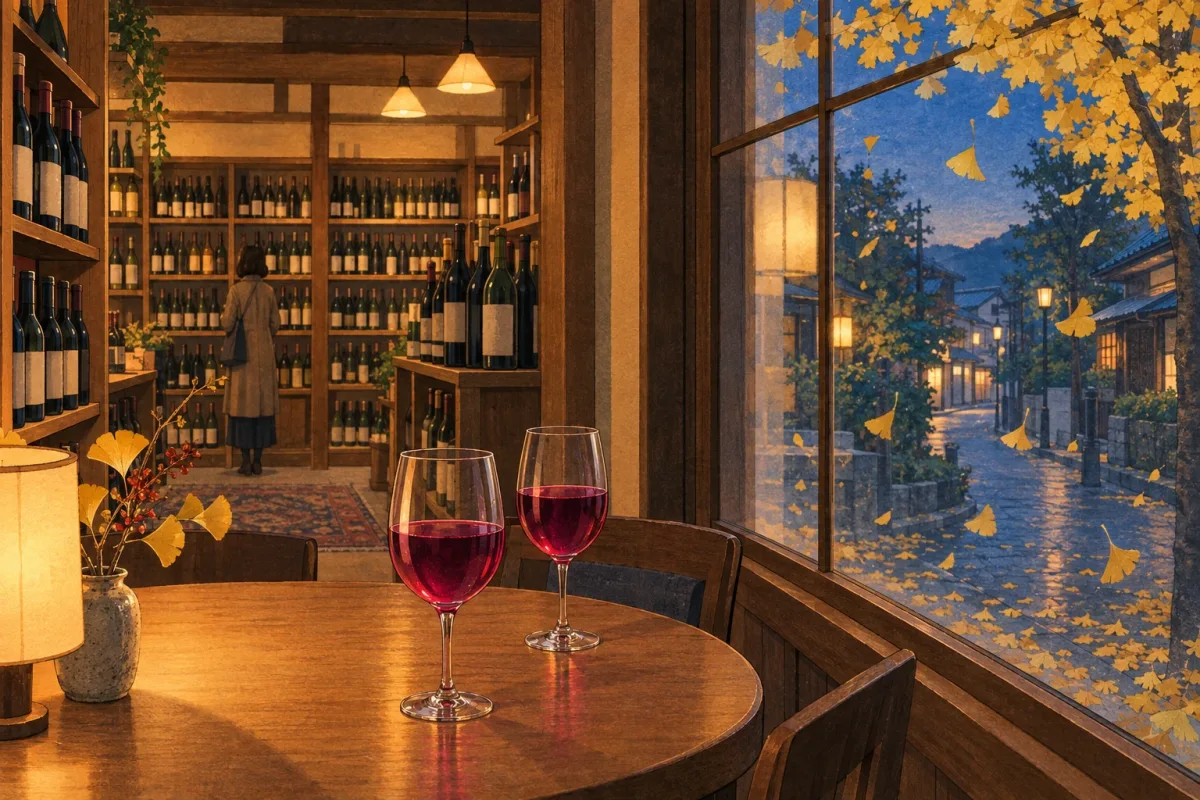
The custom of celebrating Beaujolais Nouveau lives on in Japan. In Japan and France, people raise a glass of the year's first vintage (wine from that year's harvest) on the third Thursday of November, with events held in many places. Beaujolais Nouveau is enjoyed in more than 100 countries around the world.
As food to go with Beaujolais Nouveau, Inter Beaujolais suggests gyoza (dumplings), noodles such as ramen, cherry blossom tempura in spring, and grilled meat. Beaujolais Nouveau can be enjoyed all year round, not just in November, and can even be aged for a few years.
Where do the yearly 'this year's vintage' slogans come from?
Each year's Beaujolais Nouveau comes with a short phrase summing up how that year's grapes turned out. In the title of its 2025 press release for Japan, for example, Inter Beaujolais described 2025 Beaujolais wine as a year of 'quality over quantity'. AEON's 2025 Beaujolais Nouveau news release used the same phrase, 'quality over quantity'.
Summer heat sped up ripening in 2025, and the harvest began in August. Many Beaujolais grapes are still picked by hand, with more than 20,000 people working on the harvest over about a month. Some areas were hit by hail on 1 June, and the crop was on the small side, but Inter Beaujolais described it as a year with very promising quality.
These phrases are put out by producers' bodies and by the companies that import and sell the wine, to introduce that year's vintage. Checking which body or company each phrase comes from as you read makes the yearly news a lot more fun.
Where can you buy Beaujolais Nouveau while travelling in Japan?
The easiest place is the supermarket. In 2025, AEON put Beaujolais Nouveau on sale on release day at about 4,000 stores nationwide and on its official online shop. In 2025, a 750 ml PET (plastic) bottle of Beaujolais Nouveau cost 1,848 yen including tax, and a PET bottle of Beaujolais Villages Nouveau cost 2,178 yen including tax.
Department stores are another November fixture. Takashimaya's online store took pre-orders for Beaujolais Nouveau ahead of the 2026 release day, 19 November, with the feature open until 10:00 on 25 November. Delivery on release day itself is, however, available only in some areas.
If you just want a taste, small bottles are handy. Georges Duboeuf's 2026 new wines come in five varieties, with 375 ml half bottles as well as 750 ml. They are sold at open prices (shops set their own prices), but the maker's expected prices were kept at the same level as the year before. Note that one of the five, 'Orange Nouveau', isn't Beaujolais Nouveau, because it doesn't use Beaujolais grapes.
In Japan you can buy alcohol from the age of 20. Drinking under 20 is prohibited by law, and shops are instructed to display a notice in their alcohol sections saying they won't sell to anyone who can't be confirmed to be 20 or over. If you look young, expect to be asked your age at the till (as of November 2026).
Tips
- Beaujolais Nouveau is released on the third Thursday of November every year (19 November in 2026). If you're in Japan in mid- to late November, look for it in supermarkets and department stores.
- If you're taking a bottle home in your suitcase, a PET bottle is worth considering, as it's less likely to break than glass. At AEON in 2025, a 750 ml PET bottle cost 1,848 yen including tax.
- If you'd like to compare a few, 375 ml half bottles are handy. Suntory's 2026 Georges Duboeuf range includes half bottles.
- Inter Beaujolais also recommends pairing it with gyoza or ramen. Trying it with Japanese food is a way of enjoying it that's unique to Japan.
- You can buy alcohol in Japan from 20. You may be asked your age at the till, so it's reassuring to carry something that shows your age, such as your passport (as of November 2026).
Sources
- Les chiffres de la campagne Beaujolais Nouveaux | Les Beaujolais Nouveaux - Site officiel des Beaujolais Nouveaux AOC (opens in a new tab)
- Les Beaujolais Nouveaux - Site Officiel des Vins du Beaujolais (opens in a new tab)
- ボジョレー、ブドウ畑のゆたかな表情(Carnet Beaujolais 日本語版、2024-2025年版、Inter Beaujolais) (opens in a new tab)
- ボジョレーワインPress(ボジョレーワイン委員会 日本語公式サイト) (opens in a new tab)
- ボジョレー・ヌーヴォーとは?11月の第3木曜日にお会いしましょう!(ボジョレーワイン委員会 プレスリリース) (opens in a new tab)
- 2025年ボジョレー・ヌーヴォー 2025のボジョレー・ワインは「量より質」の年(ボジョレーワイン委員会 プレスリリース) (opens in a new tab)
- 「ジョルジュ デュブッフ ボジョレー ヌーヴォー 2026」新発売 | サントリーホールディングス株式会社のプレスリリース (opens in a new tab)
- サントリー「ボジョレー ヌーヴォー 2025」解禁! 若槻千夏さんが1日宣伝部長に - グルメ Watch (opens in a new tab)
- 11月20日解禁!「2025年ボージョレ・ヌーヴォー」発売(イオン株式会社ほか ニュースリリース、2025年11月19日) (opens in a new tab)
- ボージョレ ヌーヴォー2026 | 特集 | 高島屋オンラインストア (opens in a new tab)
- 特集 ボトルワインの輸入(東京税関、平成28年10月28日) (opens in a new tab)
- ワイン参考資料(キリンホールディングス、2024年12月) (opens in a new tab)
- ボジョレーヌーヴォーは平成生まれの年中行事 【酒飲みのミカタ】(酒文化研究所) (opens in a new tab)
- 【ボジョレーヌーヴォー解禁】市場「20年で7分の1」に大手撤退、だがサントリーは? | Forbes JAPAN (opens in a new tab)
- 2.四季を感じる料理、旬に対する考え方|和食ワールドチャレンジ(アーカイブ):農林水産省 (opens in a new tab)
- 20歳未満の者の飲酒防止の推進|国税庁 (opens in a new tab)