Japan is Nippon
Why Do Japanese People Eat Soba on New Year's Eve?
On 31 December, soba noodles fill bowls across Japan: the wishes behind 'long and thin' and 'easy to break', the Edo-era history and regional twists.
The short answer
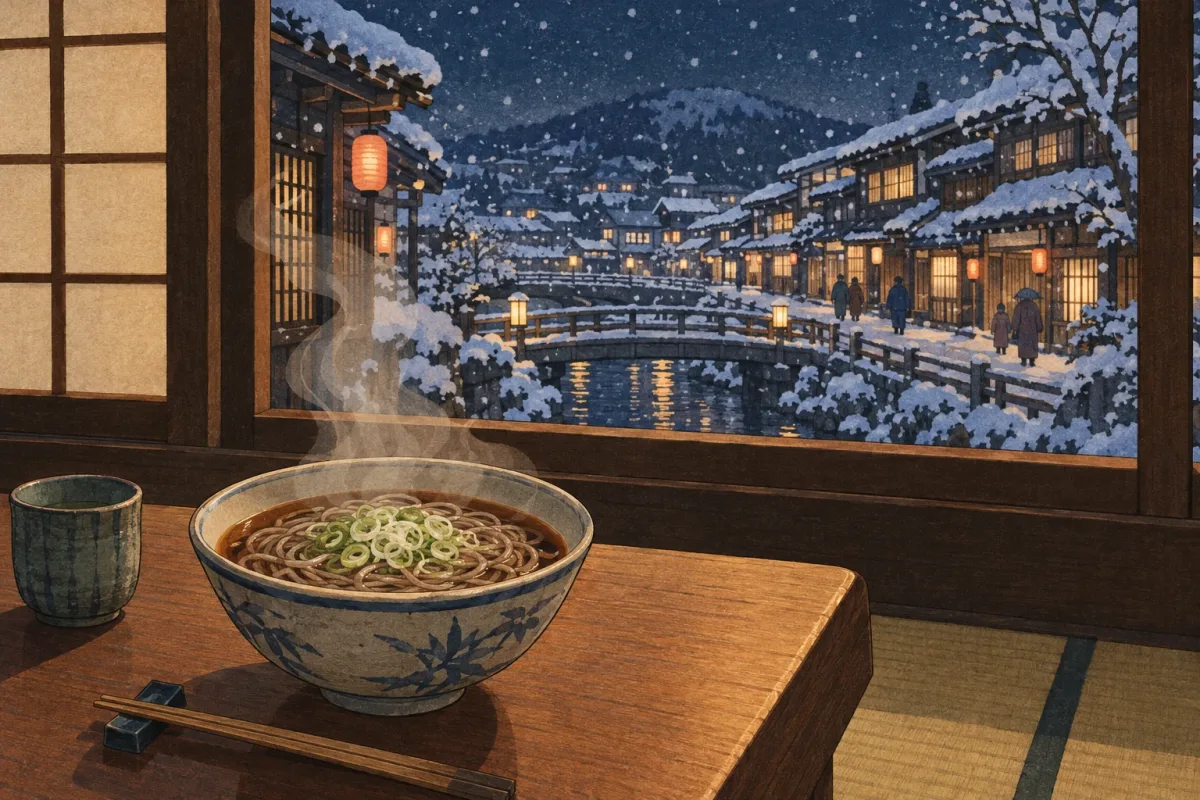
In Japan it's customary to eat toshikoshi soba ('year-crossing soba') on ōmisoka, New Year's Eve, the last day of the year (31 December). Soba are long, thin noodles made from buckwheat flour. There are various explanations for the custom, but the two you hear most often are wishes: 'may we live long, like these long, thin noodles', and 'just as soba breaks easily, let's cut off the year's hardships and misfortunes here'.
According to an article by Japan's Ministry of Agriculture, Forestry and Fisheries, the custom began in the Edo period, and more than 60% of households still eat soba on New Year's Eve. Think of it as a lucky last bowl to see out the old year and welcome the new one.
What kind of day is ōmisoka?
The character 晦 can be read tsugomori, which is also written as tsukigomori, 'the moon hiding', and refers to the moon disappearing. As the Ministry of Agriculture, Forestry and Fisheries explains, in the old calendar, which followed the phases of the moon, the last day of the month (the 29th or 30th) was called misoka, and the last misoka of the year was given the prefix o ('great'), making it ōmisoka.
Ōmisoka also carries the sense of o-tsugomori, 'the great retreat': a day for staying quietly at home and preparing to welcome the New Year. People once believed the new year began on the night of 31 December, so, the story goes, a custom grew up of staying awake from New Year's Eve into New Year's Day to welcome Toshigami-sama, the god who brings a good harvest and happiness in the coming year. Toshikoshi soba is what you eat on this special night.
From the streets of Edo to the whole country
Buckwheat itself has been eaten since long ago, but originally as a kneaded dough or as whole grains. According to the ministry's 'Our Regional Cuisines' (Uchi no Kyodo Ryori), soba in today's noodle form (sobakiri) was first served at temples in the early Edo period, and before long it was being sold alongside udon in the city of Edo (today's Tokyo). Edo townspeople preferred soba to udon, and it spread everywhere from proper soba restaurants to street stalls.
Already in the Edo period, soba was regarded as good for you, and good for you meant lucky. So people began eating it as misoka soba at the end of every month and as setsubun soba at the turn of each season. The last of these in the year is New Year's Eve's toshikoshi soba.
Another ministry article says the custom of eating soba on New Year's Eve is said to have spread among ordinary people from the Edo period. 'Our Regional Cuisines', meanwhile, says it was only from the Meiji era onwards that people all over Japan came to eat soba on New Year's Eve. The easiest way to picture it is as a custom of the city of Edo that spread across the country over time.
More than one wish in the bowl
There are several theories about where toshikoshi soba comes from. The ones the Ministry of Agriculture, Forestry and Fisheries introduces are: that the long, thin shape stands for a long life and the family's fortunes stretching on; that because soba breaks more easily than other noodles, it cuts off the year's hardships and misfortunes; and that because buckwheat is a crop that stands up well to rain and wind, eating it is a wish to be free of illness and misfortune.
There are some fun legends too. The noodle maker Yamadai describes a theory that gold and silver craftsmen used kneaded buckwheat dough (sobagaki) to gather up stray gold dust, which made soba a lucky charm for 'gathering money'. It also tells a legend that in the Kamakura period, Jotenji temple in Hakata (now Fukuoka) handed out 'soba mochi' to people who were struggling to get through the year, and their luck turned the following year. These are all simply theories people tell; there's no single right answer.
Different names and ways to eat it around Japan
According to the Ministry of Agriculture, Forestry and Fisheries, toshikoshi soba goes by different names depending on the region, such as ōmisoka soba, toshitori soba ('year-taking soba'), jumyo soba ('long-life soba') and shian soba ('pondering soba'). The day it's eaten varies too. In the Aizu area of Fukushima Prefecture there's an old saying, 'soba on New Year's Day, mochi on the 2nd, grated yam on the 3rd', and people eat soba on New Year's Day. Some parts of Niigata Prefecture also eat soba on New Year's Day, and there's a custom called jushi-nichi soba ('14th-day soba'), eaten on the day before koshogatsu, the 'Little New Year' on 15 January.
The soba itself has local character as well. Kyoto is known for nishin soba, topped with migaki nishin (dried herring) that arrived by ship from Hokkaido in the Meiji era, and Niigata Prefecture for hegi soba, which uses a seaweed called funori as a binder. The broth differs too: in the Kanto region it's mainly katsuobushi (dried bonito flakes) with dark soy sauce, and in the Kansai region kombu and katsuobushi with light soy sauce.
Some places don't eat soba at all. According to an article introducing the ministry's 'Our Regional Cuisines', until not so long ago there was almost no custom of eating toshikoshi soba in Kochi Prefecture, and in Kagawa Prefecture people sometimes eat udon (shippoku udon) instead.
Enjoying toshikoshi soba as a traveller or resident
There's no set time to eat it: at dinner or just before midnight are both fine. That said, the ministry's article suggests finishing before the year changes, so that your 'year-crossing soba' doesn't turn into 'New Year soba'.
Soba comes as cold mori soba, which you dip into a sauce, or as kake soba, served in a bowl with hot broth poured over. Either one counts as toshikoshi soba. If you're spending the end of the year in Japan, try the local soba and you'll get a New Year's Eve with a real taste of the place.
Tips
- Finishing your toshikoshi soba while it's still 31 December is considered lucky. Dinner or late at night are both fine.
- Mori soba is cold soba that you dip into a sauce; kake soba has hot broth poured over it. Keep that in mind when ordering.
- If you're spending the end of the year in Kyoto, try nishin soba; in Niigata, hegi soba. Go for the local style.
- If you move house in Japan, it's worth knowing about hikkoshi soba ('moving soba'), given to neighbours with the meaning 'here's to being near you (osoba ni) for a long time'. It makes a good conversation starter.