Japan is Nippon
Why Do Japanese People Send New Year's Cards?
Nengajo cards in the letterbox on 1 January: how a Heian-era greeting became a postcard custom, plus lottery cards and etiquette.
The short answer
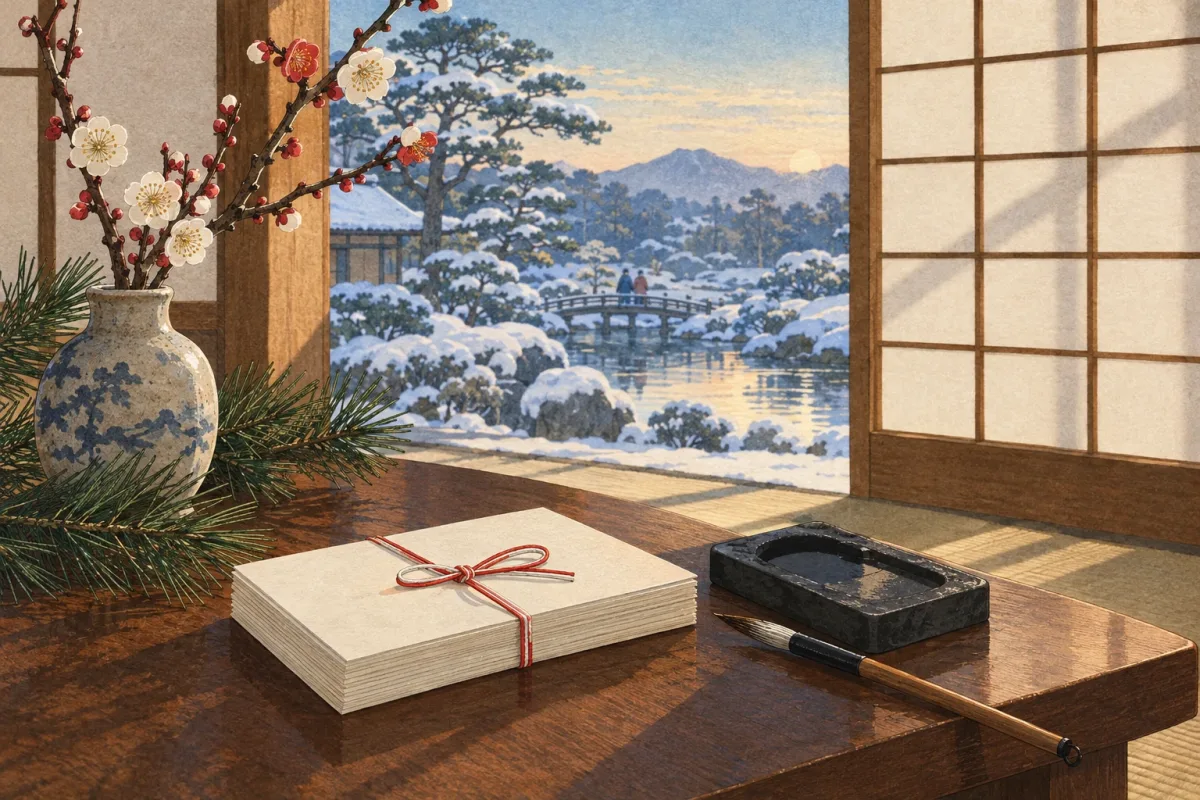
Nengajo are postcards with a New Year's greeting written on them. Japan Post delivers them all together on New Year's Day (1 January), so opening the letterbox on the morning of the New Year to find cards from friends, relatives and people who've helped you at work is one of the classic scenes of a Japanese New Year.
Originally, the basic way to give New Year's greetings was nenshi-mawari: going round to visit people in person once the year had begun. A nengajo delivers that greeting by letter instead. For nearly a thousand years, it has been the way to keep in touch with people who live far away or whom you rarely see, sharing your news and saying 'I look forward to another year of your friendship'.
From Heian-period letters to Meiji postcards
According to JP CAST, the media site of the Japan Post Group, the exact origin isn't known, but the custom of New Year's cards is said to go back to the Heian period. Collections of model letters from the time record that, in the late Heian period, people sometimes exchanged New Year's greetings by letter, even though greeting each other face to face was still the norm.
At first it was a custom for only a few people, but in the Edo period it spread to ordinary people as the network of hikyaku (couriers who carried letters) developed. A modern postal service began in 1871 (Meiji 4), Japan's first postcards were issued on 1 December 1873 (Meiji 6), and in 1900 (Meiji 33) privately made postcards were also permitted. Step by step, New Year's cards became part of everyday life.
The birth of the lottery New Year's postcard
What really boosted the New Year's card culture was the otoshidama-tsuki nenga hagaki, a New Year's postcard with a lottery number attached (otoshidama is the New Year gift traditionally given to children). It was first issued on 1 December 1949 (Showa 24), and the idea came from Hayashi Masaji, who lived in Kyoto. After the war, many people had lost touch with each other, and his thinking was reportedly this: 'If New Year's cards come back, people will learn how each other are doing. Add prizes and a charity donation, and they'll offer something to dream about and help social welfare too.'
Hayashi made sample postcards and posters himself and took them to what was then the Ministry of Posts and Telecommunications. Despite some opposition, the world's first postal lottery scheme was born. New Year's postcards went on to become so popular that at their peak more than 4.2 billion were issued. Illustrated postcards appeared in 1982 (Showa 57), followed in 1983 by regional editions with designs sold only in certain areas.
The lottery still runs today. According to Japan Post, the draw for the 2027 New Year's postcards takes place on 25 January 2027. If a card you received has a winning number, take it to a post office without cutting off the lottery section and you can exchange it for a prize.
How they arrive on New Year's Day, and the 2027 schedule
New Year's cards arrive on 1 January because post offices hold on to mail sent as 'nenga' (New Year's greetings) at the end of the year and deliver it all together on New Year's Day. The official nenga hagaki sold by Japan Post are handled as New Year's cards if you simply drop them in a postbox. If you send an ordinary postcard or an envelope, you need to write 年賀 (nenga) in red on the front; without it, the item isn't treated as a New Year's card and won't be delivered on New Year's Day. Conversely, if you use a New Year's postcard for something other than a New Year's greeting, strike through the 年賀 characters below the postage area, for example with a double line, before posting it.
On 31 August 2026, Japan Post announced the schedule for the 2027 cards. New Year's postcards go on sale on 2 November 2026 and stay on sale until 15 January 2027 (previously until around 10 January). Cards are accepted as New Year's mail from 20 December 2026 (previously 15 December), and the recommended last day to post them for New Year's Day delivery has moved to 27 December (previously 25 December). The changes reflect the growing number of people who send their cards at the last minute. Also, although 3 January 2027 is a Sunday, New Year's cards and other mail will still be delivered.
New Year's card etiquette worth knowing
Japan Post's New Year's card printing service website introduces a few points of etiquette. For example, use a four-character greeting such as 謹賀新年 (kinga shinnen, 'respectful New Year greetings') for people senior to you. Avoid 去年 (kyonen, 'last year'), because its first character means 'to leave' and is considered unlucky; write 昨年 (sakunen) or 旧年 (kyunen) instead. And don't use punctuation (、 and 。), so as not to put a break in your good wishes. Because 元旦 (gantan) means the morning of 1 January, the correct form is said to be 'gantan of Reiwa year X' rather than 'January gantan'.
People who have lost a family member during the year are in mochu (mourning) and refrain from sending New Year's cards. Instead, between November and around early December, they send a mochu hagaki (mourning postcard, also called a nenga ketsureijo) to let people know they won't be sending New Year's greetings. If you receive one, it's usual not to send that person a New Year's card.
As a rule, New Year's cards should be sent within matsu no uchi, the New Year period, which generally lasts until 7 January (until 15 January in some areas, such as Kansai). After that, instead of a New Year's card you send a kanchu mimai (a midwinter greeting card), up to the day before risshun, the traditional start of spring (around 4 February).
Fewer cards, but why the custom carries on
The number of New Year's cards has fallen sharply. According to Japan Post, the total number of New Year's postcards issued for 2026 was about 785 million, less than a fifth of the peak of more than 4.2 billion. The initial print run for 2027 has been announced as about 556 million. Japan Post itself acknowledges that, now that keeping in touch on social media is the norm, the habit of sending New Year's cards is changing. A new phrase, nengajo-jimai ('closing out New Year's cards'), has even appeared for telling people in a final card that you won't be sending them in future.
Even so, with the slogan 'Let's send them again this year: New Year's cards', Japan Post is trying to get across the value of a card that takes time and carries your feelings to the people who matter to you. If you live in Japan, try sending a New Year's card with a short note to someone who has helped you; it's sure to be warmly received. Just a line or two in your own handwriting makes your feelings come across so much more clearly.
Tips
- For delivery on New Year's Day, post your 2027 cards by 27 December 2026 (they're accepted from 20 December). The dates can change from year to year, so check Japan Post's latest information.
- If you're using an ordinary postcard or a handmade card as a New Year's card, don't forget to write 年賀 (nenga) in red on the front. Without it, it will be delivered before the New Year.
- Little points of etiquette, such as writing sakunen rather than kyonen for 'last year' and leaving out punctuation, will make a good impression on Japanese recipients too.
- Don't send a New Year's card to anyone who has sent you a mourning postcard; instead, send a kanchu mimai (midwinter greeting) once matsu no uchi is over.
- Keep the New Year's cards you receive until you've checked their lottery numbers. The draw for the 2027 cards is on 25 January 2027.
Sources
- 年賀状の歴史|郵政にまつわるエトセトラ(JP CAST/日本郵政) (opens in a new tab)
- 2027(令和9)年用年賀はがき等の発行概要 ~今年も出しとこ、年賀状。~(日本郵便、2026年8月31日) (opens in a new tab)
- 年賀状の引受は何日からですか?(日本郵便) (opens in a new tab)
- 2026(令和8)年用年賀はがきおよび寄付金付お年玉付年賀切手のお年玉くじ当せん番号等(日本郵便) (opens in a new tab)
- 年賀はがき以外でもOK!年賀状として出せる郵便物(郵便局のプリントサービス) (opens in a new tab)
- 年賀状の書き方をチェックしよう!マナーと豆知識(郵便局のプリントサービス) (opens in a new tab)
- 「喪中の人への年賀状」や「喪中にもらった年賀状」はどうする?(郵便局のプリントサービス) (opens in a new tab)
- 年賀状の返事はいつまで?(郵便局のプリントサービス) (opens in a new tab)