Japan is Nippon
Why Do Japanese Families Celebrate Shichi-Go-San (Around 15 November)?
Tiny children in kimono and long bags of sweets at a November shrine? That's Shichi-Go-San, when families give thanks that a child has reached 3, 5 or 7.
The short answer
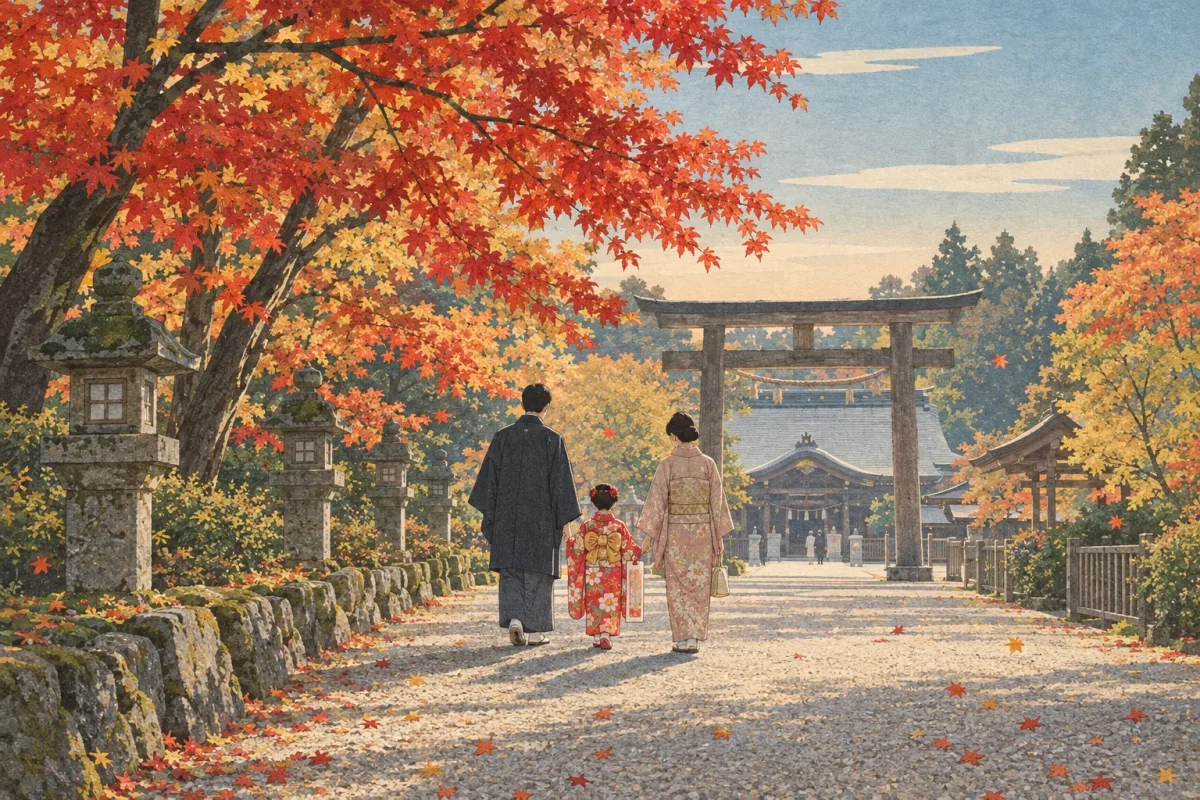
Shichi-Go-San is a family occasion for children in the year they turn 3, 5 or 7. The family visits a shrine (a place where Shinto gods are worshipped) to give thanks that the child has grown up healthy so far and to pray for the years ahead. The name is simply those ages: shichi (seven), go (five), san (three).
The Association of Shinto Shrines (the body that oversees many of Japan's shrines) describes Shichi-Go-San as a rite of passage in which everyone celebrates a child having grown up safely. The background is that young children used to die far more often, so simply reaching these ages was a real cause for joy.
The traditional date is 15 November, but these days most families make their visit on whichever weekend suits them between about October and December.
It started as three separate ceremonies
Shichi-Go-San grew out of three ceremonies that were originally held at different ages. At 3 came kamioki ('setting the hair'): from that day, hair that had been kept short was allowed to grow, and it was done for both boys and girls. At 5 came hakamagi, when a boy wore hakama for the first time (pleated, trouser-like garments worn over a kimono).
At 7 came obitoki, when a girl stopped using the ties sewn onto children's kimono and began wearing a proper obi sash like an adult. Each one turned a stage of growing up, from baby to child and from child to a little more grown-up, into something you could see in a child's clothes or hair.
These ceremonies are thought to go back to the rites of passage of the aristocracy in the Heian period (roughly 794 to 1185). They spread to well-off townspeople in the Edo period (1603 to 1868), and it is said that only in the Meiji era were the three combined and called Shichi-Go-San.
Why 15 November?
The best-known story is that Tokugawa Tsunayoshi, the fifth shogun of the Edo shogunate, held lavish prayers on this day for the healthy growth of his eldest son, Tokumatsu, and that ordinary people then took up the custom of celebrating on the same date. The Association of Shinto Shrines and the official websites of shrines also give this origin.
There are other theories too. One says the 15th of the month in the old lunar calendar fell on kishukunichi, a day considered lucky for anything you might do. Another says the 11th lunar month was when people thanked the gods once the harvest was in, and that on the full moon of that month they gave thanks for their children's growth as well.
After Japan switched to today's solar calendar in the Meiji era, the celebration moved to 15 November in the new calendar. Note that 15 November is not a public holiday, so in years when it falls on a weekday, many families go on the weekend before or after.
What Shichi-Go-San looks like today
Generally, boys celebrate at 5 and girls at 3 and 7, although in some regions and families boys celebrate at 3 as well. The ages used to be counted in kazoedoshi (the traditional system in which a baby is 1 in the year of birth and everyone gains a year each New Year), but now almost every family goes by the child's actual age.
There's no dress code: kimono and Western clothes are both fine. Popular choices are haori hakama (a formal jacket worn with hakama) or a suit for boys, and furisode (a colourful kimono with long sleeves) or a dress for girls. Three-year-old girls often wear a hifu, a sleeveless overgarment, on top of their kimono. Some families also receive a kito (a prayer ceremony in which a Shinto priest recites prayers for them), and in that case they make an offering called hatsuhoryo.
And then there's the one thing nobody goes without: chitose-ame, long, thin red and white sticks of candy. Chitose means 'a thousand years', so the name is a wish for a long life. The sweets come in bags decorated with lucky motifs such as cranes and turtles or pine, bamboo and plum, and their length carries the hope that the child will live a long, healthy life. One theory says they began as 'thousand-year sweets' sold by a candy seller in Asakusa in the Edo period.
Regional differences and modern twists
In cold areas such as Hokkaido, mid-November is already quite chilly, so families there are said to often celebrate a month early, around 15 October. The Kansai region also has a separate custom called jusan-mairi, a shrine visit at age 13, which is gradually spreading to the rest of the country.
These days, putting on kimono for commemorative photos at a photo studio has become one of the big pleasures of Shichi-Go-San. Some families even have the photos taken in advance, on a different day from the shrine visit.
As the Association of Shinto Shrines puts it, this is a rite of passage that everyone celebrates together. At its heart are thanks to the ujigami (the local guardian deity) and to the family's ancestors, and the whole family's joy at seeing a child grow up.
Enjoying it as a traveller or resident
Visit a large shrine at the weekend from late October through November and you'll see lots of little children in kimono and hakama, with their families watching proudly. The grounds are more colourful than usual, and it's a lovely time to get a feel for a Japanese family occasion.
Shichi-Go-San isn't an event that visitors take part in, but any family raising children in Japan can celebrate it, whatever their nationality. You might book a prayer ceremony at a shrine or rent outfits at a photo studio; there are plenty of ways to enjoy it.
At this time of year, chitose-ame appears in shrine shops and on sweet shelves. Why not buy a bag and get a taste of the wishes Japanese children are given?
Tips
- Shichi-Go-San families are adorable, but please don't photograph other people's children without asking. If you'd like a picture, always ask a parent first.
- Famous shrines get very crowded at weekends in November, especially the Saturday and Sunday around the 15th. For a calmer visit, go on a weekday or early in the morning.
- If you're raising children in Japan, any convenient day from October to December is fine for the visit. If you'd like a prayer ceremony, check the shrine's official website for reception hours and whether you need to book.
- Autumn is the busiest season for photo studios, so if you're thinking of renting outfits or booking a shoot, reserve early to be safe.
- At the shrine, follow the basic etiquette, such as bowing before the torii gate and rinsing your hands and mouth at the chozuya (the purification basin), and you'll fit in comfortably on a local family's special day.