Japan is Nippon
Saidaiji Eyo (Naked Festival)
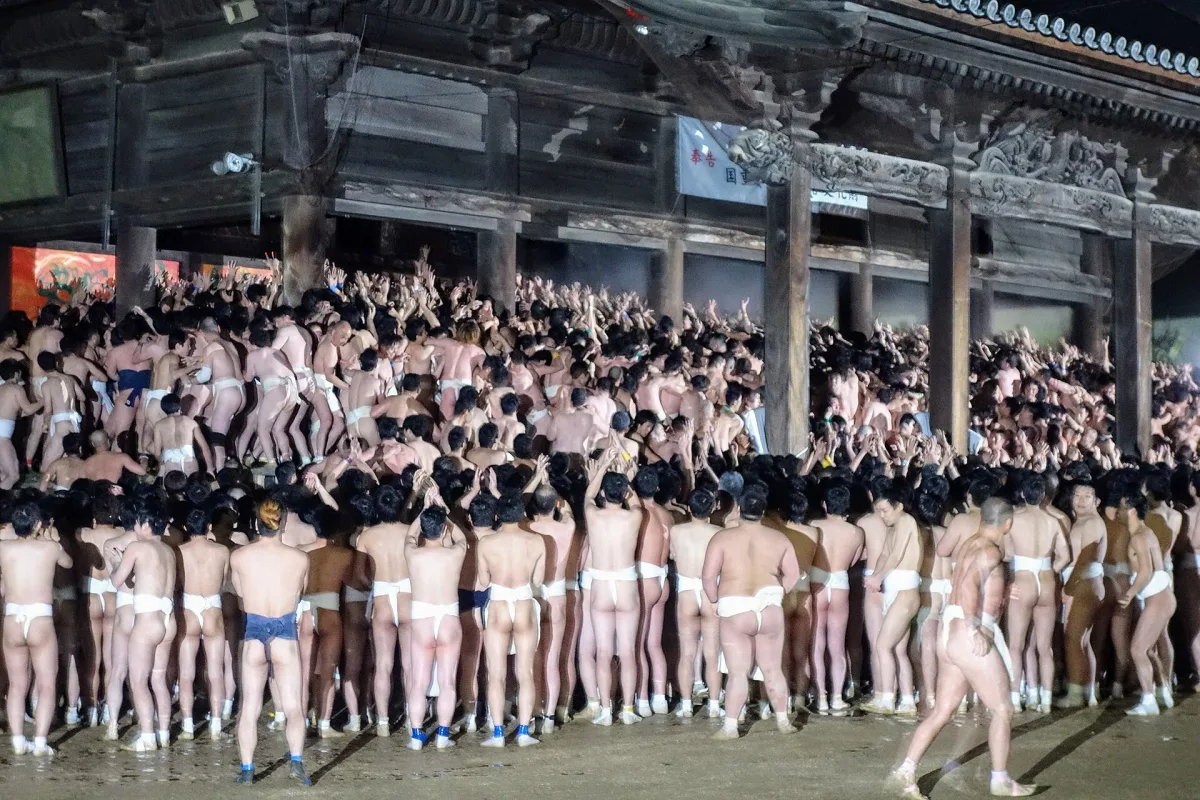
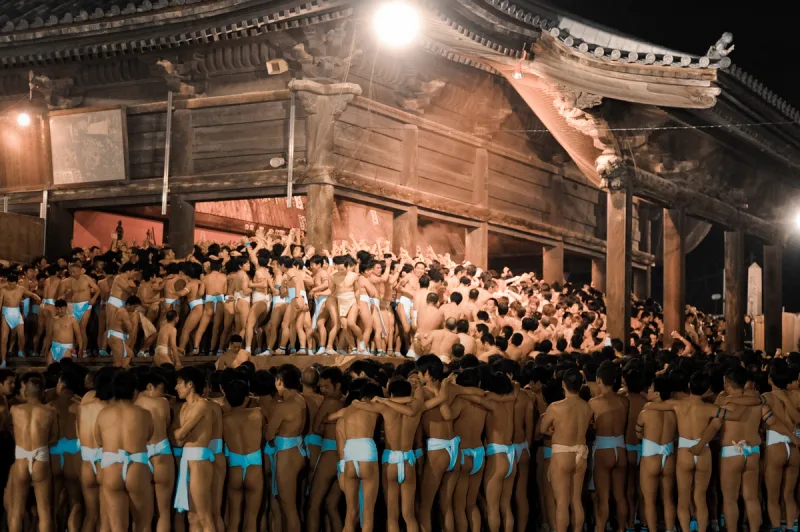
On a midwinter night, about 10,000 men in loincloths fight over two sticks thrown from a temple window. Okayama's 500-year-old Naked Festival is at a turning point.
Okayama
- OkayamaSaidaiji Kannon-in, Higashi Ward, Okayama City (about 10 minutes' walk from Saidaiji Station on the JR Ako Line)
Recent years
| Year | Dates | Visitors | Notes |
|---|---|---|---|
| 2026 | 21 February | — | About 10,000 men took part in loincloths, according to the organisers. During the shingi scramble three participants lost consciousness, and two of them died. The organisers are working towards not holding the shingi scramble in 2027 (reports at the end of September 2026). |
| 2025 | 15 February | — | The shingi were thrown at 10pm as usual. |
| 2024 | 17 February | — | The shingi scramble, suspended during the COVID-19 pandemic, was held for the first time in four years. |
| 2023 | 18 February | — | No shingi scramble was held, but the jioshi, in which the men jostle on the main hall's great floor, was opened to spectators for the first time in three years. Only this year, the spectator stands were free. |
What is it, and when and where?
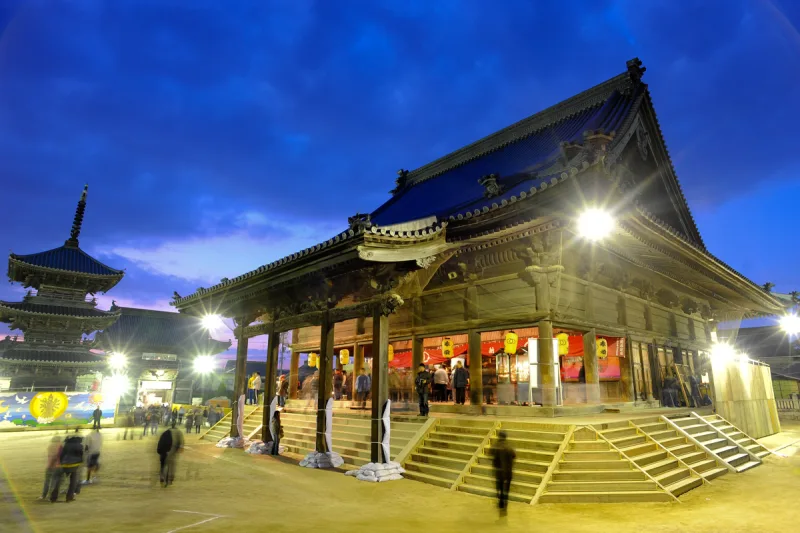
Saidaiji Eyo is a festival held at Saidaiji Kannon-in, a temple of the Shingon school of Buddhism in Higashi Ward, Okayama City, Okayama Prefecture, and is known as the 'Hadaka Matsuri' (Naked Festival). Every year on the night of the third Saturday of February, near-naked men wearing mawashi (loincloths like those of sumo wrestlers) fight over two shingi (sacred sticks) thrown from the main hall's Gofuku-mado ('window of good fortune').
The shingi are thrown at 10pm. Until 2009 they were thrown at midnight, but the current time has been used since 2010, the 500th anniversary of the Eyo. The 2026 festival was held on 21 February, and according to the organisers about 10,000 men took part.
It is a large-scale event dating back to the Muromachi period (1336–1573), and because its customs have been so faithfully handed down, it was designated an Important Intangible Folk Cultural Property of Japan on 2 March 2016. In June 2024 it was also added as a component of a Japan Heritage story on the theme of the kitamaebune, the merchant ships that sailed between the Sea of Japan and the Seto Inland Sea from the Edo to the Meiji period.
500 years of history that began with a scramble for talismans
The Eyo grew out of shushoe, a New Year prayer ritual. It was started in the Nara period by Jicchu, a monk of Todaiji Temple, and is said to have been brought to Saidaiji by its founding monk, Anryu, and held for 14 days at the lunar New Year.
According to the temple's tradition, it took its present form in 1510. On the last day of the prayers, the head priest at the time, Chua, threw paper talismans over the heads of worshippers who had crowded in to get them. A scramble broke out, and people stripped off so they could move more freely: that, it is said, is how it all began.
The shingi are a pair of wooden sticks steeped in incense smoke, each wrapped in a talisman paper called goo-shi before being thrown. The temple regards the shingi as a symbol of life. Preparations start about three weeks ahead: the 'shingi-tori', when the wood for the shingi is collected from Muryojuin, a temple also in Higashi Ward, Okayama City, then the 'shingi-kezuri', when it is carved and finished, followed by 14 days of prayers.
How the festival night unfolds
From early afternoon on the day there is a children's naked festival. From the evening comes the Eyo Daiko drumming that announces the start of the festival, with an all-female group of drummers. In the 'women's hadaka', women in white robes purify themselves at the kori-toriba (a place for cleansing the body with water) in the temple grounds and parade through the grounds. At night there are also Eyo winter fireworks.
As the night deepens, the men in loincloths gather, chanting 'Wassho, wassho!', pray at the shrine of Goosho Daigongen, the guardian deity of the temple grounds, and then head for the main hall. At 10pm the lights in the main hall go out and the shingi are thrown from the Gofuku-mado, and a fierce scramble begins on the great floor (the main hall's wide raised floor).
Whoever gets out through the Niomon (the temple's main gate) still holding a shingi is that year's fukuotoko ('lucky man'). Once the shingi has been handed to the organisers and confirmed as genuine, it is presented to that year's iwainushi, the sponsoring company or similar, where it is enshrined with care for about a year.
The 2026 tragedy and the future of the Eyo
At the festival on 21 February 2026, three participants were found unconscious during the shingi scramble shortly after 10pm, and two of them died. Okayama Prefectural Police are looking into whether they were crushed by pressure from the crowd around them or ended up underneath other participants. People had also died at the Eyo before this, in accidents in 1987 and 2007.
In response, the organisers, the Saidaiji Eyo Hosankai (a body made up of representatives of local businesses, the volunteer fire brigade and others), set up an independent review committee including lawyers in July 2026, which is considering the festival from 2028 onwards. It was reported that at a meeting of senior members on 29 September 2026 they agreed, on the grounds that safety measures were not yet in place, to work towards not holding the shingi scramble in 2027. A formal decision is due to be made by the board, and how the festival itself will be held is to be discussed with Saidaiji Kannon-in.
The shingi scramble has been called off before, during the COVID-19 pandemic. In those years the head priest chose the fukuotoko by lot, or the shingi was handed to a representative chosen in advance. Always check the latest information before you visit.
Tips for watching
Paid spectator stands (reserved seats and standing areas) are set up in the temple grounds, and there are also tickets that let you see inside the main hall. Standing tickets almost never sell out in advance, and most spectators reportedly buy them on the day at the entrance to the stands. The venue gets extremely crowded, so visitors are asked to be in the stands by about 9pm if possible.
According to the usual guidance, from 7.30pm some roads around the temple are closed to the general public, and from 8pm entry may be restricted. In the grounds, always follow the instructions of police, firefighters and staff. Women, children and older people are asked to visit the temple early, and visitors are asked not to bring pushchairs.
Flying drones at and around the venue is banned, and so are camera tripods in the stands. On rainy days umbrellas get in other people's way, so wear a raincoat. The throwing of the shingi has been streamed live on the official YouTube channel.
Tips
- Reports say the shingi scramble is unlikely to take place in 2027 (as of late September 2026). Always check the dates and programme announced by Saidaiji Kannon-in and the Saidaiji Eyo Hosankai (Okayama Chamber of Commerce and Industry, Saidaiji branch).
- Saidaiji Kannon-in is about a 10-minute walk from Saidaiji Station, about 18 minutes from JR Okayama Station on the Ako Line. With road closures and limited parking, go by train or bus.
- Try to be in the spectator stands by about 9pm. Entry may be restricted after 8pm.
- If it rains, wear a raincoat rather than using an umbrella. Flying drones and using tripods in the stands are banned.
- To take part as one of the near-naked men you must apply in advance. People who have been drinking or who have tattoos cannot take part, and glasses, accessories and smartphones are not allowed.
Sources
- 西大寺観音院公式サイト「天下の奇祭、会陽裸祭り」 (opens in a new tab)
- 西大寺観音院公式サイト「会陽行事日程と会場案内」 (opens in a new tab)
- 西大寺観音院公式サイト「令和8年度 奉修第五百十七会 西大寺会陽と歴代祝主・福男」 (opens in a new tab)
- 岡山商工会議所(西大寺会陽奉賛会)「会陽を観覧する」 (opens in a new tab)
- 岡山商工会議所(西大寺会陽奉賛会)「会陽に参加する」 (opens in a new tab)
- 岡山市「西大寺会陽(はだか祭り)」 (opens in a new tab)
- 岡山市「西大寺会陽(はだか祭り)」2025年2月時点(Internet Archive) (opens in a new tab)
- 岡山市「西大寺会陽(はだか祭り)」2024年2月時点(Internet Archive) (opens in a new tab)
- 岡山市「西大寺会陽(はだか祭り)」2023年1月時点(Internet Archive) (opens in a new tab)
- おかやま観光コンベンション協会「西大寺会陽(はだか祭り)」 (opens in a new tab)
- 岡山観光WEB(岡山県観光連盟)「【2026年】西大寺会陽(はだか祭り)」 (opens in a new tab)
- 毎日新聞「『裸祭り』で3人意識不明 岡山の西大寺観音院 搬送は計6人」(2026年2月22日) (opens in a new tab)
- 山陽新聞「重体の58歳男性死亡 西大寺会陽事故 死者は2人に」(2026年3月17日) (opens in a new tab)
- 読売新聞「2人が死亡した岡山の裸祭り『西大寺会陽』、来年の宝木争奪戦中止を検討」(2026年9月30日) (opens in a new tab)
- OHK岡山放送「西大寺会陽 27年は宝木争奪戦“取り止め”の方向で最終調整」(2026年9月30日) (opens in a new tab)
- Wikipedia「西大寺 (岡山市)」(補助資料) (opens in a new tab)