Japan is Nippon
Namahage Sedo Festival
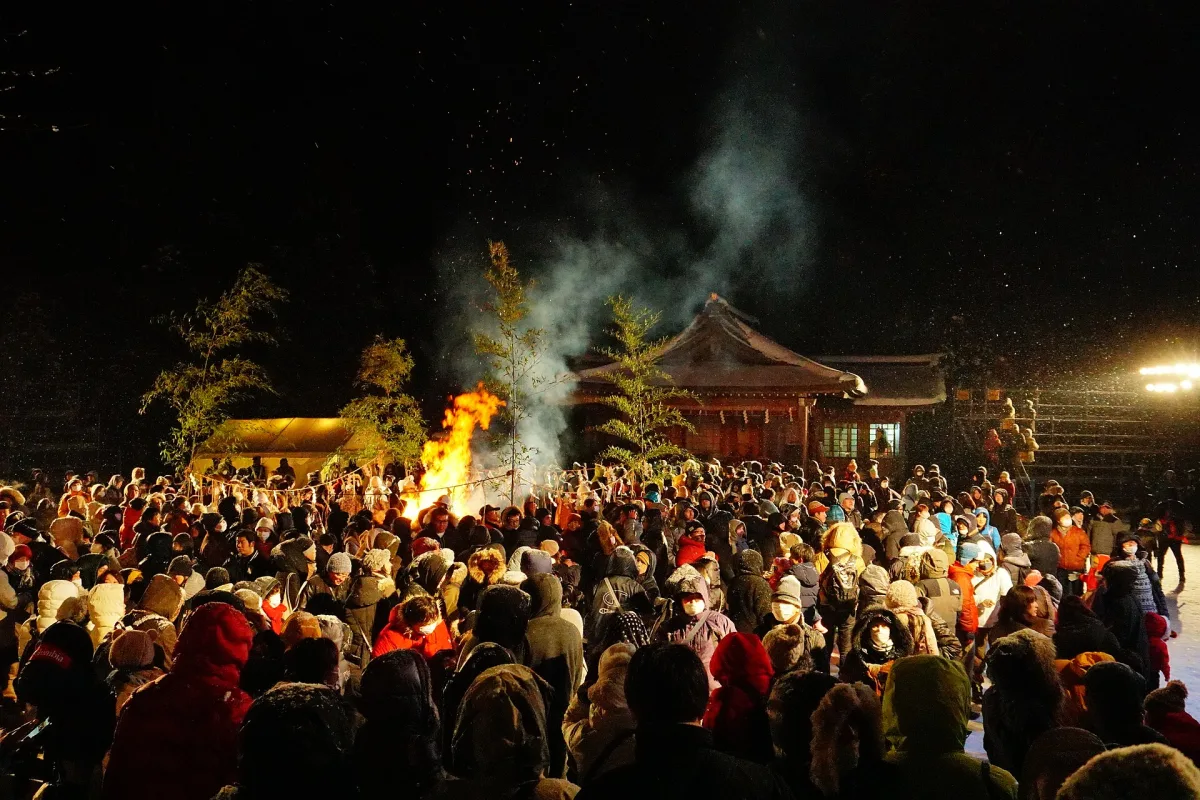
Torch-bearing Namahage descend a dark, snowy mountain: a three-day shrine festival to see up close the gods who otherwise visit homes only on New Year's Eve.
Recent years
| Year | Dates | Visitors | Notes |
|---|---|---|---|
| 2027 | 12–14 February (planned) | — | The 64th festival. Along with a higher admission contribution, more extra buses and more temporary toilets at the venue are planned. Entry is limited to 1,800 people per day, and payment is in advance only. |
| 2026 | 13–15 February | — | The 63rd festival. Because its dates clashed with Yokote's Kamakura (snow hut) festival, the two ran a joint project introducing each other's events at both venues. On the 14th, two members of a Danish Namahage fan club took part dressed as Namahage, the first time they had done so. |
| 2025 | 7–9 February | — | The 62nd festival. Entry had to be booked in advance, with a limit of 2,000 people per day. |
| 2024 | 9–11 February | — | The 61st festival. Entry had to be booked in advance, with a limit of 2,000 people per day. |
| 2023 | 10–12 February | — | The landmark 60th festival. Parts of the programme that had been restricted because of COVID-19 returned, and the 'village Namahage break-in' was held for the first time in three years. The first day took place in a snowstorm. |
When and where is it held?
The Namahage Sedo Festival is a winter festival held in the evenings at Shinzan Shrine in Kitaura, Oga City, Akita Prefecture, over three days every year: the Friday, Saturday and Sunday that include the second Saturday of February. It is run by an organising committee whose office is in Oga City's tourism section.
The next one is the 64th, and according to the official website it will be held on Friday 12, Saturday 13 and Sunday 14 February 2027. Because the venue has limited space, entry must be booked in advance, with a limit of 1,800 people per day. Entry requires an admission contribution; from 2027 this can only be paid in advance when you book, with no cash payment at the venue on the day. Children of junior high school age and under get in free.
What are Namahage? Visiting gods who come on New Year's Eve
Namahage are messengers of the gods, wearing masks and costumes, who appear in a New Year's Eve tradition of the Oga Peninsula. On the night of 31 December, young men from each community dress up as Namahage and go from house to house, shouting things like 'Naku ko wa inega!' ('Are there any crying children here?'). For local people they are gods who visit at the turn of the year to scold laziness and to bring good health and the bounty of the fields, mountains and sea. The households they visit welcome them with food and sake, following time-honoured etiquette.
Today the tradition is kept in about 85 neighbourhoods across the city. In 1978 it was designated an Important Intangible Folk Cultural Property of Japan as 'Oga no Namahage', and in 2018 it was inscribed on UNESCO's Intangible Cultural Heritage list as one of the Raiho-shin: Ritual visits of deities in masks and costumes. The name is said to come from a corruption of 'namomi wo hagu': peeling off the namomi, the heat marks that appear on your hands and feet if you sit by the irori (sunken hearth) for too long.
Because the New Year's Eve tradition is a local religious rite that goes from home to home, it is not easy for travellers to see. The Sedo Festival was created so that visitors could see the Namahage.
A festival since 1964, built on a 900-year-old rite
The festival is rooted in the Saitosai, a Shinto rite that Shinzan Shrine has held every 3 January for more than 900 years. The Namahage Sedo Festival combines this rite with the Namahage folk tradition. Throughout the festival a large sacred bonfire (the sedo fire) burns in the open space in the shrine grounds.
It began in 1964, when a 'snow festival' designed to liven up winter tourism at Oga Onsen hot spring resort was held at Hoshitsuji Shrine in Kitaura Yumoto. The first three festivals took place at Hoshitsuji Shrine, but as visitor numbers grew it became too cramped, and the festival moved to Shinzan Shrine, which has close links with the Namahage. There was one year (1974) when heavy snow meant Shinzan Shrine could not be cleared in time and the festival went back to Hoshitsuji Shrine, but it has never once been cancelled, not even during the COVID-19 pandemic.
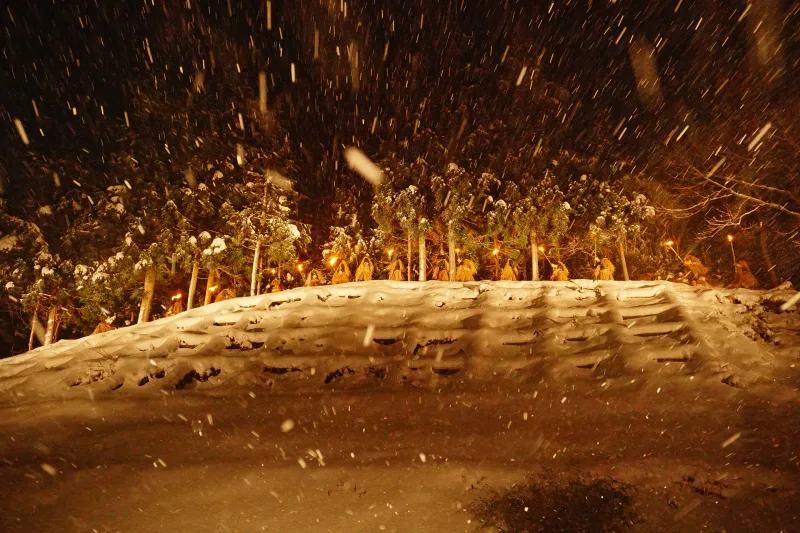
Shinzan Shrine is an old shrine said by some accounts to have been founded in the reign of Emperor Keiko. Unlike the New Year's Eve Namahage visits, the festival is a tourist event, so its content has reportedly been refined year after year, with touches such as Namahage lined up on the snowy hill holding torches.
How the evening unfolds, and the highlights
The festival opens with Shinto rites in the open space in the shrine grounds. First comes the Chinkamasai, a yudate ritual in which water is boiled in a great cauldron and a priest stirs it with a straw broom, and then the Yu no Mai, a purification kagura (sacred dance) unique to the Oga area. In the 'Namahage soul-infusing' ceremony that follows, the young men playing Namahage receive their masks from a priest on the stone steps at the entrance to the approach path, become Namahage and head off into the mountain.
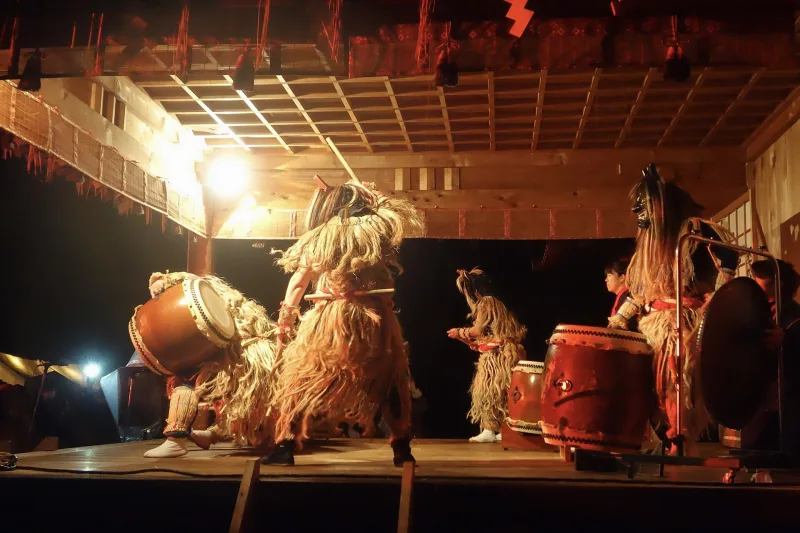
Next, on the kagura-den (the stage where sacred dances are offered), there is a re-enactment of the New Year's Eve house visits. In front of the sedo fire comes the Namahage Odori dance, created in 1961 with choreography by Akita-born dancer Baku Ishii and music by his son, the composer Kan Ishii. Namahage Daiko, a local performing art that combines Namahage with Japanese taiko drums, is another highlight.
The climax is the Namahage descent. Torchlight appears in the darkness on the snowy hill facing the shrine grounds, and a line of Namahage comes down the approach path and parades through the packed grounds. In the Kenpei (offering of mochi) that follows, a priest offers the Namahage a large goma mochi toasted over the sedo fire, but because the mochi is charged with divine power the Namahage can hardly bring themselves to touch it and dash this way and that. The evening ends with the 'village Namahage break-in', when Namahage from districts all over the city, each with different masks and costumes, burst into the venue.
Rules for spectators, and preparing for the cold and the journey
At the venue, places such as the kagura-den and the approach path become the stage at different points in the programme. Apart from restricted areas you are free to move around, so changing spots for each part lets you feel the full force of the Namahage up close. Some years large screens have been set up to help with the crowds. For safety and to prevent congestion, umbrellas, camera tripods and monopods, selfie sticks, stepladders and step stools are banned. Pets are not allowed either.
The venue is in the mountains, and the ground is unpaved and covered in snow. There are steps in front of the venue; staff will help wheelchair users, but getting around inside is not easy. You will be outdoors on a February night for more than two hours, so bring shoes you can walk on snow in and properly warm clothing.
No regular bus route runs near the venue. From Akita Station, take the JR Oga Line to Oga Station (about 55 minutes), then a festival shuttle bus (fare charged, no booking needed) from Michi-no-Eki Oga, the roadside station next to Oga Station, which takes about 30 minutes: about two hours in total. Shuttle buses also run from Oga Onsen. Parking is limited, and the organising committee recommends that anyone not used to driving on snowy roads park at Michi-no-Eki Oga and take the shuttle bus.
Tips
- Entry must be booked in advance. Booking usually opens around December, and Saturdays in particular tend to fill up fast, so apply early once you know your dates.
- The stage moves with each part of the programme, so check the site map as you go. For the climax, the Namahage descent, keep your eyes on the snowy hill facing the shrine grounds and on the approach path.
- Umbrellas, tripods, monopods, selfie sticks and stepladders are not allowed. You can't use an umbrella even if it snows, so a warm coat with a hood is handy.
- After the festival, the toasted goma mochi (sacred rice cakes) are cut up and handed out to the audience by the Namahage in front of the kagura hall. They are said to protect against fire.
- Straw that falls from the Namahage's kede (a straw cape a bit like a traditional raincoat) is considered lucky, and some people pick it up to take home.
Sources
- なまはげ柴灯まつり公式サイト(実行委員会・男鹿なび) (opens in a new tab)
- なまはげ柴灯まつり公式サイト「なまはげ柴灯まつりについて」 (opens in a new tab)
- なまはげ柴灯まつり公式サイト「まつりの内容」 (opens in a new tab)
- なまはげ柴灯まつり公式サイト「事前申込と入場料」 (opens in a new tab)
- なまはげ柴灯まつり公式サイト「交通案内」 (opens in a new tab)
- なまはげ柴灯まつり公式サイト「第60回 なまはげ柴灯まつり」レポート (opens in a new tab)
- なまはげ柴灯まつり公式サイト「60年間、途切れることなく開催してきた男鹿市真山地区住民の誇り」 (opens in a new tab)
- 男鹿なび「第62回なまはげ柴灯まつりの入場事前申込受付を開始しました」 (opens in a new tab)
- 男鹿市「男鹿のナマハゲ」柴灯まつり (opens in a new tab)
- なまはげ館「男鹿のナマハゲ」 (opens in a new tab)
- アキタファン(秋田県公式観光サイト)「なまはげ柴灯(せど)まつり」 (opens in a new tab)
- トレたび「第61回 なまはげ柴灯まつり」(2024年) (opens in a new tab)
- トレたび「第62回 なまはげ柴灯まつり」(2025年) (opens in a new tab)
- 秋田魁新報「来訪神、勇壮かつ幻想的に 男鹿市・なまはげ柴灯まつり開幕」(2026年2月13日) (opens in a new tab)
- 秋田魁新報「男鹿ナマハゲ、横手かまくらがコラボ! 周遊観光に向け企画」(2026年2月8日) (opens in a new tab)
- 秋田魁新報「デンマークから2匹のナマハゲ乱入、男鹿の柴灯まつりで大暴れ」(2026年2月17日) (opens in a new tab)
- 秋田魁新報「なまはげ柴灯まつり入場協賛金、千円→2千円に 利便性向上目指し値上げ」(2026年7月14日) (opens in a new tab)